
What is NdFeB made of?
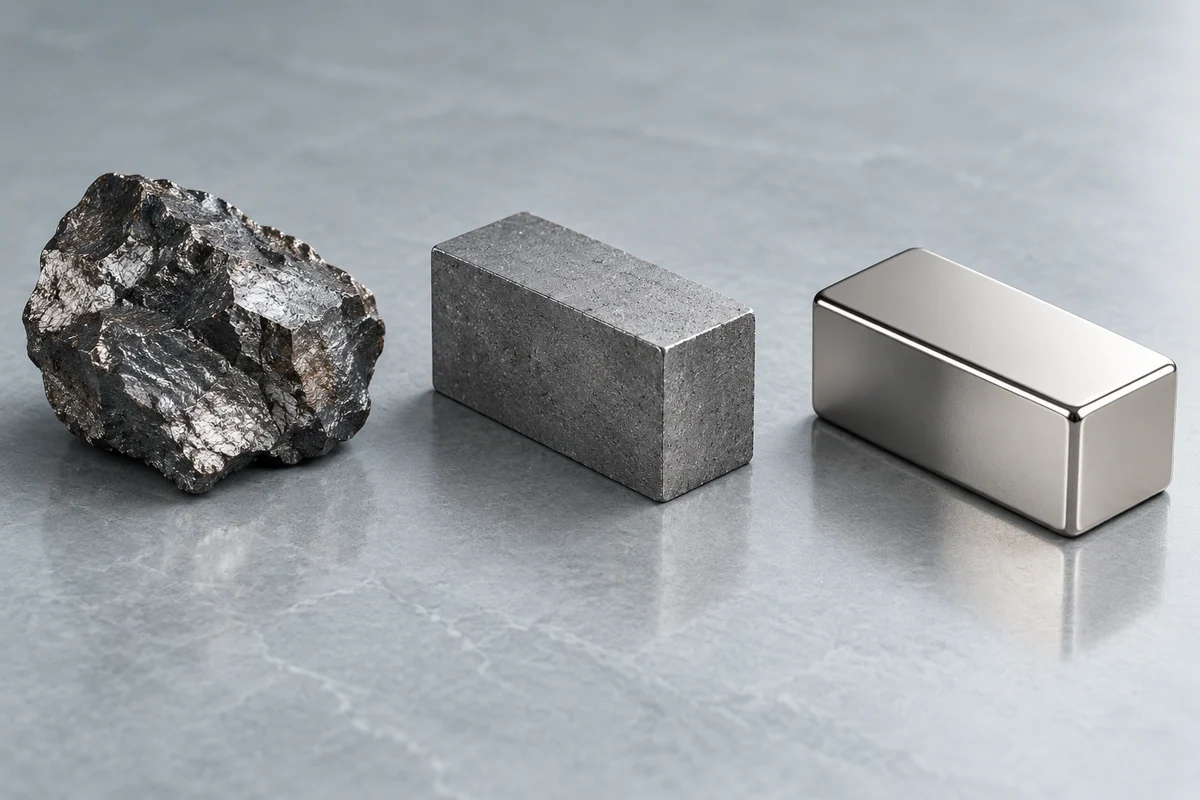
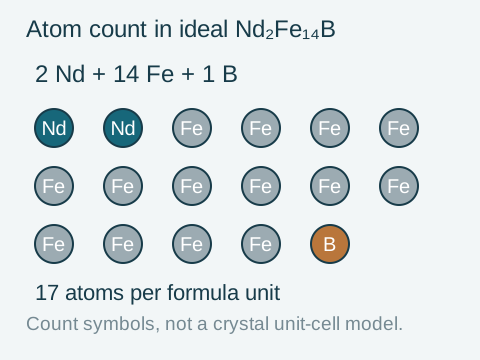
NdFeB is the neodymium-iron-boron magnet family. Its principal hard magnetic phase is commonly represented by Nd₂Fe₁₄B: two neodymium atoms, fourteen iron atoms and one boron atom per formula unit. Commercial material may also contain other rare-earth elements, alloy additions and grain-boundary phases. A finished component may include a coating or binder.
Before comparing percentages, check what they describe: the ideal magnetic phase, the commercial alloy or the complete finished component. Each can have a different composition.
What do neodymium, iron and boron contribute?
Iron supplies much of the magnetization. Neodymium contributes strong magnetic anisotropy, giving the crystal a preferred direction of magnetization. [9] Boron helps stabilize the Nd₂Fe₁₄B phase, despite making up only a small fraction of its mass. [10]
A closer look at the elements' roles
The roles overlap: research also identifies Fe's contribution to magnetic order and anisotropy. Calculations of boron's role distinguish phase stabilization from a simple increase in magnetic moment. Element percentages alone therefore cannot predict a finished magnet's performance. [9] [10]
Mass percentages in ideal Nd₂Fe₁₄B
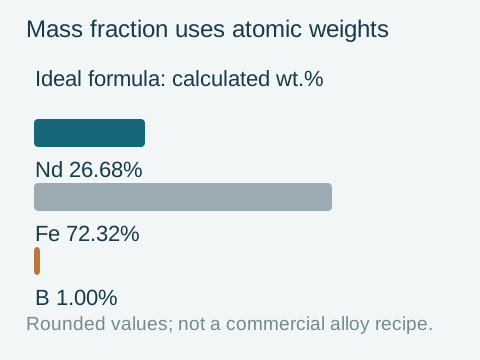
The subscripts in Nd₂Fe₁₄B count atoms. For the mass calculation, use the elemental molar masses corresponding to the standard atomic weights: Nd = 144.242 g/mol, Fe = 55.845 g/mol and rounded B = 10.81 g/mol. Multiply each by its atom count to obtain its contribution per mole of Nd₂Fe₁₄B.
Formula molar mass:
(2 × 144.242 + 14 × 55.845 + 10.81) g/mol = 1,081.124 g/mol
Divide each molar-mass contribution by this total, then multiply by 100 to obtain its mass percentage. Both quantities use g/mol, so the units cancel. CIAAW gives an interval for boron's standard atomic weight; the calculation uses the rounded value above. [2]
| Element | Atoms per formula unit | Atom fraction | Molar mass contribution (g/mol) | Mass fraction |
|---|---|---|---|---|
| Neodymium, Nd | 2 | 11.76 at.% | 288.484 | 26.68 wt.% |
| Iron, Fe | 14 | 82.35 at.% | 781.830 | 72.32 wt.% |
| Boron, B | 1 | 5.88 at.% | 10.810 | 1.00 wt.% |
Calculated composition of ideal Nd₂Fe₁₄B
Neodymium, Nd
- Atoms per formula unit
- 2
- Atom fraction
- 11.76 at.%
- Molar mass contribution (g/mol)
- 288.484
- Mass fraction
- 26.68 wt.%
Iron, Fe
- Atoms per formula unit
- 14
- Atom fraction
- 82.35 at.%
- Molar mass contribution (g/mol)
- 781.830
- Mass fraction
- 72.32 wt.%
Boron, B
- Atoms per formula unit
- 1
- Atom fraction
- 5.88 at.%
- Molar mass contribution (g/mol)
- 10.810
- Mass fraction
- 1.00 wt.%
The theoretical neodymium content is therefore about 26.68% by mass. Nd is the only rare-earth element in this ideal formula, so its theoretical total rare-earth mass fraction is also 26.68%. Rounded atom fractions may not sum to exactly 100%.
A purchased part can differ from these ideal-phase percentages because its alloy contains other phases or elements, and its coating or binder contributes to the total mass.
Why commercial alloys differ
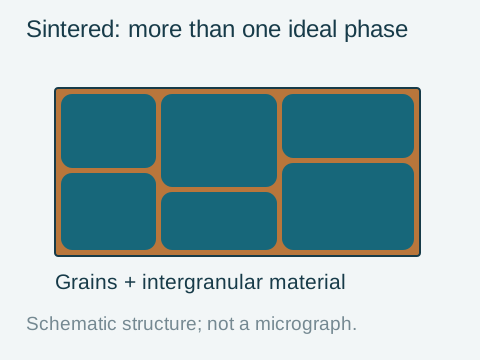
A sintered magnet contains magnetic grains and intergranular material, the material between those grains. Local chemistry, grain boundaries and processing affect the resulting magnetic properties. An elemental analysis averaged across the alloy includes those regions as well as the main magnetic phase. [3]
Some rare-earth material may occur in other phases, and some Nd may be replaced by another rare-earth element. Magnequench describes the broader RE₂Fe₁₄B family, where RE identifies the rare-earth constituent. [1]
Two alloys with similar average composition can still have different microstructures and magnetic properties. Sintered production includes alloy preparation, orientation, densification and finishing. [8] A chemical report and a magnetic-grade specification answer complementary questions.
Pr, Dy and Tb in NdFeB
Praseodymium (Pr) can occupy rare-earth sites in this material family; Magnequench lists PrNd powder products. [4] A composition report should name which elements its total rare-earth value includes.
Dysprosium (Dy) or terbium (Tb) can be used to increase resistance to demagnetization. Grain-boundary diffusion can concentrate additions near grain surfaces. Arnold describes these diffusion approaches; TDK's archived HAL explanation illustrates selective Dy distribution and its magnetic-property trade-offs. [5] [6] The amount and distribution depend on the material and process, so a high-temperature grade suffix is not an elemental analysis.
If a project limits heavy rare-earth content, identify the elements and the reporting basis. “Total rare earth”, “Nd content” and “Dy content” should be separate entries where they are separately required.
What a finished-part analysis includes
For an overall mass percentage, identify the sample: magnetic material alone, a coated or bonded part, or a complete assembly. That choice determines which materials contribute to the total sample mass used in the calculation.
A surface or spot measurement may describe only the region examined. For example, X-ray fluorescence (XRF) results can be affected by nonuniform material or surface contamination. A reading from a plated surface does not automatically give the average composition of the whole magnet. Check the preparation method, measurement location and reporting basis before using the result as a bulk composition. [11]
A bonded magnet includes its binder
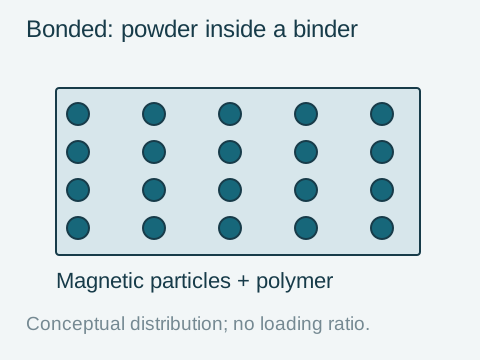
Bonded NdFeB consists of magnetic powder in a polymer matrix. Compression molding and injection molding are among the forming routes. A powder composition describes one constituent; a finished bonded-part composition includes the binder as well. [1]
Powder loading may be given by mass or volume. Those percentages are different because the constituents have different densities. Keep the loading basis with the number. Finished magnetic properties and density belong to the particular formulation and process, as illustrated by Magnequench's product-specific data. [7] The sintered/bonded comparison explains the performance implications.
A coating changes the whole-part analysis basis
A nickel finish adds a surface material outside the ideal Nd₂Fe₁₄B phase. An epoxy coating is a surface layer, while the polymer binder in a bonded magnet is distributed through the body. Including a coating or binder in the total sample mass changes what a reported percentage represents.
For analysis, identify whether the coating is included, removed or tested separately. For choosing protection, continue with the coating guide, Ni-Cu-Ni guide or epoxy guide.
Housings, adhesives and other attached parts
If a supplied item includes a steel housing, mounting adhesive or another attached component, state whether it is part of the tested sample. A mass percentage for the whole assembly cannot be read as the composition of the magnet inside it. A component list and sample description make that distinction explicit.
Comparing composition reports
Nd content and total rare-earth content
In a hypothetical 100 g sample containing 24 g Nd and 6 g Pr as its only rare-earth elements, Nd content is 24 wt.% and total rare-earth content is 30 wt.%. Here, the 30 wt.% total includes both Nd and Pr. These numbers illustrate reporting terms, not a commercial formulation.
The sample mass used in the calculation
For a whole-part mass calculation, including a coating or binder that contains no rare-earth elements adds to the total mass without adding rare-earth mass. The resulting rare-earth weight percentage is lower than for the magnetic material alone. This calculation assumes the included materials are accounted for on the same overall mass basis; it cannot be applied directly to a surface reading.
When both the elements and samples differ
In this fictional report comparison, both entries use mass percentages. They count different elements and describe different samples.
| Report field | Example A | Example B |
|---|---|---|
| Reported value | Nd: 28 wt.% | Total rare earth: 30 wt.% |
| Sample | Raw magnetic powder | Plated finished component |
| Elements counted | Nd alone | Element list not provided |
| Coating basis | No coating on the powder sample | Not stated |
| Next clarification | Does this powder report apply to the supplied material? | Which rare earths are included, and was the coating removed? |
Teaching example: why 28% and 30% are not directly comparable
Reported value
- Example A
- Nd: 28 wt.%
- Example B
- Total rare earth: 30 wt.%
Sample
- Example A
- Raw magnetic powder
- Example B
- Plated finished component
Elements counted
- Example A
- Nd alone
- Example B
- Element list not provided
Coating basis
- Example A
- No coating on the powder sample
- Example B
- Not stated
Next clarification
- Example A
- Does this powder report apply to the supplied material?
- Example B
- Which rare earths are included, and was the coating removed?
Example B does not establish a higher Nd content than A. Subtracting 28 from 30 cannot establish the amount of another element either. Before comparing the figures, check:
- Which elements each result includes.
- What was sampled, including any coating or binder in the total mass.
- The analysis method and whether the result describes a surface, a local region or the overall material.
- Whether the units are wt.% or at.%. Convert atomic percentages before making a mass-based comparison.
Request comparable results for the supplied material and retain the sample identity and document revision. Keep the magnetic grade and performance data alongside the composition report.
Ask about a composition report
Send the material description and the report entry you need to clarify. If you need a composition report with an order, tell Nike Industrial Trading which elements and reporting basis it must cover. We will check document availability for the proposed item.
Composition question
Material or component being discussed:
Element / percentage / report entry to clarify:
What the percentage must include:
Available report or main question:
Details for a formal composition requirement
Named elements and limits, mass or atom basis, coating and binder treatment, analysis method, sample identity, document revision and component reference. Keep these with the magnetic specification when both chemistry and performance must be accepted.
Technical sources
- Neo Performance Materials / Magnequench: About Bonded Neo PowdersRE₂Fe₁₄B powders and the construction of bonded magnets.
- CIAAW / IUPAC: Standard Atomic Weights 2024Standard Atomic Weights 2024: boron, iron and neodymium.
- Zhang et al. research group: Microstructure Engineering Toward High Cost-Effective Nd–Fe–B Sintered Magnets: A ReviewReview of microstructure and grain boundaries in sintered NdFeB.
- Neo Performance Materials / Magnequench: Bonded neo powder portfolioBonded powder portfolio, including PrNd products.
- Arnold Magnetic Technologies: Neodymium Iron Boron MagnetsNdFeB temperature performance, corrosion and grain-boundary diffusion.
- TDK: HAL production processArchived HAL process description: selective dysprosium diffusion and magnetic properties.
- Neo Performance Materials / Magnequench: Magnetic propertiesProduct-specific density and magnetic properties for bonded magnets.
- Arnold Magnetic Technologies: Magnet manufacturing processPowder metallurgy, magnetic orientation and finishing processes.
- Bouaziz, Patrick and Staunton (2023): Fe and hard magnetic properties of Nd₂Fe₁₄BResearch on the contributions of Fe and Nd to magnetic order and anisotropy.
- Tatetsu et al. (2018): role of B in Nd₂Fe₁₄XCalculations of boron’s role in phase stabilization and magnetic properties.
- Thermo Fisher Scientific: XRF technology in the fieldPage 12: sample uniformity and surface conditions can affect XRF results.