

Is neodymium the same as rare earth?
A neodymium magnet is one type of rare-earth magnet. Rare earth is the broader family. Its main commercial permanent-magnet systems are neodymium iron boron (NdFeB) and samarium cobalt (SmCo). So “rare earth versus neodymium” compares a category with one of its members.[1] [2]
If a product says only “rare-earth magnet,” its material is still incomplete. It may be NdFeB or SmCo. A description that explicitly says “neodymium” or “NdFeB” identifies the former.

Why are they called rare-earth magnets?
The name comes from the rare-earth elements used in the magnetic alloy, such as neodymium or samarium. “Earths” is an old term associated with their oxide compounds. “Rare” reflects the historical difficulty of finding concentrated deposits; it does not mean all these elements are exceptionally scarce throughout the Earth's crust.[9]
Neodymium magnets use an alloy containing neodymium, iron and boron, rather than pure neodymium metal.
Which materials belong to the family?
| Material | Rare earth? | Meaning |
|---|---|---|
| Neodymium / NdFeB / neo | Yes | Neodymium, iron and boron form the main system; commercial grades may contain additional elements. |
| Samarium cobalt / SmCo | Yes | Samarium-cobalt systems include SmCo5 and Sm2Co17, also called 1:5 and 2:17. |
| Ferrite / ceramic magnet | No | A separate magnetic-material family, often encountered in ceramic permanent magnets. |
| Alnico | No | A family named for aluminium, nickel and cobalt; it includes cast and sintered forms. |
Common material names
Neodymium / NdFeB / neo
- Rare earth?
- Yes
- Meaning
- Neodymium, iron and boron form the main system; commercial grades may contain additional elements.
Samarium cobalt / SmCo
- Rare earth?
- Yes
- Meaning
- Samarium-cobalt systems include SmCo5 and Sm2Co17, also called 1:5 and 2:17.
Ferrite / ceramic magnet
- Rare earth?
- No
- Meaning
- A separate magnetic-material family, often encountered in ceramic permanent magnets.
Alnico
- Rare earth?
- No
- Meaning
- A family named for aluminium, nickel and cobalt; it includes cast and sintered forms.
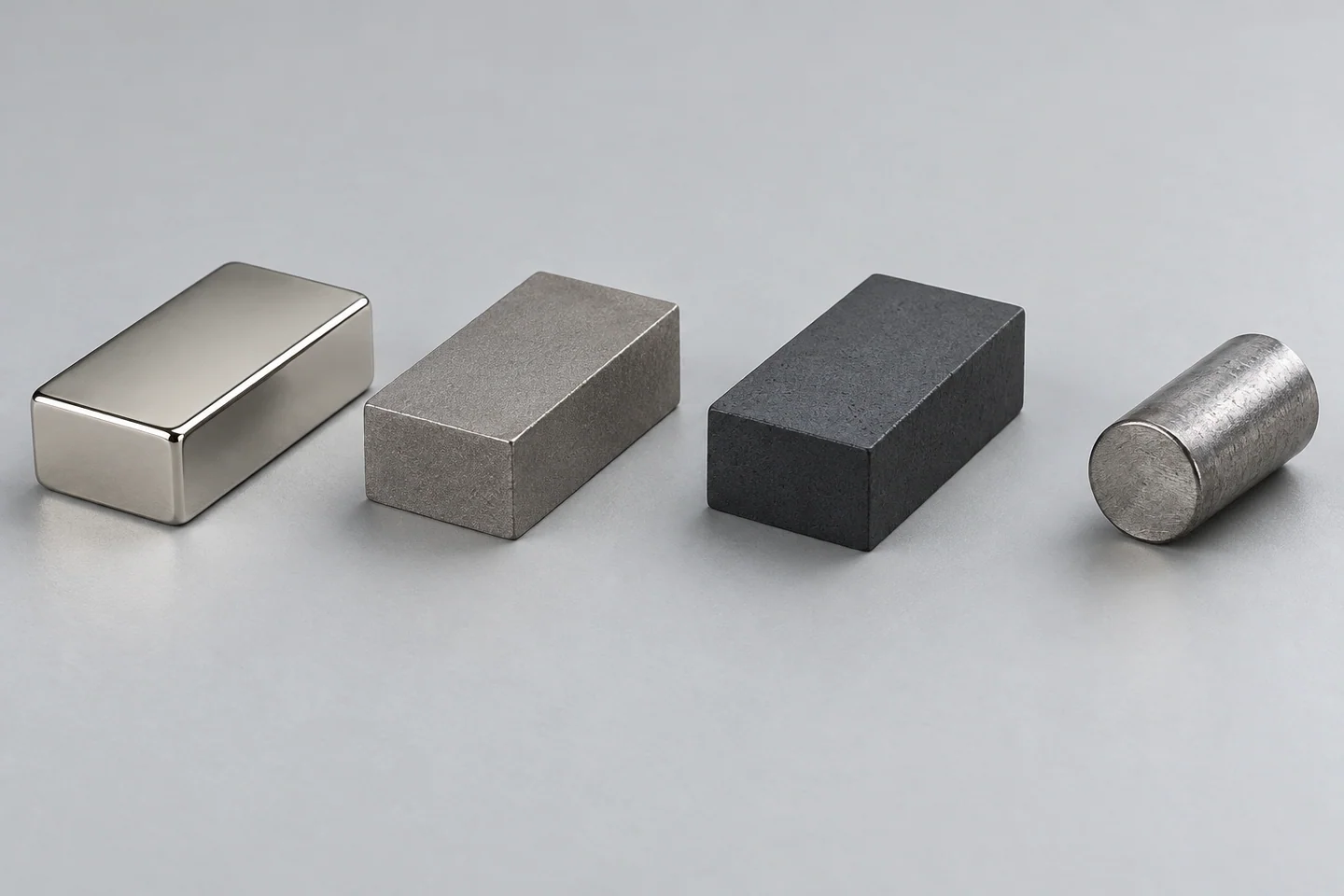
The material names describe the alloy or material system; a silver surface coating does not identify which one is underneath.[3] [6] [8]
What does the formula Nd₂Fe₁₄B describe?
It describes the main magnetic phase in NdFeB. Commercial sintered magnets also contain grain-boundary regions between the crystals, so the formula does not list every constituent of a finished magnet.[5]
Does dysprosium-free mean rare-earth-free?
No. A dysprosium-free NdFeB magnet still contains neodymium, a rare-earth element. TDK's March 2017 guide uses dysprosium-free terminology for NdFeB development.[5]
Read one complete product description
Example: sintered NdFeB N42, Ni-Cu-Ni, 20 × 10 × 3 mm
In this illustrative description, each term answers a different question:
- NdFeB: the material system, within the rare-earth family.
- Sintered: the manufacturing form. Bonded NdFeB uses a different forming route.
- N42: a material grade designation. Read its magnetic properties in the supplier's grade data.
- Ni-Cu-Ni: the surface layers: nickel, copper and nickel. This does not change the material-family name.
- 20 × 10 × 3 mm: nominal dimensions. Finished tolerances and magnetization direction still need definition.
NdFeB and SmCo have their own grade designations and material data.[3] [4] Use the grade guide for N-grade terminology and the sintered versus bonded guide for manufacturing forms.
Clarify an incomplete material label
If a listing says only “rare earth,” send the part reference or product description with this question:
“Is this magnet NdFeB or SmCo? Please confirm the full material grade and whether it is sintered or bonded.”
Once the material is clear, the neodymium product pages can help with shape-specific requirements.
What should you compare next?
- If both products are NdFeB, compare their grades and finished specifications, including dimensions, coating and pole arrangement.
- If one is NdFeB and the other SmCo, compare the material systems. Compact magnetic output can lead a designer to consider NdFeB; demanding thermal conditions can lead to SmCo. Use the actual grade and operating conditions in the NdFeB versus SmCo comparison.[1] [4]
- If the alternative is a ceramic magnet, use the neodymium versus ferrite comparison.
There is no general “rare earth is stronger than neodymium” ranking: the rare-earth product may itself be NdFeB. Identify both materials first. For holding force, compare the complete arrangement: size, poles, air gap and steel counterpart.[7]
Explore this requirement
Technical sources
Read each source with its stated material, test conditions and publication scope.
- Selecting a Rare Earth MagnetNdFeB and SmCo family definitions and application-dependent selection.
- What Makes Rare Earth Magnets Different from Regular MagnetsRare-earth materials compared with ferrite and Alnico families.
- Neodymium Iron Boron MagnetsNdFeB material identity and grade-specific information.
- Samarium Cobalt MagnetsSamarium-cobalt material and grade information.
- NEOREC Series Neodymium Magnets Product Guide (March 2017)Historical March 2017 guide: microstructure and dysprosium-free terminology.
- Samarium CobaltSmCo alloy systems and available material forms.
- Magnet Materials Comparison GuideWhy magnetic performance depends on the application and component arrangement.
- Alnico Magnetic MaterialsAlnico composition and the distinction between cast and sintered forms.
- Missouri Geological Survey — Rare Earth Elements, PUB2911History of the rare-earth name, oxide terminology and mineral deposits.