
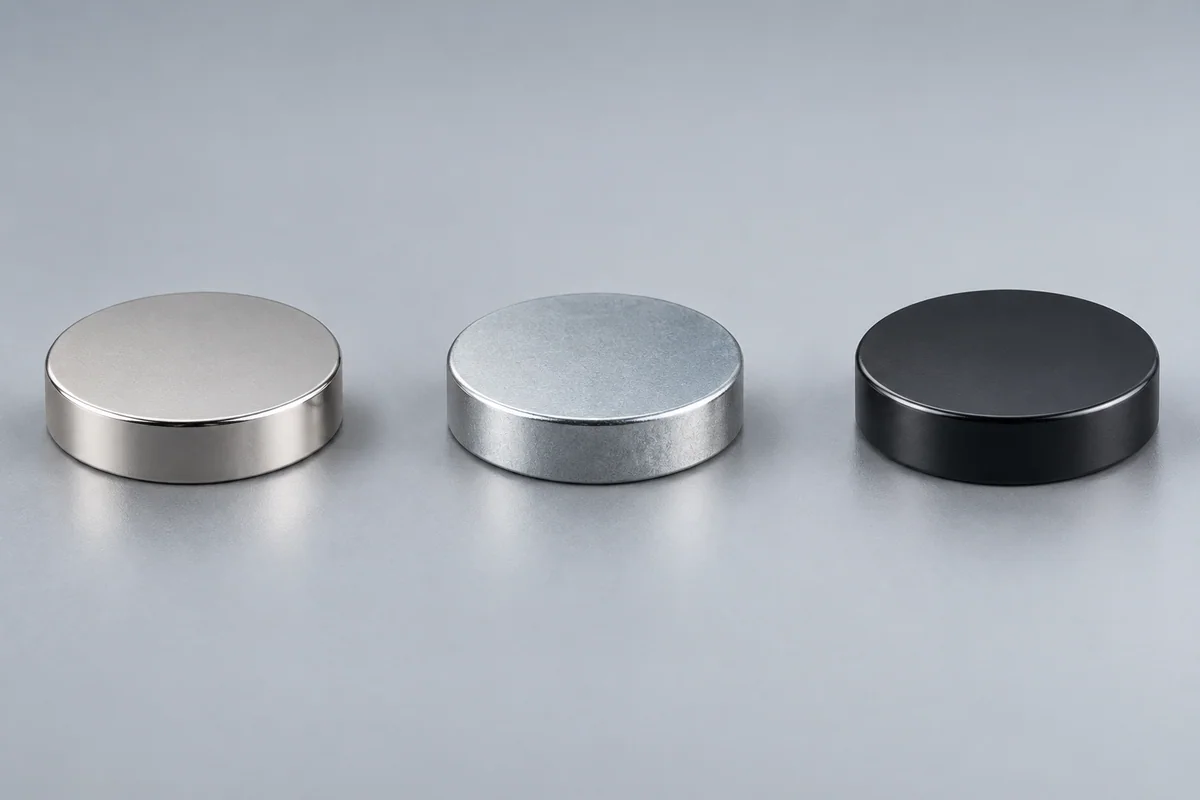
Compare the coating system, not its colour
Sintered NdFeB is vulnerable to corrosion, so the surface system is part of the specification. “Nickel”, “black” or “epoxy” can describe different layer stacks, thicknesses and processes. State the complete agreed finish, including a base layer where required.[2]
| Finish | Why discuss it | What to check |
|---|---|---|
| Ni–Cu–Ni | Common metallic protection and a smooth surface | Moisture exposure, edge damage and adhesive compatibility |
| Zinc | An alternative metallic surface | Actual corrosion process, finish and application conditions |
| Epoxy or nickel plus epoxy | A polymer barrier that can be useful in more demanding exposure | Full layer stack, scratches, cure, thickness and bonding |
| Parylene or other specialist systems | Particular insulation, conformity or environment requirements | Process, pinholes, underlayers and validation for the intended use |
| Rubber, plastic or encapsulation | Mechanical contact, grip or an additional barrier | Added gap, seams, UV, abrasion, retention and chemical compatibility |
Selection questions for common finishes
Ni–Cu–Ni
- Why discuss it
- Common metallic protection and a smooth surface
- What to check
- Moisture exposure, edge damage and adhesive compatibility
Zinc
- Why discuss it
- An alternative metallic surface
- What to check
- Actual corrosion process, finish and application conditions
Epoxy or nickel plus epoxy
- Why discuss it
- A polymer barrier that can be useful in more demanding exposure
- What to check
- Full layer stack, scratches, cure, thickness and bonding
Parylene or other specialist systems
- Why discuss it
- Particular insulation, conformity or environment requirements
- What to check
- Process, pinholes, underlayers and validation for the intended use
Rubber, plastic or encapsulation
- Why discuss it
- Mechanical contact, grip or an additional barrier
- What to check
- Added gap, seams, UV, abrasion, retention and chemical compatibility
A decorative gold or silver layer can be applied over a base plating. Its appearance does not establish a different magnetic grade, an impermeable barrier, or medical suitability.[1]
Describe exposure precisely
Dry indoor use, intermittent condensation, salt spray and continuous immersion are different environments. Include the liquid or chemical, concentration where known, temperature, cleaning process and exposure duration. Also state vibration, impact, contact wear and whether cut or damaged edges can become exposed.
A coating that performs in one test can fail after scratches, thermal cycling or assembly. Choosing only from a general “good/better/best” table hides those conditions. SM Magnetics’ selection guidance treats environment, temperature profile, tolerance stack and mechanical stress as connected inputs.[3]
Special uses such as food contact, medical applications or electrical insulation need their own applicable material and product verification. A familiar coating name does not establish compliance for the finished device.
Allow for coating in fit and bonding
Specify whether dimensions apply to the finished part. Coating thickness, coverage and variation can matter at a close-fitting bore or pocket. For two coated mating faces, the stack and bond line need to be considered together. Do not simply subtract a catalogue coating number from a finished dimension without agreeing the measurement convention.
An adhesive joins to the outer surface, so the reliability of the coating-to-magnet interface matters alongside the adhesive itself. Define surface preparation, adhesive type, cure temperature, bond-line thickness and environmental exposure. Verify the complete joint rather than testing only a clean, uncoated coupon.
TDK compares surface-treatment functions such as corrosion resistance, adhesion, dimensional precision and thermal resistance separately. That is a useful reminder that a single finish rarely leads every criterion.[4]

Example: an indoor sensor with condensation
Illustrative selection path
Assume a magnet is bonded into a sensor housing, sees occasional condensation and must fit a close pocket. A dry-indoor nickel choice is not enough evidence for that environment. Compare a specified nickel-based system and an epoxy-over-base system against the actual exposure, joint and available clearance.
Check coated dimensions first; then evaluate joint adhesion, damaged edges and condensation cycling on the assembled sample. Continuous saltwater immersion would require a different protection review. This is a selection example, not a supplied project or a coating-life promise.
Choose a candidate surface from its barrier and assembly functions, then validate the complete system rather than ranking finishes by colour.[3] [1]
Agree the test and acceptance endpoint
When a corrosion test is required, name the procedure and revision, specimen condition, temperature, humidity or solution, duration and acceptance endpoint. Decide whether the test is on an intact surface, a scribed sample or an assembled product. Describe acceptable corrosion, blistering, adhesion and magnetic change as applicable.
A published number of test hours cannot be converted directly into outdoor service years. Separate visual inspection from coating thickness, adhesion, dimensional and assembled-function checks. Supplier data may show reference thicknesses and test outcomes, but those remain tied to their specimen and method.[2]
Send the finish requirement and actual exposure with your drawing. Where the surface system is undecided, identify the conditions that the proposed finish must survive, then confirm the specification before ordering.
Technical sources
Source material has its own scope and conditions. These references explain technical choices; they are not evidence of our stock, certifications or supplied products.