

When should you consider nickel-coated magnets?
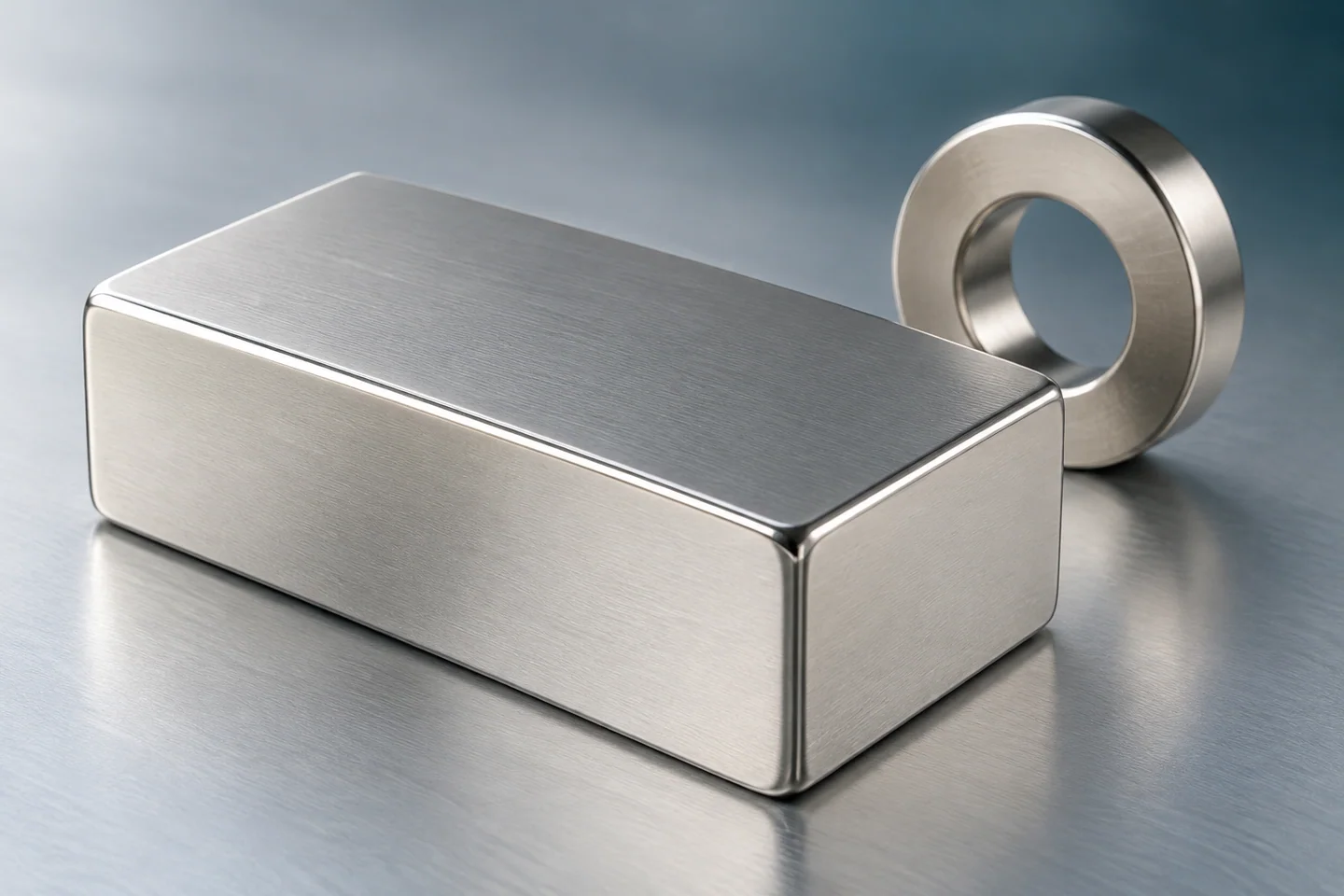
Nickel plating gives NdFeB a metallic protective surface. Ni-Cu-Ni is a common option for controlled indoor conditions and applications where resistance to surface wear matters.[2] [4] Start by checking whether the magnet stays dry, rubs against another part or will be glued into a housing.
For a dry assembly, review the finished fit and contact surfaces. For a glued assembly, also check the adhesive and coating together. Condensation, salt, cleaning fluids or immersion require evidence for that exposure; nickel plating should not be treated as a waterproof enclosure.[3] The coating comparison covers other finishes when these conditions drive the choice.
What do the nickel and copper layers do?
Ni-Cu-Ni means nickel, copper and an outer nickel layer over the NdFeB. It is a common finish, although a drawing that says only “nickel coated” does not establish this exact construction. Eclipse lists nickel and Ni-Cu-Ni separately.[1]
K&J describes a system in which the inner and outer nickel deposits differ in structure and electrochemical behaviour. The outer nickel can corrode preferentially, helping protect the layer beneath; the copper provides a ductile intermediate layer and helps level the rough surface. This describes how that multilayer system works, not a universal recipe for every nickel-plated magnet.[9]
| Layer | Role in the described system | What appearance cannot tell you |
|---|---|---|
| Inner nickel | A protective metal layer beneath the copper and outer nickel. | Its continuity or attachment to the prepared magnet surface. |
| Copper | A ductile underlayer that helps level the surface. | Its thickness and whether the specified layer is present. |
| Outer nickel | The exposed metallic finish and part of the multilayer corrosion protection. | The condition of the hidden layers beneath the shine. |
From the magnet outward
Inner nickel
- Role in the described system
- A protective metal layer beneath the copper and outer nickel.
- What appearance cannot tell you
- Its continuity or attachment to the prepared magnet surface.
Copper
- Role in the described system
- A ductile underlayer that helps level the surface.
- What appearance cannot tell you
- Its thickness and whether the specified layer is present.
Outer nickel
- Role in the described system
- The exposed metallic finish and part of the multilayer corrosion protection.
- What appearance cannot tell you
- The condition of the hidden layers beneath the shine.
Black nickel is also distinct from black epoxy. K&J describes a dark nickel finish within its plated stack; an epoxy overcoat instead presents a polymer surface to the adhesive or mating part.[3] For that option, use the epoxy guide.
Check coverage and adhesion as well as appearance
A bright, smooth surface is useful for spotting obvious damage, but it does not reveal the condition of the hidden layers. Corrosion protection depends on surface preparation, coverage of the actual shape, the underlying material and damage after plating.[5] A thicker coating cannot compensate for a poorly attached layer or an exposed corner.
Look at edges, holes and contact faces as well as the largest flat face. Record the condition before assembly so later damage can be traced to handling, fitting or exposure. The magnet beneath the plating remains brittle.
How much size does nickel plating add?
Amazing Magnets lists 10 to 20 µm for its Ni-Cu-Ni coating.[2] Treat that as supplier-specific context. Establish whether your stated thickness means the complete stack or one layer, and whether it is nominal, minimum or a controlled range.
If uniform coating of thickness t covers both opposing faces, an outside dimension increases by 2t. A uniformly coated hole becomes smaller by 2t. Real edge and hole coverage must be checked rather than assumed.
Example: outside size and bore change in opposite directions
Assume a complete stack of 15 µm (0.015 mm) on each relevant surface. A 10.000 mm bare outside dimension becomes 10.030 mm; a 4.000 mm bare bore becomes 3.970 mm. This is a geometric illustration that excludes manufacturing variation.
Accept the finished coated dimensions against the drawing. If the drawing already specifies the finished size, do not add the coating allowance again. A new finish may require a different bare blank to retain the same final fit.

Include the coating and any adhesive thickness when defining the distance from the magnet to its counterpart. Use the dimensional inspection guide for measurement conditions and the datasheet guide to separate grade properties from finished-part requirements.
Check the complete joint during assembly
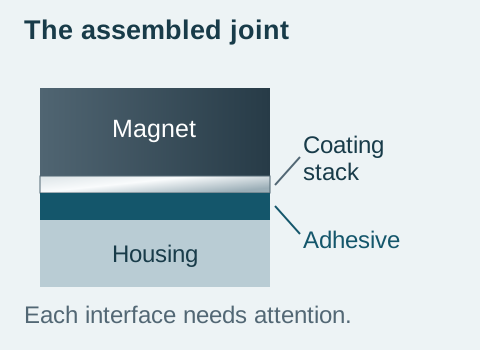
The joint includes several interfaces: magnet to plating, interfaces within the plated stack, plating to adhesive and adhesive to housing. Use the intended finish and mating material in trials, and inspect where a failed sample separated.
Choose an adhesive compatible with the actual outer finish and housing, and follow its cleaning and curing instructions.[7] Agree any primer or abrasion with the coating and adhesive suppliers; preparation that exposes NdFeB can undermine corrosion protection. Check clearance before fitting and support the part during cure.
The bond line is the adhesive layer between the magnet and housing. Its thickness needs space in the assembly. Include the cure temperature and operating peaks when reviewing both the adhesive and magnet grade.[8] After a trial, check that the magnet stays attached under the specified load and exposure.
Separate plating damage, broken material and corrosion
If a part fails, preserve it before cleaning or reworking it. Delamination means separation at an interface; chipping means loss of material; corrosion is chemical deterioration. These can occur together, so record the symptom before assigning a cause.
| Observed symptom | Record or preserve | Next check |
|---|---|---|
| Peeling or a raised metallic film | The detached film, its underside, exposed area and whether it appeared before or after assembly. | Locate the separation interface; compare preparation, adhesion evidence and coating-process changes. |
| A chipped edge with missing material | The fragment, contact marks and the mating edge or fastener position. | Check for substrate fracture and concentrated loads. Compare fit, handling and installation method. |
| Rust first noticed after installation | Incoming and installed photographs, wetting locations, cleaning history and elapsed time. | Check concealed contact faces for scraping or retained moisture; compare an unassembled control from the same lot. |
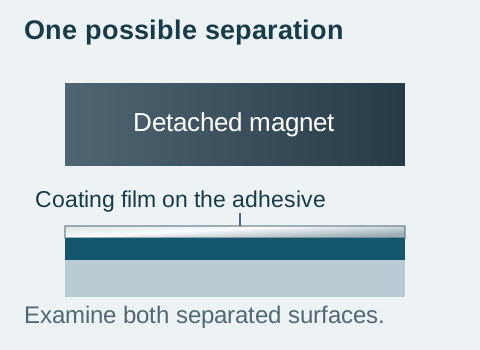
| Adhesive remains on the housing after the magnet releases | Both fracture surfaces, any metallic film on the adhesive, and any magnet fragments. | Determine whether separation occurred at the housing, adhesive, coating or substrate before changing the glue. |
Evidence to collect and checks to make
Peeling or a raised metallic film
- Record or preserve
- The detached film, its underside, exposed area and whether it appeared before or after assembly.
- Next check
- Locate the separation interface; compare preparation, adhesion evidence and coating-process changes.
A chipped edge with missing material
- Record or preserve
- The fragment, contact marks and the mating edge or fastener position.
- Next check
- Check for substrate fracture and concentrated loads. Compare fit, handling and installation method.
Rust first noticed after installation
- Record or preserve
- Incoming and installed photographs, wetting locations, cleaning history and elapsed time.
- Next check
- Check concealed contact faces for scraping or retained moisture; compare an unassembled control from the same lot.
Adhesive remains on the housing after the magnet releases
- Record or preserve
- Both fracture surfaces, any metallic film on the adhesive, and any magnet fragments.
- Next check
- Determine whether separation occurred at the housing, adhesive, coating or substrate before changing the glue.
A coating can separate from the magnet while remaining attached to the glue.[1] If a metallic film remains on the housing, establish where it came from before selecting a stronger adhesive. Photographs help document the failure, but examination of the separated surfaces may be needed to locate it. The corrosion investigation guide covers the broader exposure review.
What should be rechecked when the finish changes?
Choose checks according to what changed. A changed total coating thickness calls for a fit review. A different outer surface or preparation calls for adhesive-compatibility and retention checks. A changed layer sequence, coating process or exposed geometry calls for renewed protection evidence. If the finished dimensions or magnet-to-target gap changes, recheck the affected magnetic function.
Keep thickness, adhesion, appearance and corrosion as separate results. A thickness measurement cannot substitute for an adhesion test; an acceptable loose part cannot demonstrate retention after installation. Define sample identity, method, conditions and limits for the result being used.
ISO 9227's public scope does not set a product's test duration or acceptance interpretation, and cautions against converting salt-spray performance into long-term service resistance.[6] Compare the agreed exposure and endpoint, not an isolated number of hours.
Example: reviewing a plated-block substitution
Illustrative review of an alternative finish
A sintered block magnet adhesively bonded into a housing is specified as Ni-Cu-Ni. An alternative quote says only “nickel coated.” Ask for its layer sequence and finished tolerances. A missing layer description is an open question; a confirmed difference needs a review of fit, the bonding surface and environmental protection.
Once those details are available, identify the checks affected by the change. For the glued assembly, compare retention before and after the agreed exposure using the intended housing and adhesive. If a sample releases, preserve both separated surfaces and use the symptom table to guide the investigation.
Start with the information relevant to your purchase
For a new part or a first purchase
Use this brief even if the grade or finish is undecided. Describe the application and leave unknown details as open questions. You do not need an earlier coating specification or a faulty part to begin.
New nickel-coated magnet inquiry
Part reference / drawing / finished dimensions, if available:
Application, moisture, contact and operating temperature:
Known material grade / pole direction / preferred finish:
Installation method / housing / adhesive and cure, if used:
Sample quantity / order quantity / delivery destination:
Fit or functional requirements / questions still open:
For a finish change or an existing problem
Use the review brief below for an existing part. For a proposed substitute, compare the approved and proposed specifications. For a defect, describe what happened and preserve the evidence. Fill only the branch that applies.
Existing nickel-coated magnet review
Part reference / drawing revision / finished dimensions:
Material grade and pole direction, if known:
Application / housing / adhesive / preparation and cure:
Review quantity or affected quantity:

If changing the finish:
Approved and proposed layer sequences:
Total coating thickness / finished tolerances / other changes:
Fit, attachment and exposure limits / evidence requested:

If investigating a defect:
Observed symptom / first occurrence / affected lot:
Photographs and preserved parts / test conditions and results:
Question or supply issue to resolve:
Send the relevant brief through the inquiry button, or use the custom requirements page for an open product question. Nike Industrial Trading is the trading contact for supply inquiries; the proposed coating, available documents and acceptance arrangements are confirmed for the actual part.
Technical sources
Read each source with its stated material, test conditions and publication scope.
- Eclipse Magnetics — NdFeB Standard Range, rev. 1NdFeB standard-range technical sheet, revision 1: coatings and adhesive interfaces on pages 2 to 4.
- Amazing Magnets — Plating & CoatingsExamples of this supplier's coating sequences and thickness ranges.
- K&J Magnetics — Magnet FAQNickel, black nickel and epoxy finishes, including limitations in wet applications.
- Bunting — Coatings for Neodymium MagnetsCoating selection factors: environment, abrasion, thickness and adhesive interaction.
- Dura Magnetics — Corrosion Resistance of Neodymium MagnetsHow pretreatment, material and geometry affect corrosion protection.
- ISO 9227:2022 — Salt spray tests, public scopePublic scope of the salt-spray test method, including limits on interpreting results as service life.
- K&J Magnetics — Sticky Business: How to Glue Neodymium MagnetsAdhesive selection, surface cleaning and curing for magnet assemblies.
- Arnold Magnetic Technologies — Neodymium Iron Boron MagnetsMagnet material selection, temperature and application requirements.
- K&J Magnetics — Can Magnets Rust?K&J's explanation of nickel-copper-nickel layer behaviour and surface protection.