
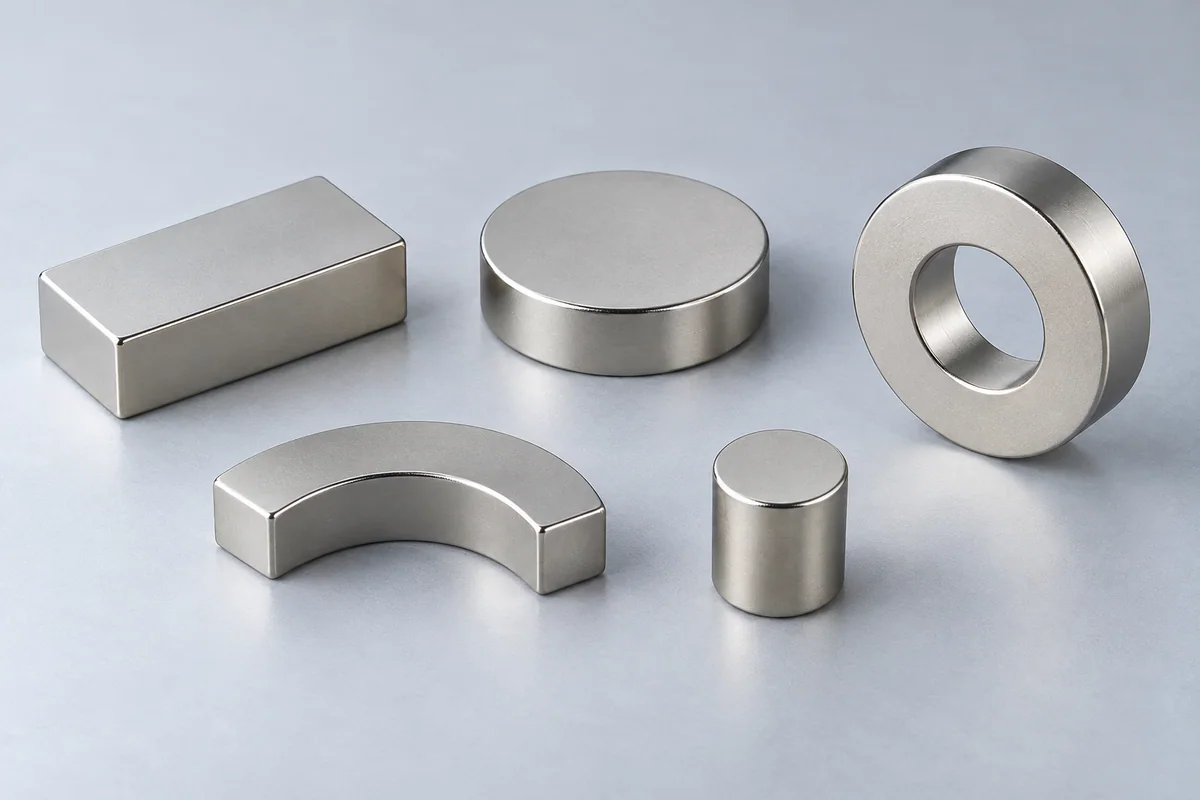
NdFeB, neo and Nd₂Fe₁₄B
NdFeB abbreviates neodymium, iron and boron. These permanent-magnet materials retain magnetization after the magnetizing field is removed. They are often called neodymium magnets, neo magnets or rare-earth magnets. Samarium cobalt is another rare-earth permanent-magnet family, so “rare earth” is a broader description than NdFeB.
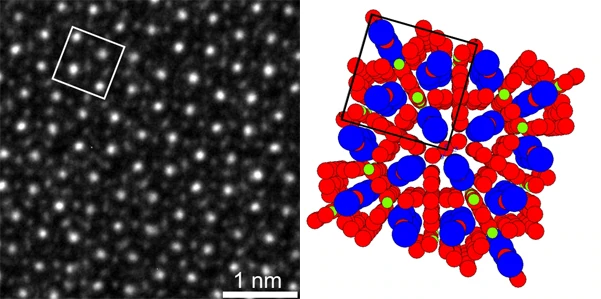
Nd₂Fe₁₄B describes the principal hard-magnetic phase and its atomic ratio of two neodymium atoms to fourteen iron atoms to one boron atom. That ratio is not a statement that every finished magnet has exactly the same total composition or weight percentages. Actual materials can include other phases and additions; a bonded magnet also contains a binder.[1]
Different material grades balance remanence, resistance to demagnetization and other properties. Manufacturer information may also distinguish processing technologies and orientation. A chemical name alone leaves those choices open.[2]
Why NdFeB is used in compact magnetic systems
NdFeB can provide high magnetic energy density, making it useful in motors, actuators, sensors, couplings and holding assemblies where space matters. The useful output still depends on the component shape, magnetic circuit and temperature.
A permanent magnet does not need a continuous electrical supply to retain its magnetization, although the device around it may use electrical power. Its field and long-term performance are still affected by its environment, operating point, temperature and condition.
Keep three questions distinct: what properties the material has, what field the finished magnet produces at a particular location, and what the assembly actually does. TDK’s guide explicitly separates basic material measurements from product characteristics agreed with the customer.[3]
Two broad material routes
| Route | What to identify | Why it matters |
|---|---|---|
| Sintered | Alloy grade, orientation, geometry and surface treatment | Magnetic properties, thermal margin, brittle handling and fit |
| Bonded | Powder, binder, forming process and orientation | Density, pole-pattern options, shape and material limits |
Details the NdFeB name leaves unspecified
Sintered
- What to identify
- Alloy grade, orientation, geometry and surface treatment
- Why it matters
- Magnetic properties, thermal margin, brittle handling and fit
Bonded
- What to identify
- Powder, binder, forming process and orientation
- Why it matters
- Density, pole-pattern options, shape and material limits
A bonded system can be isotropic or anisotropic. Its density and performance depend on the particular compound; Magnequench’s material sheet and SDM’s orientation explanation show why the forming route and orientation should both be specified.[4] [5]
See the sintered and bonded comparison before treating two parts with the same general material name as interchangeable.
What to decide for a useful inquiry
- Function: holding, a field at a sensor, torque transfer or another task.
- Geometry: dimensions and units, with mating parts and working gaps.
- Magnetization: direction, required pole location and any pattern.
- Material: specified grade or the conditions needed to discuss one.
- Environment: temperature, moisture, chemicals and mechanical loading.
- Supply and acceptance: quantity, samples, documents and the checks required.
Hard, brittle magnets require appropriate handling and retention. Their strong fields can also affect equipment and implanted medical devices. Read the handling guide when planning receipt or assembly.[3]
If you have a drawing, send its revision and known requirements. If you are starting from an application, describe what the magnet must do and which constraints are fixed. Nike Industrial Trading can discuss the product and supply requirement with you.
Technical sources
Source material has its own scope and conditions. These references explain technical choices; they are not evidence of our stock, certifications or supplied products.
- ASTM International: ASTM A1101 public abstract and scope
- Arnold Magnetic Technologies: NdFeB material properties and grade data
- TDK: NEOREC product guide: materials, measurement and precautions
- Magnequench / Neo Performance Materials: MQ1-4 compression-bonded material data
- SDM Magnetics: Anisotropic bonded magnetic materials