
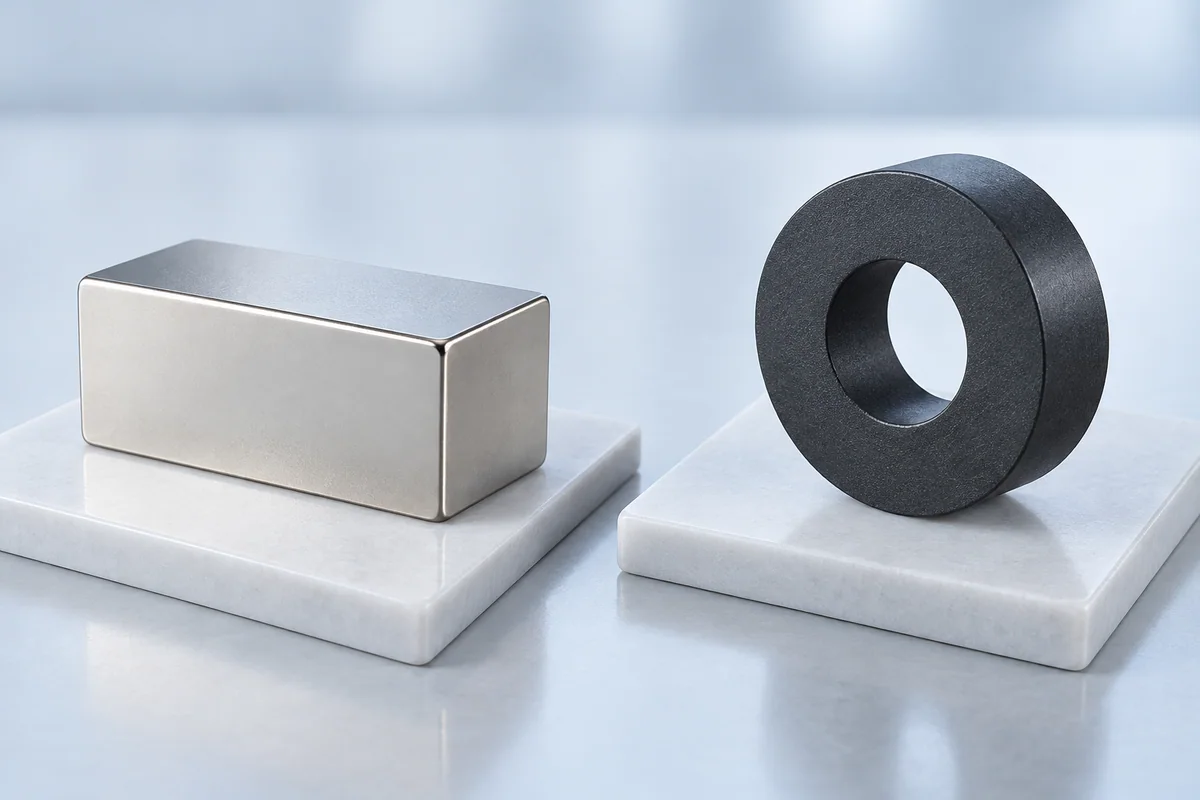
Start with the forming route
| Route | Basic process | Important variables |
|---|---|---|
| Sintered NdFeB | Magnetic alloy powder is compacted and densified by sintering; finishing follows as needed | Material grade, orientation, heat treatment, geometry and surface protection |
| Compression-bonded NdFeB | Powder and a binder are compacted into a part, with the required curing or processing | Powder, binder system, loading, density, shape and magnetic pattern |
| Injection-moulded NdFeB compound | A magnetic powder/polymer compound is moulded into the component | Polymer, powder, tooling, orientation, integration and thermal limits |
Three descriptions that belong in the specification
Sintered NdFeB
- Basic process
- Magnetic alloy powder is compacted and densified by sintering; finishing follows as needed
- Important variables
- Material grade, orientation, heat treatment, geometry and surface protection
Compression-bonded NdFeB
- Basic process
- Powder and a binder are compacted into a part, with the required curing or processing
- Important variables
- Powder, binder system, loading, density, shape and magnetic pattern
Injection-moulded NdFeB compound
- Basic process
- A magnetic powder/polymer compound is moulded into the component
- Important variables
- Polymer, powder, tooling, orientation, integration and thermal limits
Sintered and bonded names describe material and manufacturing routes. They do not fully specify density, magnetization, allowable temperature or the available geometry. Thyssenkrupp’s sintered-material information and Bunting’s compression-moulded description illustrate distinct processes and design constraints.[1] [4]
Keep powder, binder and orientation separate
Bonded magnets contain a non-magnetic binder that changes the amount of magnetic material within the component. The powder properties, loading and resulting density affect magnetic output. The binder can also introduce mechanical, chemical and thermal limits independent of the magnetic phase.
For example, Magnequench MQ1-4 is a specific compression-bonded material with its own density and magnetic-property ranges. A generic N-grade sintered table is not a substitute for that compound’s data.[2]
Some bonded systems are isotropic; others are anisotropic. Anisotropic bonded material requires orientation during forming. Even an isotropic part needs an appropriate magnetizing fixture and geometry to produce the intended pole pattern. “Bonded” alone does not establish unlimited magnetization freedom.[3]
For common anisotropic sintered material, the preferred axis is set during processing. The finishing and final magnetizing operation need to respect it.[5]

Compare the complete part design
Sintered NdFeB can provide high magnetic energy density, useful where the available magnet volume is constrained. Its hard, brittle nature and finishing requirements influence features, tolerances, edge support and assembly.
Bonded routes can offer useful forming and integration options, but compression and injection moulding have different tooling and geometry constraints. A shape must be removable from the tool, and a thin section must survive both manufacture and service. Do not assign every complicated feature to every bonded process.
Compare actual material and component data for density, field or magnetic moment, dimensions, thermal cycling, chemical exposure and retention. A lower material density does not automatically produce a lighter system if more volume or another housing is required. Likewise, tooling and volume can change the economics of each route.
Choose a route from the job the part must do
- Small available volume, high magnetic output
- Begin with a sintered candidate, then review machining, magnetization, coating and assembled tests.
- Complex formed geometry or an integrated insert
- Evaluate an injection-moulded magnetic compound. Identify its binder and powder before checking temperature, shrinkage and field performance.
- A formed ring with a defined pole pattern
- Compare suitable bonded options and the pole fixture against the field profile needed by the application. Compression bonding and injection moulding are separate routes.
For example, a compact motor segment and a shaped multipole sensor component can favour different routes even though both are called NdFeB. Decide against the required flux, envelope, pole pattern and thermal conditions, then validate a sample. These are selection examples; no particular geometry or process is represented as available from us.[1] [3] [4]
A specification that avoids “same NdFeB” substitutions
- Name sintered, compression-bonded or injection-moulded material.
- Identify the material or compound grade and supplier data revision.
- For bonded systems, define the binder or required compound where relevant.
- State isotropic/anisotropic requirements, magnetic axis and pole pattern.
- Provide finished geometry, surface and environmental requirements.
- Agree product-level magnetic, mechanical and dimensional acceptance.
If your goal is a process substitution, provide the current part, function and reason for the change. Evaluate the proposed material as a new component against that requirement rather than accepting a matching “NdFeB” label.
Technical sources
Source material has its own scope and conditions. These references explain technical choices; they are not evidence of our stock, certifications or supplied products.
- thyssenkrupp Magnettechnik: Sintered NdFeB material information
- Magnequench / Neo Performance Materials: MQ1-4 compression-bonded material data
- SDM Magnetics: Anisotropic bonded magnetic materials
- Bunting / Magnet Applications: Compression-moulded magnet process
- Dura Magnetics: Neodymium magnetization options