

Read a real material row before comparing datasheets
Open Eclipse's NdFeB data sheet (PDF) or Bunting's standard-grade data sheet (PDF). These are external supplier documents for reading practice.
Reading Arnold's N35 row
Arnold's online NdFeB grade table, checked on 25 October 2026, lists typical Br = 1,210 mT, minimum HcJ = 955 kA/m and typical (BH)max = 283 kJ/m³ for its N35 row. This is an example of that supplier's table, not our approved supply specification.[5]
- The Br conversion is 1,210 mT ÷ 1,000 = 1.210 T. Keep “typical” attached to it; the row does not turn it into a guaranteed minimum.
- HcJ is a field magnitude with a minimum qualifier. Do not compare its number directly with Br or replace it with the HcB column.
- 283 kJ/m³ is an energy density. It is not the magnet's force rating or the energy of every finished part.
- Use the linked grade sheet to retain its test temperature and conditions. Obtain the applicable current revision for a purchase; an online table alone does not establish finished-part acceptance.
A magnet material datasheet describes a grade under stated conditions. First identify the material system: sintered NdFeB and bonded NdFeB have different structures and property ranges. Then read the symbols and units before comparing rows. Supplier tables show how these fields are reported; the values belong to that supplier's material and document version.[1] [2] [3]
| Field | That supplier's entry | Read it as |
|---|---|---|
| Br | Typical 1,210 mT | A typical remanence, equivalent to 1.210 T, with the source's conditions. |
| HcB | Minimum 860 kA/m | A lower limit for the normal-curve coercive-field magnitude. |
| HcJ | Minimum 955 kA/m | A separate intrinsic-coercivity limit; keep its own column and units. |
| (BH)max | Typical 283 kJ/m³ | A typical maximum energy density on the normal curve, not a finished-part force rating. |
Reading example: Arnold N35 online row, checked 25 October 2026
Br
- That supplier's entry
- Typical 1,210 mT
- Read it as
- A typical remanence, equivalent to 1.210 T, with the source's conditions.
HcB
- That supplier's entry
- Minimum 860 kA/m
- Read it as
- A lower limit for the normal-curve coercive-field magnitude.
HcJ
- That supplier's entry
- Minimum 955 kA/m
- Read it as
- A separate intrinsic-coercivity limit; keep its own column and units.
(BH)max
- That supplier's entry
- Typical 283 kJ/m³
- Read it as
- A typical maximum energy density on the normal curve, not a finished-part force rating.
HcB and HcJ identify different intercepts. Do not substitute one for the other or calculate (BH)max by multiplying Br by HcJ. Br is also different from the field measured at a point beside a finished magnet. See magnetic property definitions and the B–H and J–H curve guide for those distinctions.[2] [4]
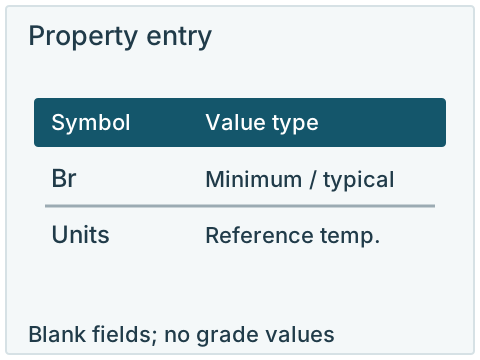
Keep the value type with the number. A typical value, minimum requirement and range serve different purposes. Two entries can look similar while one is a typical laboratory result and the other is a specified lower limit. Compare them only after resolving that difference.
Read the conditions and the document revision
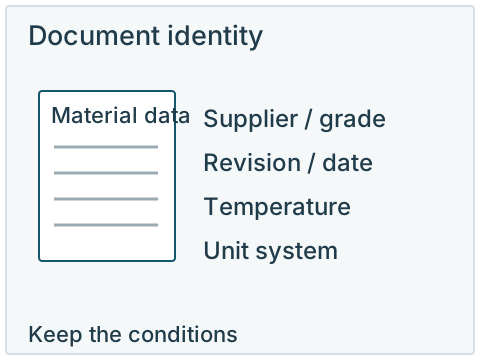
Record the supplier, document title or number, revision and date. Check the reference temperature for magnetic properties, the temperature interval for any coefficients, and the conditions attached to the maximum working temperature. Curves at the relevant operating temperatures are particularly useful where demagnetization is a concern.[1] [5]
- Grade identity: retain the full designation, including its suffix. A grade name does not replace the complete property specification.
- Units: keep units in every comparison. A magnetic-field axis in kA/m cannot be read as kOe without conversion.
- Temperature: separate room-temperature properties, reversible coefficients, working-temperature guidance and Curie temperature.
- Scope: distinguish a general material table from a part-specific specification or a lot-specific inspection record.
Older catalogues remain useful examples of field layout and terminology. For a purchase decision, obtain the current document applicable to the proposed supply. Check the grade guide and the sintered-versus-bonded comparison if the material identity is uncertain.
Connect the datasheet to the finished-part requirement
A material table cannot specify every finished dimension, coating, pole location or acceptance test. Keep three records connected by the same part reference: material information, the finished-part drawing and the acceptance requirements.
- Material information
- Grade, property limits and units, temperature conditions, and the applicable curves or supplier document.
- Finished-part drawing
- Geometry, units, tolerances, coating, magnetization direction, pole reference and drawing revision.
- Acceptance requirements
- What will be measured, the method and setup, the limits, sample or lot identification, and the documents required.
A document request you can adapt
“Please identify the material datasheet revision for the proposed grade, distinguish minimum and typical properties, and provide relevant temperature curves. Please also confirm the finished drawing revision and the inspection conditions for the specified dimensions and magnetic requirement.”
For a PDF search, use the original supplier references below as reading examples. The checklist on this page is a document-reading aid; it is not a supplier-issued datasheet. If you need a particular N35, N38SH, N52 or bonded material sheet, request the exact supplier, material designation and revision. A generic table does not resolve a grade-specific value.
The tolerance and inspection guide explains finished-part acceptance. A pull-force requirement also needs its test setup; it cannot be guaranteed from a Br or (BH)max entry alone.
Related buyer guides
Technical sources
Read each source with its stated material, test conditions and publication scope.
- NdFeB data sheetSupplier-specific material information; not an approved supply specification.
- NdFeB Standard Grade Data SheetSupplier-specific material information; not an approved supply specification.
- SM Magnetics NdFeB material specificationsSupplier-specific material information; not an approved supply specification.
- K&J Magnetics specifications and tolerancesSupplier-specific material information; not an approved supply specification.
- Arnold NdFeB product and grade dataSupplier-specific material information; not an approved supply specification.