
What are neodymium magnets used for?
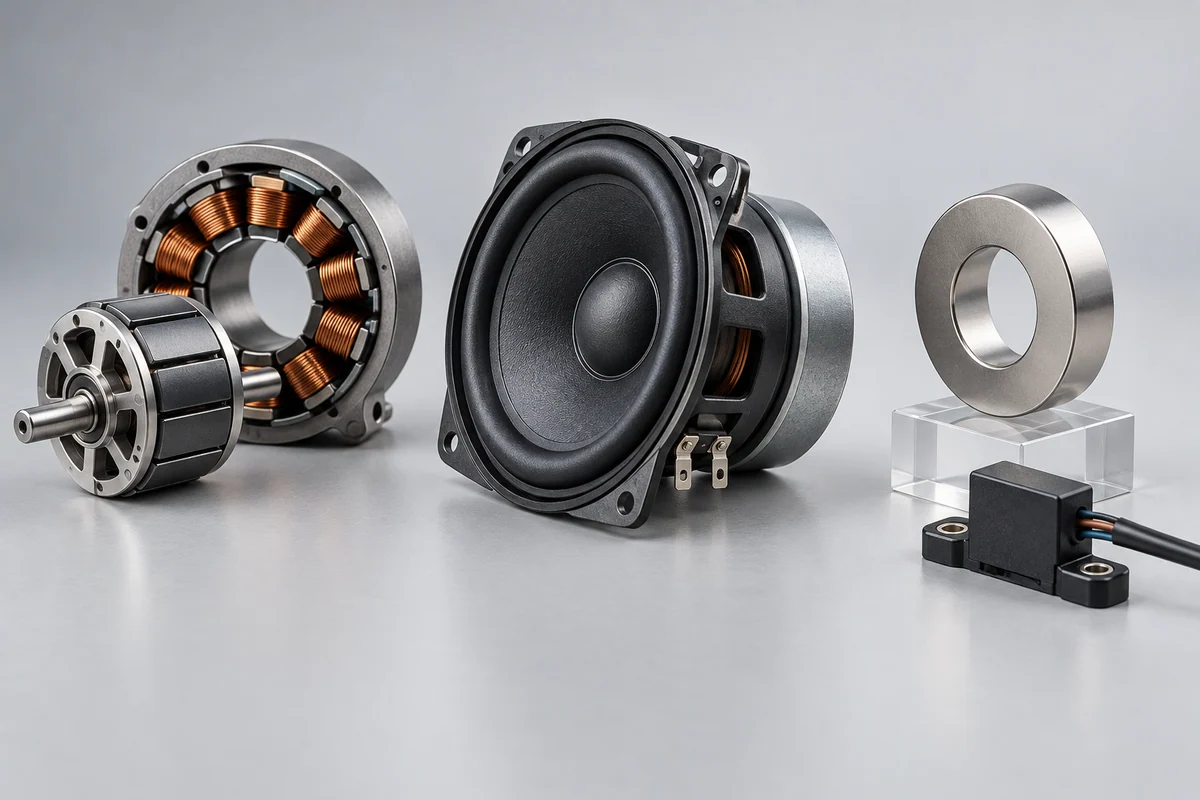
Neodymium magnets supply permanent fields in motors, generators, headphones, actuators, position sensors and holding assemblies. Their magnetic output suits equipment with limited space, from a compact drive to a thin removable cover.
In each application, the magnet works with other parts: windings, a steel return path, a sensor or a target. Those parts and their arrangement determine the result. Both neodymium and ferrite magnets are used in industrial and automotive equipment, so the equipment name alone does not identify the material. [1] [2]
Common applications
| Equipment | Typical magnetic component | Role of the magnet | Result to evaluate |
|---|---|---|---|
| Permanent-magnet motors, including servo motors | Permanent magnets in the rotor | Field interacts with winding current | Torque through the operating range |
| Permanent-magnet generators | Rotor magnets in a rotating-field design | Motion changes flux linking the windings | Electrical output at the intended speed and load |
| Headphones and loudspeakers | Magnet within the voice-coil magnetic circuit | Establishes the field in the coil gap | Performance of the complete acoustic assembly |
| Linear voice-coil actuators | Permanent magnets in the actuator's magnetic circuit | Field interacts with coil current to produce linear motion | Force over the required travel |
| Position and speed sensors | Magnetic target on the moving part | Presents a changing field to the sensor | Position signal or switching points |
| Closures and fixtures | Retention magnet paired with a steel target or another magnet | Attraction holds the counterpart | Holding and release in the intended direction |
Common uses and the magnetic parts inside them
Permanent-magnet motors, including servo motors
- Typical magnetic component
- Permanent magnets in the rotor
- Role of the magnet
- Field interacts with winding current
- Result to evaluate
- Torque through the operating range
Permanent-magnet generators
- Typical magnetic component
- Rotor magnets in a rotating-field design
- Role of the magnet
- Motion changes flux linking the windings
- Result to evaluate
- Electrical output at the intended speed and load
Headphones and loudspeakers
- Typical magnetic component
- Magnet within the voice-coil magnetic circuit
- Role of the magnet
- Establishes the field in the coil gap
- Result to evaluate
- Performance of the complete acoustic assembly
Linear voice-coil actuators
- Typical magnetic component
- Permanent magnets in the actuator's magnetic circuit
- Role of the magnet
- Field interacts with coil current to produce linear motion
- Result to evaluate
- Force over the required travel
Position and speed sensors
- Typical magnetic component
- Magnetic target on the moving part
- Role of the magnet
- Presents a changing field to the sensor
- Result to evaluate
- Position signal or switching points
Closures and fixtures
- Typical magnetic component
- Retention magnet paired with a steel target or another magnet
- Role of the magnet
- Attraction holds the counterpart
- Result to evaluate
- Holding and release in the intended direction
The magnet's geometry and pole arrangement depend on the equipment design. [3]
Motors and generators
In a permanent-magnet motor, magnets provide a field and energized windings interact with it to produce torque. A rotor design places the magnetic components in a defined arrangement around the axis. The working air gap separates moving and stationary parts; the magnetic circuit has to deliver useful output across that gap.
NdFeB is used in robot drives, elevator motors and permanent-magnet wind generators where its output suits the available space and operating conditions. [2]
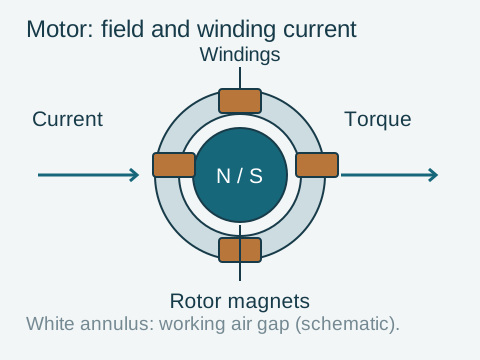
A compact drive may meet its output requirement when cold and fall short when hot. Magnetic properties change with temperature, and opposing fields can affect the working point. Check performance at the operating temperature and design the rotor retention for its motion. A room-temperature pull test on a loose magnet does not establish either result.
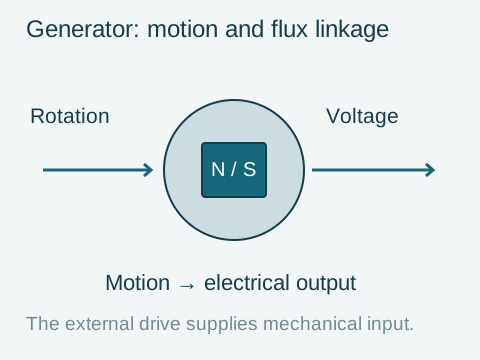
A generator uses an external mechanical drive to create relative motion and changing flux linkage. Its magnet choice also depends on the magnetic circuit and thermal conditions. Permanent-magnet linear motors and linear voice-coil actuators use permanent fields to produce straight-line movement. [5]
Position and speed sensors
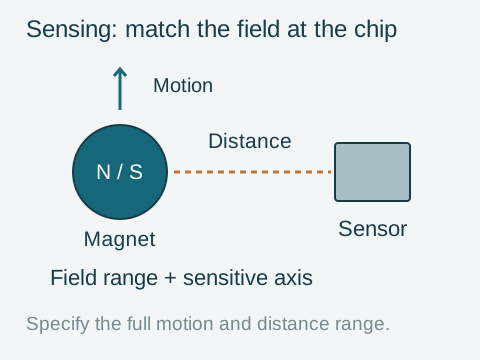
A magnet attached to a moving component can change the field seen by a stationary Hall or magnetoresistive sensor. A rotary arrangement changes the field pattern as the shaft turns; a linear arrangement changes it over a travel path. The sensor converts the relevant field component into a signal. [6]
A compact NdFeB part may provide the required field in a tight space. Check the sensor's permitted field range throughout the motion: too much field, too little field or the wrong pole orientation can prevent the intended response. A diametric two-pole cylinder and an axially magnetized cylinder present different patterns.
For example, if a magnetic target is moved farther from a switch to clear a new housing, the switching position may change. Review the sensor's specified operating and release thresholds across the full distance and temperature range. Comparing magnets only at their surfaces would miss what happens at the chip.
The magnetization direction guide explains axial and diametric layouts; the cylinder guide helps define the component geometry.
Covers and holding fixtures
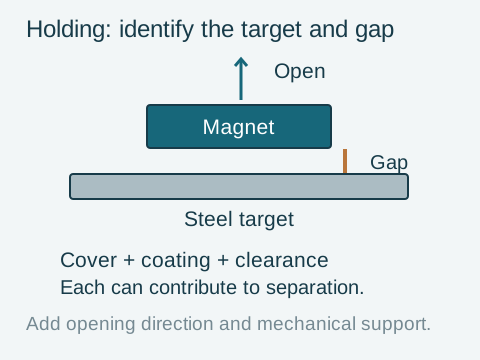
A cover magnet attracts a steel target or another magnet across the separation between them. NdFeB is useful where the retaining component must occupy little space. The target's geometry and material, the cover thickness and the opening direction all affect the assembly result. [7]
A plastic cover over a magnet creates a gap even when the outside surfaces touch. If the cover carries a sideways load, its locating features also need to support that load. Test the intended opening motion: peeling the cover from an edge gives a different result from pulling it straight off.
Use the installed cover and its actual target for these tests. The thin magnet guide works through a shallow cover example; the large magnet guide covers component size and installation access.
Audio and linear actuators
In a moving-coil headphone or loudspeaker, current in the voice coil interacts with the gap field and moves the acoustic element. NdFeB enables a compact magnetic assembly in headphones. The magnet, pole pieces, coil and gap form one working system. [4]
In a linear voice-coil actuator, the same interaction produces controlled movement along a stroke. Compare force throughout that stroke and account for clearance and heating. A loose magnet's attraction rating does not describe its performance in this coil-and-magnet arrangement.
Choosing a material and process
| Main constraint | Option to assess | Selection criteria |
|---|---|---|
| Demanding output in limited space | Sintered NdFeB | Installed output, demagnetization curves at the operating temperature, and surface protection |
| Complex molded form or multipole pattern | Bonded NdFeB | Process, binder and finished magnetic properties |
| More space and less demanding field density | Compare ferrite with NdFeB | Assembly performance and total cost within the available space |
| The proposed material is unsuitable for the temperature or environment | Compare grades and alternative material families | Performance under the actual thermal and environmental conditions |
Material options for different requirements
Demanding output in limited space
- Option to assess
- Sintered NdFeB
- Selection criteria
- Installed output, demagnetization curves at the operating temperature, and surface protection
Complex molded form or multipole pattern
- Option to assess
- Bonded NdFeB
- Selection criteria
- Process, binder and finished magnetic properties
More space and less demanding field density
- Option to assess
- Compare ferrite with NdFeB
- Selection criteria
- Assembly performance and total cost within the available space
The proposed material is unsuitable for the temperature or environment
- Option to assess
- Compare grades and alternative material families
- Selection criteria
- Performance under the actual thermal and environmental conditions
Bonded NdFeB combines magnetic powder and a binder, allowing different forming options from sintered material. Its applications include automotive accessory motors and sensors. [8] [9]
Tell us about your application
Send a sketch or existing part reference with the magnet's job and available space. For a replacement, include the dimensions, features and performance that must be retained.
Application question
Equipment and the magnet's job:
Available space or existing part reference:
Result needed / problem observed:
What is already known, and what needs clarification:
Useful information for a later component enquiry
Drawing and pole arrangement, operating conditions, working gap, counterpart or sensor details, intended validation, and quantity. These can be added once the application has been narrowed down.
Technical sources
- TDK: Automotive magnet applicationsAutomotive application chart for different magnet materials.
- TDK: Industrial magnet applicationsIndustrial application chart, including motors and generators.
- Arnold Magnetic Technologies: Permanent Magnet Applications GuidePermanent-magnet applications and material choices.
- Arnold Magnetic Technologies: Speakers and microphonesNdFeB magnetic assemblies in headphones.
- SM Magnetics / SuperMagnetMan: Motors and generatorsPermanent-magnet motor and generator designs, including linear devices.
- SM Magnetics / SuperMagnetMan: SensorsMagnetic fields and sensor triggering.
- totalElement: How Air Gaps Impact Magnet StrengthHow separation between a magnet and its target affects pull force.
- Neo Performance Materials / Magnequench: About Bonded Neo PowdersRE₂Fe₁₄B powders and the construction of bonded magnets.
- Neo Performance Materials / Magnequench: Automotive applicationsBonded and hot-formed magnets in automotive equipment.