
Size and application requirements
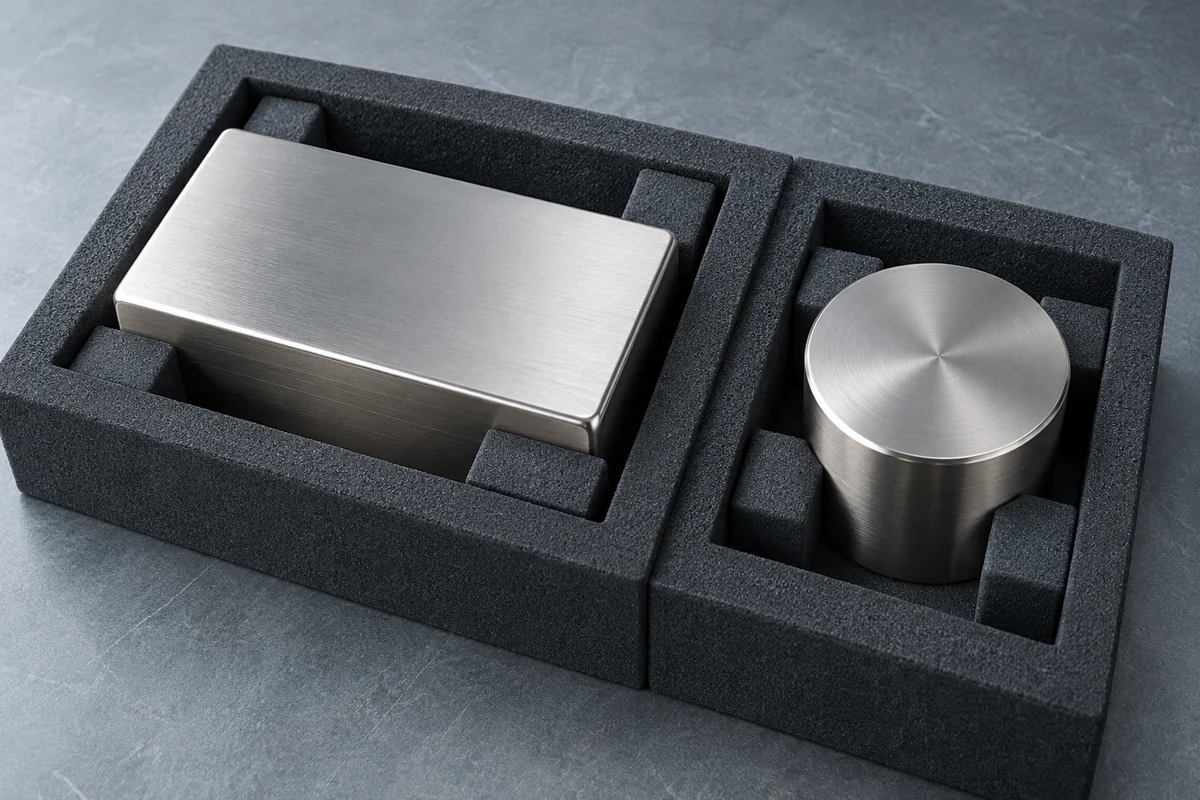
Large neodymium magnets include wide discs, long blocks and parts for magnetic assemblies. Suppliers use “large” for different sizes, so give the dimensions and units when requesting a quotation. Include the space available to install the part as well as its final position.
For a cover, specify the target, gap and opening load. For a motor, include the component drawing and pole arrangement. For a sensor, specify the field needed at the chip. Br, or remanence, is a property of the magnetic material. A catalogue pull force describes a test arrangement; check its target and gap before using it for your assembly.
A block, a custom part or an assembly?
Start with the component you need to fit, then decide what should be included in the supply. The block specification below is an example for an enquiry; final dimensions, material and availability are confirmed in the quotation.
| Configuration | Specification to discuss | Fit and installation |
|---|---|---|
| 50 × 25 × 10 mm block | N48, nickel finish, magnetized through the 10 mm thickness | Check the rectangular pocket, working gap and support for the part. |
| A solid part made to your drawing | Required outline, dimensions, magnetic axis and finish | Include holes, edge details and the space needed to install it. |
| Separate segments or an assembled item | Component layout, pole arrangement, joint gaps and retention | Identify who supplies the housing and who installs and retains the magnets. |
Starting points for a large magnet enquiry
50 × 25 × 10 mm block
- Specification to discuss
- N48, nickel finish, magnetized through the 10 mm thickness
- Fit and installation
- Check the rectangular pocket, working gap and support for the part.
A solid part made to your drawing
- Specification to discuss
- Required outline, dimensions, magnetic axis and finish
- Fit and installation
- Include holes, edge details and the space needed to install it.
Separate segments or an assembled item
- Specification to discuss
- Component layout, pole arrangement, joint gaps and retention
- Fit and installation
- Identify who supplies the housing and who installs and retains the magnets.
Large magnet supply enquiries
Nike Industrial Trading coordinates magnet sourcing around your component or assembly requirements. Send a drawing and revision, or photos and measured dimensions of an existing part. For a new application, give the function, space available and approximate quantity.
We first clarify what is being priced: a finished magnet, loose segments or an assembled item. For an assembly, include a component list and assembly drawing showing the magnets, housing or backing plate, retention parts and assembly work required.
Before ordering, confirm the quoted drawing revision, components, quantity, price, packaging and delivery terms. If you need samples or product documents, ask us to confirm their availability and what they cover for that item.
Download the large magnet specification worksheet (TXT). Use it to keep the component, assembly scope and open questions together. You can also start with a short enquiry.
What to include in a quote request
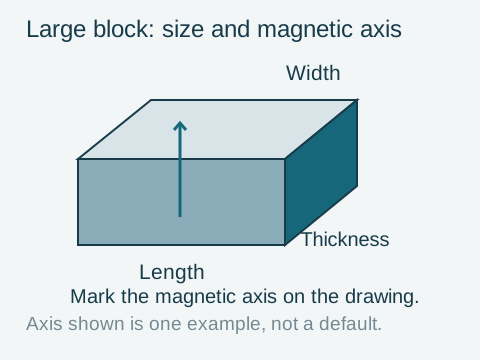
Send the component and installation drawings together, with the required dimensions and performance. For a rectangular magnet, identify length, width and thickness and mark the magnetic axis. A block can be magnetized through its thickness, but that direction should be shown on the drawing rather than assumed.
| Requirement | Details to agree |
|---|---|
| Geometry | Finished dimensions, coating allowance, critical tolerances, holes and edge details |
| Magnetic performance and operating conditions | Grade or required output, pole layout, counterpart, gap and operating temperature |
| Construction | One piece or segments; drawing revision and responsibility for assembly |
| Order scope | Sample and production quantities, destination, packaging and required documents |
| Acceptance | Dimensional checks and any field or force test, including its fixture and direction |
Specifications for comparing quotations
Geometry
- Details to agree
- Finished dimensions, coating allowance, critical tolerances, holes and edge details
Magnetic performance and operating conditions
- Details to agree
- Grade or required output, pole layout, counterpart, gap and operating temperature
Construction
- Details to agree
- One piece or segments; drawing revision and responsibility for assembly
Order scope
- Details to agree
- Sample and production quantities, destination, packaging and required documents
Acceptance
- Details to agree
- Dimensional checks and any field or force test, including its fixture and direction
Select the grade for the required output and demagnetizing conditions, and choose surface protection for the expected exposure. Record both on the drawing. Increasing the grade does not remove the need to check the circuit and mounting.
One piece or separate segments?
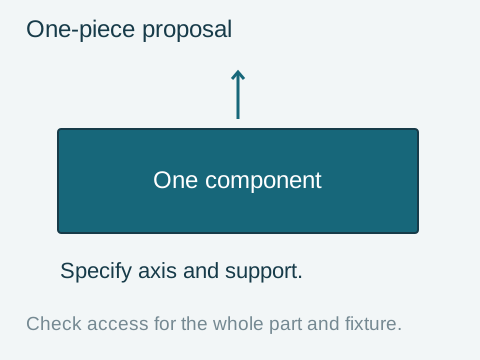
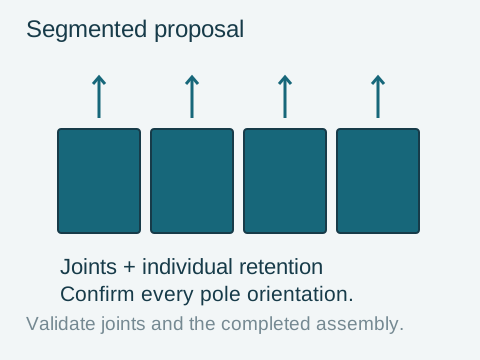
Consider segments when access, assembly sequence or another design constraint makes a single component difficult to use. The comparison must include joint gaps, pole arrangement and retention in the finished assembly.
| Requirement | One component | Several segments |
|---|---|---|
| Installation access | Room for the whole part and its fixture | Room to position and retain each segment |
| Internal joints | No segment interfaces | Gaps and adhesives enter the magnetic geometry |
| Location | One outline and its tolerances | Placement tolerances across multiple parts |
| Retention | Support for the full component | Support for every segment during installation and service |
| Acceptance | Component dimensions and installed output | Parts, poles, joints and completed-assembly output |
Installation and performance considerations
Installation access
- One component
- Room for the whole part and its fixture
- Several segments
- Room to position and retain each segment
Internal joints
- One component
- No segment interfaces
- Several segments
- Gaps and adhesives enter the magnetic geometry
Location
- One component
- One outline and its tolerances
- Several segments
- Placement tolerances across multiple parts
Retention
- One component
- Support for the full component
- Several segments
- Support for every segment during installation and service
Acceptance
- One component
- Component dimensions and installed output
- Several segments
- Parts, poles, joints and completed-assembly output
Geometry and magnetic orientation also affect manufacturing feasibility. Validate a segmented proposal magnetically and mechanically before accepting it as a replacement.
Example: the installation opening is too small
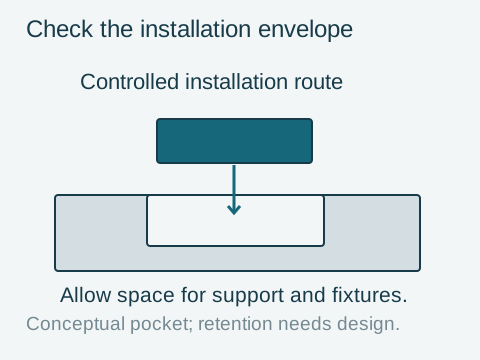
In a hypothetical enclosure, a block fits the final cavity but cannot pass through the access opening with its fixture. Compare installing it before the enclosure closes with using separately installed segments. The choice depends on servicing access, permitted magnetic joints, positioning space and retention. If neither route meets those conditions, revise the enclosure or assembly sequence.
Handling, packaging and weight
Large magnets can attract steel tools and other magnets unexpectedly. The sintered body can chip or fracture on impact. Receiving, separation and installation therefore need a controlled method suited to the actual parts and forces.
Agree how the package will be opened, what separates the parts and how each magnet will be supported and restrained. Leave space for the installation fixture in the assembly drawing. Packaging discussions should include the destination, quantities per pack and the receiving process; transport arrangements depend on the finished package.
Weight estimate for planning: a hypothetical 80 × 40 × 15 mm solid block occupies 48 cm³. At an assumed density of 7.5 g/cm³, it weighs about 360 g. Use the actual density and geometry for the proposed part; holes or a housing change the estimate. This weight does not describe its magnetic attraction.
The mass calculation guide explains the unit conversion and other shapes.
Shapes and ordering questions
Use the block guide for rectangular geometry or the arc guide for radii, angles and pole layout. Large physical dimensions and bulk order quantities are separate purchasing questions: include both where they apply.
Can I enquire without a complete drawing?
Yes. Send the function, approximate dimensions and quantity. Add a sketch of any installation constraint or explain the performance problem. We will need a defined specification before confirming the part to supply.
What should I specify if I want to assemble the segments myself?
State that you need loose components. Define each part, its pole orientation and its location in the final assembly. Include any requirements for pole marking and separation during delivery. Agree the assembly and validation responsibilities before ordering.
Can a large magnet be drilled after delivery?
Specify holes and recesses before ordering. Sintered NdFeB requires specialist machining, followed by protection of exposed material. Do not plan to drill a finished magnet with ordinary workshop equipment.
Request a large magnet quote
Send the dimensions, required function and quantity. If access or assembly is the problem, include a sketch of that area and say whether you need loose magnets or an assembled item.
Large magnet enquiry: initial information
Application and required result:
Approximate dimensions / available space, with units:
Supply scope: single magnet / loose segments / assembled item / undecided:
Quantity, destination and main question:
Information to confirm before ordering
Finished drawing and revision; grade and pole arrangement; counterpart and gap; temperature and surface protection; support and installation route; packaging; agreed sample, document and acceptance requirements. Identify who supplies and assembles each item. Your design team should validate the magnetic circuit and installation in the intended equipment.