
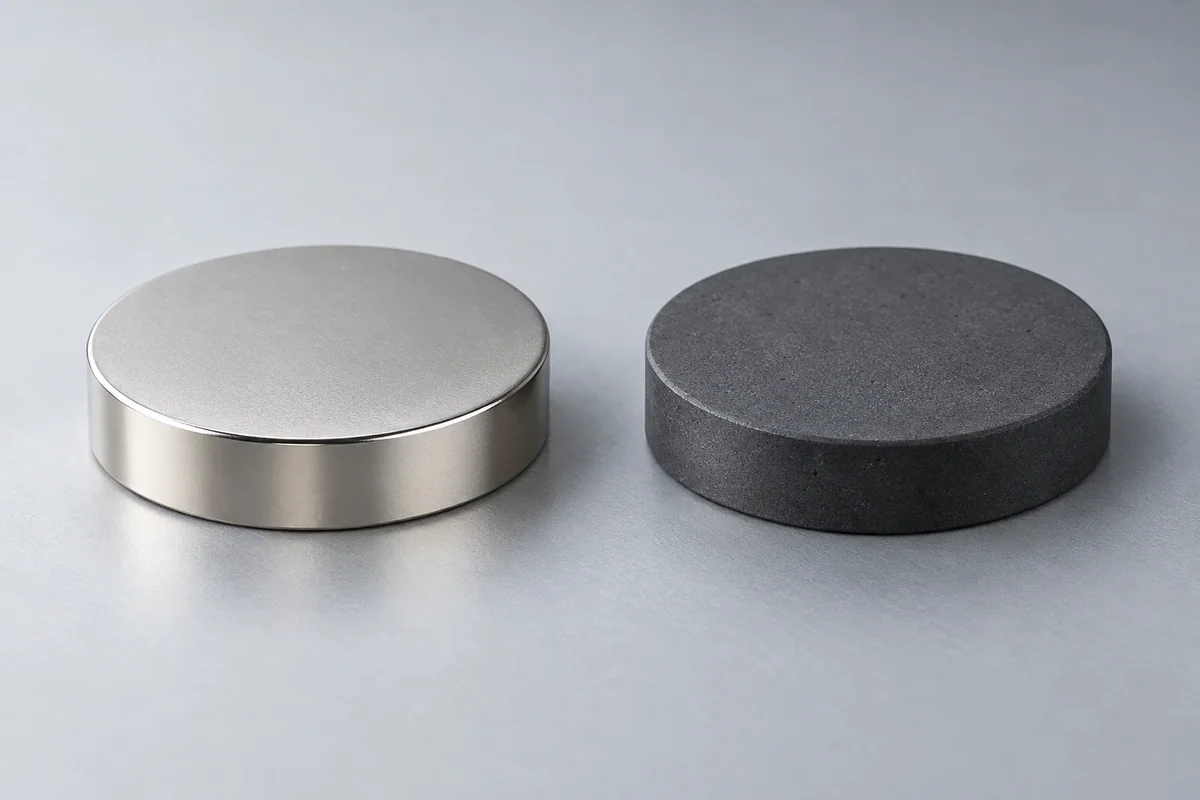
Compare the material systems
Neodymium–iron–boron and hard ferrite are different permanent-magnet families. Ferrite, often called ceramic magnet material, commonly uses strontium or barium ferrite. Both families can be hard and brittle. A ferrite part is not simply a low-grade NdFeB magnet, and their grade codes should not be ranked by comparing the numbers in the names.[1] [2]
| Design question | NdFeB | Ferrite |
|---|---|---|
| Restricted magnetic volume | High energy density can support a compact magnetic circuit | Often needs more material volume for a comparable task |
| Corrosion exposure | Usually needs a suitable protective surface or enclosure | Often selected for good inherent corrosion resistance |
| Temperature | Grade, geometry and opposing field strongly affect usable range | Different thermal behaviour; assess both cold and hot conditions |
| Mechanical assembly | Protect against impact, chipping and unsuitable fits | Also brittle; avoid using the magnet as a structural member |
| Cost decision | Consider potential savings from smaller surrounding components | Can be attractive when volume is available and material cost matters |
Useful starting comparisons; verify the chosen grades
Restricted magnetic volume
- NdFeB
- High energy density can support a compact magnetic circuit
- Ferrite
- Often needs more material volume for a comparable task
Corrosion exposure
- NdFeB
- Usually needs a suitable protective surface or enclosure
- Ferrite
- Often selected for good inherent corrosion resistance
Temperature
- NdFeB
- Grade, geometry and opposing field strongly affect usable range
- Ferrite
- Different thermal behaviour; assess both cold and hot conditions
Mechanical assembly
- NdFeB
- Protect against impact, chipping and unsuitable fits
- Ferrite
- Also brittle; avoid using the magnet as a structural member
Cost decision
- NdFeB
- Consider potential savings from smaller surrounding components
- Ferrite
- Can be attractive when volume is available and material cost matters
These are selection tendencies, not fixed strength, price or service-life ratios. Material comparisons need temperature, air gap, required output and manufacturing context.[3]
When ferrite deserves a serious comparison
Ferrite may be worth evaluating when the assembly can accommodate more magnetic volume, raw material cost matters and a compact rare-earth design is unnecessary. It can also reduce dependence on a protective metallic coating, although the whole assembly still needs environmental evaluation.
Show the available envelope rather than assuming both candidate magnets must have identical dimensions. The best comparison may be two redesigned magnetic circuits that meet the same functional target. Include the target steel, housing, retention and assembly operations in the cost comparison.
Ferrite has its own grade and orientation choices. Manufacturer data distinguishes isotropic and anisotropic material, along with temperature-related properties. A room-temperature test alone does not establish performance over the required range.[1]
When NdFeB’s compactness matters
NdFeB can be valuable where space, moving mass or the size of the magnetic circuit is a constraint. That benefit still depends on the grade, shape and circuit. The magnet needs adequate coercivity at the operating temperature, a suitable surface and a mechanically sound installation.
Check the proposed material’s numerical values and curves. Arnold’s material guidance emphasizes the relationship between remanence, coercivity, shape and alignment; a high headline energy product does not resolve every design constraint.[4]
Example: more space is available in a closure
Illustrative design choice
Assume a closure must meet a defined retention force through a plastic cover, with room for a larger magnet. Ferrite deserves evaluation because volume is available and corrosion exposure matters. If the enclosure cannot grow, NdFeB may be the more useful starting candidate.
Keep the actual plastic gap and steel target in both prototype tests. Compare achieved retention, installed volume and assembly cost. Enlarging the ferrite does not by itself establish equivalent performance; measure the same functional endpoint.
Test a replacement against the same function
- Set the required force, torque or field at a defined position.
- Give both designs the real temperature and environment requirements.
- Compare the complete magnetic circuit, not only the loose magnets.
- Check saturation, sensor operating window and mechanical retention.
- Measure samples with a reproducible method and review total system cost.
A material curve, a local field reading and an assembly measurement provide different evidence. Keep the acceptance metric tied to the application.[5]
If you are considering ferrite instead of NdFeB, send the current drawing and the reason for the change. We can discuss the magnet requirement without assuming a fixed one-for-one substitution.

Technical sources
Source material has its own scope and conditions. These references explain technical choices; they are not evidence of our stock, certifications or supplied products.
- Dexter Magnetic Technologies: Ceramic ferrite material properties
- Webcraft / supermagnete: Magnetic data for NdFeB and ferrite
- Dura Magnetics: Permanent-magnet material selection
- Arnold Magnetic Technologies: NdFeB material properties and grade data
- Arnold Magnetic Technologies: Magnetic properties and measuring techniques