
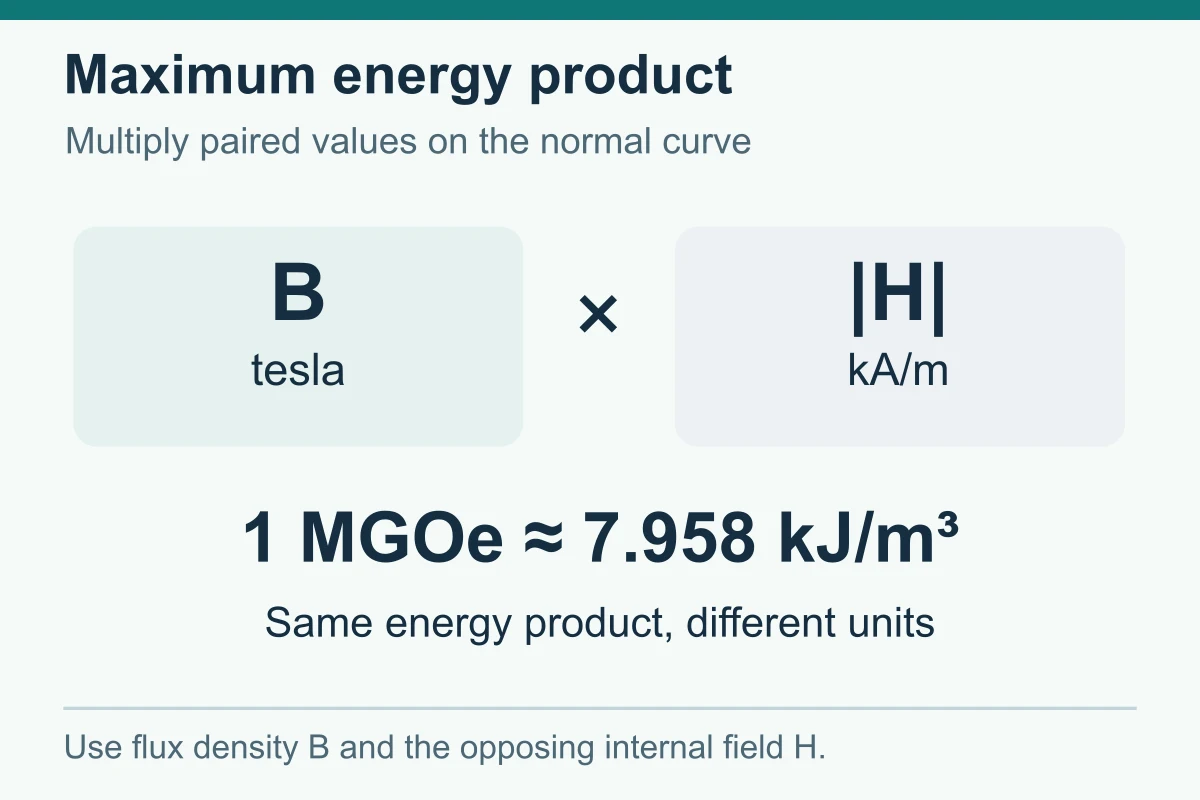
What maximum energy product measures
(BH)max is the largest magnitude of B × H on the normal demagnetization curve in the second quadrant. Here the flux density B is positive and the internal H opposes the magnetization. Multiply B in tesla by the magnitude of H in kA/m to obtain kJ/m³. Use the normal B–H curve for this calculation. The intrinsic J–H curve shows polarization and helps reveal irreversible reversal. [1] [2]
Read a series of points on the descending normal curve and compute B × |H| at each point. The peak product equals the largest rectangle from the origin to the curve. At the remanence intercept H = 0 the product is zero. At the normal coercivity intercept B = 0 it is zero again. A real curve may have a knee before the peak of an ideal straight line, so the complete curve matters. [1] [3]
How many MGOe is N52?
52 MGOe ≈ 414 kJ/m³, but the N52 label does not establish a 52 MGOe acceptance minimum. Published specifications below distinguish a typical value, a nominal value and a range. [7]
| Source and material | (BH)max | Value type |
|---|---|---|
| Arnold N52 | 390 / 406 / 422 kJ/m³ 49 / 51 / 53 MGOe | Min. / nominal / max. in data sheet rev. 210802. The overview lists the middle value as typical. [4] [11] |
| K&J N52 | 49.5–52 MGOe | Catalog range [5] |
| Shin-Etsu N52-F | 382–422 kJ/m³ / 48–53 MGOe | Range for the named material [6] |
1 MGOe ≈ 7.958 kJ/m³. Accordingly, 400 kJ/m³ ≈ 50.3 MGOe. Published SI and cgs columns can be rounded independently. Compare the agreed minimum in consistent units before deciding whether one offer meets a limit. Use the full supplier material designation, reference temperature and data revision. [7] [8]
For comparison with the N52 row above, K&J lists N42 at 40–42 MGOe. A published commercial example above the N52 label is Shin-Etsu N56-F at 51–57 MGOe. Its upper endpoint is not a guaranteed minimum or a market-wide record. [5] [6]
Which permanent magnet material has the highest energy product?
For room-temperature maximum energy product, NdFeB leads the four common families compared here. Integrated Magnetics' material guide gives the following typical catalog examples. [12]
| Material and named grade | Published typical (MGOe) | Converted, approximately (kJ/m³) |
|---|---|---|
| NdFeB 39H | 40 | 318 |
| SmCo 26 | 26 | 207 |
| Alnico 5 | 5.5 | 43.8 |
| Ferrite 8 | 3.5 | 27.9 |
The source discusses the material ranking at room temperature, but its comparison table does not give an exact test temperature for each row. These are named-grade typical values for initial comparison, not acceptance limits, family-wide maxima or a ranking at elevated temperature. SI values above use 1 MGOe ≈ 7.958 kJ/m³. [12] [7]
A higher (BH)max can help reduce magnet volume for a specified magnetic circuit. It does not by itself predict holding force or resistance to demagnetization. For heat, opposing fields and cost tradeoffs, compare NdFeB with SmCo, Alnico or ferrite, then use the actual grade's temperature-specific curve. [1] [3]
A worked calculation and the ideal limit
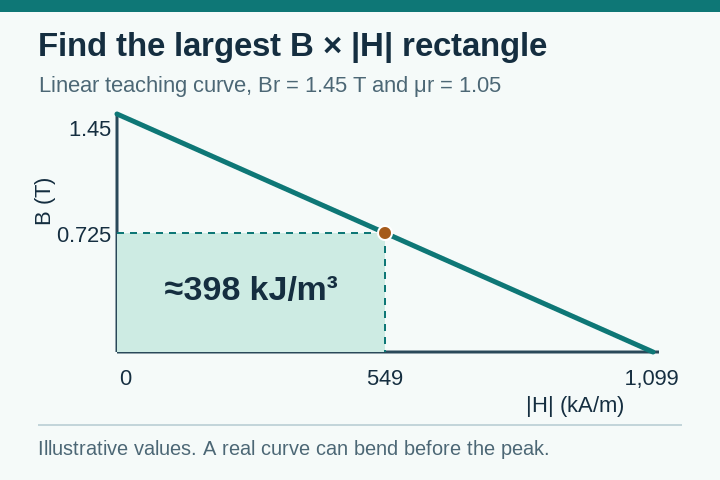
Assume a linear normal demagnetization branch with Br = 1.45 T and constant relative slope permeability μr = 1.05, with no knee in the range of interest. With x = |H| in A/m, B = Br − μ0μrx. The product x(Br − μ0μrx) peaks at x = Br/(2μ0μr). [1]
| |H| (kA/m) | B (T) | B × |H| (kJ/m³) |
|---|---|---|
| 0 | 1.450 | 0 |
| 300 | 1.054 | 316 |
| 549 | 0.726 | 398 |
| 800 | 0.394 | 316 |
The model gives a peak near 549 kA/m and B = 0.725 T, or about 398 kJ/m³ (50.1 MGOe). The result applies to this assumed curve. Use the actual branch to evaluate a material specification, particularly if it bends or the slope changes. [1]
For an ideal square polarization loop with Br equal to Js, μr = 1 and adequate coercivity to reach the optimum, the model reduces to Js²/(4μ0). A phase-level Js of 1.60 T gives about 509 kJ/m³ (64 MGOe). This illustrates why the phase benchmark is higher than ordinary grade tables. It assumes full alignment, no dilution of the magnetic phase and no reversal before the optimum. Report it as an ideal result from rounded inputs, separate from a measured finished-magnet value. [1] [3] [9]
When higher energy product helps a design
For a design with limited magnet volume, a larger B × |H| at the chosen operating point can help deliver the specified air-gap field using less magnet material. Start with the load line and the temperature-specific curve. The assembly sets the operating point, which can be well away from (BH)max. A grade with a lower room-temperature energy product can be the better choice if its hot curve keeps the working point clear of the knee. [1] [3] [10]
For example, TDK's catalog lists 390 ± 16 kJ/m³ and HcJ ≥ 1,830 kA/m for NEOREC51DSX, compared with Arnold's N52 typical 406 kJ/m³ and published HcJ minimum 876 kA/m. Those values illustrate separate tradeoffs. The catalogs use different value types, and the material labels are not interchangeable. Decide using the stated temperature curves and the intended magnetic circuit. [4] [10]
If the requirement is a force on a steel target, specify the gap, target material and thickness, alignment and direction of loading. An ideal force estimate uses the gap flux density and the effective pole area. Leakage and steel saturation change the real force. For a comparison in newtons, use a common fixture or an application model checked against measurement. See magnet pull force and fixture effects. [3] [5]
Energy product enquiry checklist
You can start with a drawing, available space and what the magnet needs to do. Fill in the fields you know. If the grade, opposing field or curve revision is unknown, leave it open and describe the application or the problem with the current magnet. The technical details can be clarified during the enquiry.
Drawing and magnet volume available:
Material grade and minimum (BH)max if specified:
Operating temperatures and opposing field:
Air gap, return steel and field or force target:
Reference curve revision and measurement basis:
Quantity and sample acceptance method:
Technical sources
Read each source with its stated material, test conditions and publication scope.
- Arnold: Measuring magnetic properties
- IEC 60404-5:2015: Permanent magnet measurements
- Coey: Perspective and prospects for rare-earth permanent magnets
- Arnold: Neodymium grade table
- K&J: Neodymium material specifications
- Shin-Etsu: N series lineup
- Arnold: Energy product unit conversion
- NIST: Units for magnetic properties
- de Groot et al.: Sintered NdFeB and DyGa additions
- TDK: NEOREC magnetic characteristics
- Arnold: N52 individual data sheet, rev. 210802
- Integrated Magnetics: Magnet Design Guide, Table 2.1