
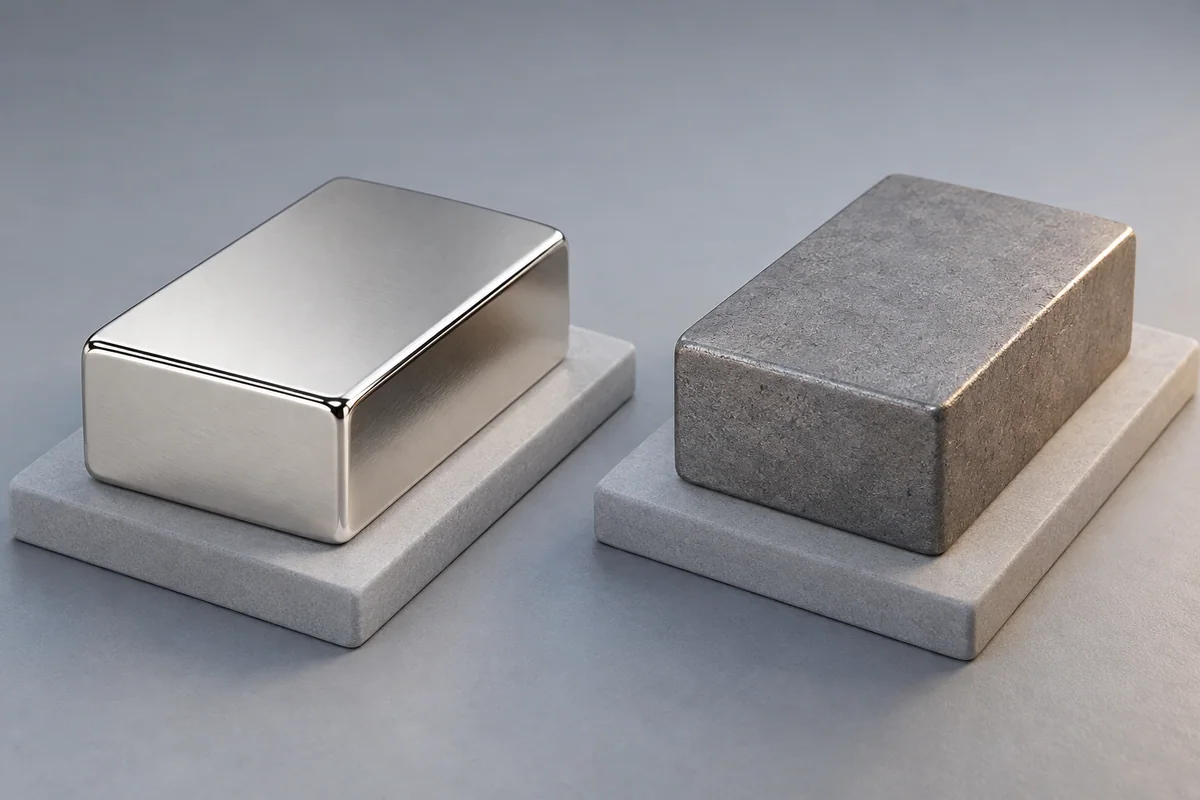
Both are rare-earth magnets; their tradeoffs differ
NdFeB and samarium cobalt, SmCo, are hard magnetic materials with high energy density. NdFeB is often attractive for compact designs at moderate temperature. SmCo deserves consideration when thermal stability, opposing fields or the environment are demanding. Both require care against chipping and impact.
SmCo includes different material families, notably 1:5 and 2:17. Do not apply one SmCo grade’s curve, temperature limit or corrosion behaviour to every composition. Dexter’s material guidance also notes that improved corrosion resistance does not eliminate the need to consider protection in acidic conditions.[2]
| Criterion | NdFeB | SmCo |
|---|---|---|
| Energy density | Usually the stronger starting candidate for a compact, moderate-temperature design | Usually lower room-temperature energy product; may offer a better hot-state result |
| Thermal behaviour | More reversible output drift; high-coercivity grades extend the useful range | Lower typical reversible drift and higher-temperature material options |
| Corrosion | Protective surface integrity is important | Generally more corrosion resistant; acidic or aggressive exposure still needs checking |
| Mechanical handling | Brittle; protect edges and avoid uncontrolled impact | Also brittle; assembly support and handling remain important |
| Purchase decision | Often attractive where space and initial material cost dominate | Often worth evaluating where heat stability can reduce compensation or protection needs |
Material tendencies; qualify the particular grades and assembly
Energy density
- NdFeB
- Usually the stronger starting candidate for a compact, moderate-temperature design
- SmCo
- Usually lower room-temperature energy product; may offer a better hot-state result
Thermal behaviour
- NdFeB
- More reversible output drift; high-coercivity grades extend the useful range
- SmCo
- Lower typical reversible drift and higher-temperature material options
Corrosion
- NdFeB
- Protective surface integrity is important
- SmCo
- Generally more corrosion resistant; acidic or aggressive exposure still needs checking
Mechanical handling
- NdFeB
- Brittle; protect edges and avoid uncontrolled impact
- SmCo
- Also brittle; assembly support and handling remain important
Purchase decision
- NdFeB
- Often attractive where space and initial material cost dominate
- SmCo
- Often worth evaluating where heat stability can reduce compensation or protection needs
These are selection tendencies described by Adams and Dexter, rather than a guarantee that one family wins every comparison.[1] [2]
Example: a hot magnetic coupling
Illustrative selection scenario
Assume a coupling must retain its specified torque at a measured magnet temperature of 170°C, with repeated heating and cooling. Begin by comparing a suitably rated high-coercivity NdFeB grade with a SmCo candidate at that temperature. SmCo is a useful first candidate when low thermal drift matters; an NdFeB candidate still needs its hot-state curves and circuit assessed.
Validate torque while hot and permitted permanent change after cooling. A room-temperature pull rating or a generic 180°C label cannot decide this case. This is a design example, not a customer project or a supplied product.
Compare usable hot-state output
A high room-temperature energy product can conceal insufficient thermal margin. Ask how the magnet performs at local hot spots and under the opposing field present in service, then measure the permitted change after cooling. Adams’ selection framework prioritizes the actual environment and operating point over an isolated BHmax number.[1]
There is no universal temperature at which every SmCo magnet outperforms every NdFeB magnet. It depends on the grades, field requirement, dimensions and circuit. Higher-coercivity NdFeB formulations and different SmCo families produce different comparisons.
Use the temperature-dependent curves rather than extending a linear coefficient through an unlimited range. Reversible drift, irreversible loss and physical assembly deterioration are separate concerns.[4]

Keep corrosion and mechanical design in the decision
SmCo’s corrosion resistance can be an advantage, but “uncoated” is not the same as “immune to every environment”. Specify chemistry, temperature, immersion or humidity and the joint materials. For NdFeB, the protective surface and the integrity of that surface during assembly are central.
Neither material should be selected solely as a stronger mechanical component. Check edge support, installation forces, retention and possible impact. A redesign can also change thermal expansion and the load on adhesive or surrounding parts.
Compare complete assembly cost rather than a fixed price-per-kilogram ratio. A material with a higher purchase cost may simplify thermal compensation or protection in one design, while a different design may gain little from that change.[5]
Prepare a fair comparison brief
- Identify the existing material, drawing and revision.
- State the function and the output required at a defined point or fixture.
- Provide local operating temperatures, time exposure and opposing-field conditions.
- Describe the environment, surface and mechanical retention.
- Agree samples, hot/cold tests and permitted permanent change.
If NdFeB is the current option, obtain the exact supplier data and its minima or typical values rather than a generic grade chart.[3]
Send the reason for considering SmCo along with your known conditions. Material selection and availability can then be discussed against the actual requirement.
Technical sources
Source material has its own scope and conditions. These references explain technical choices; they are not evidence of our stock, certifications or supplied products.
- Adams Magnetic Products: When to consider SmCo instead of NdFeB
- Dexter Magnetic Technologies: SmCo material families and application conditions
- Arnold Magnetic Technologies: NdFeB material properties and grade data
- Arnold Magnetic Technologies: Magnetic properties and measuring techniques
- Dura Magnetics: Permanent-magnet material selection