
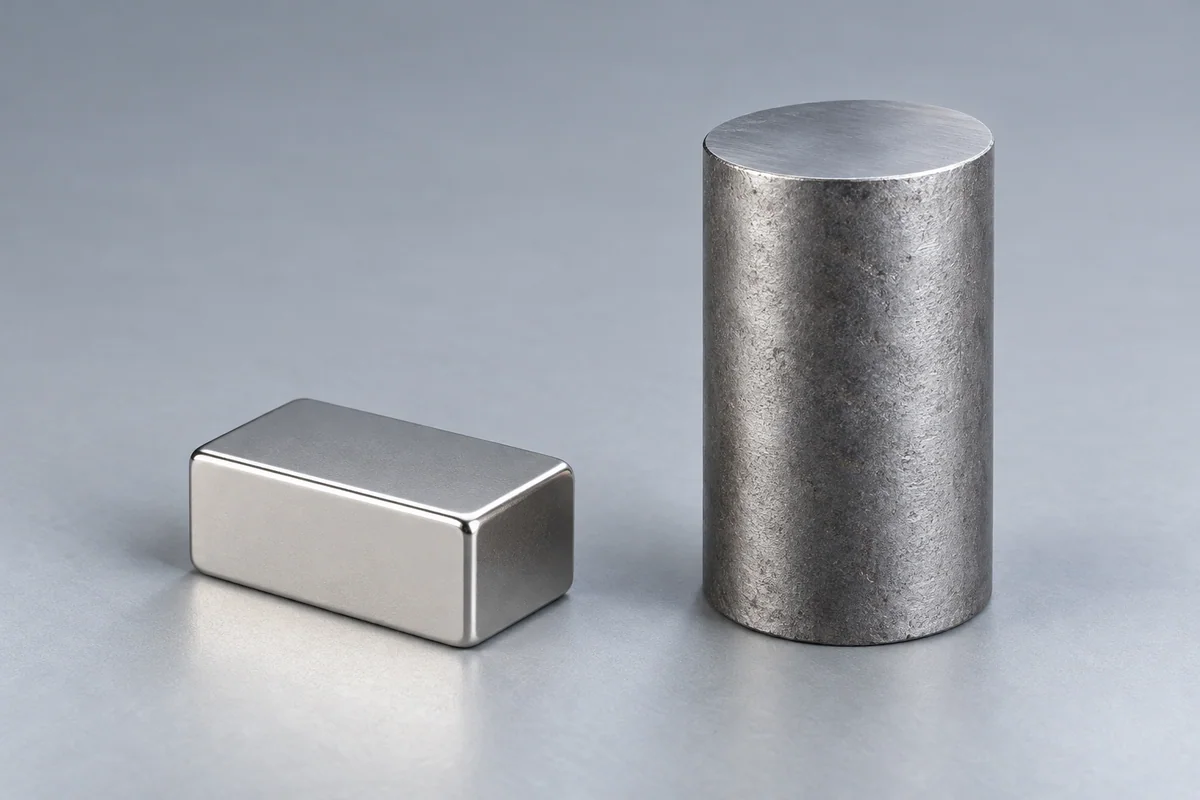
High remanence and high coercivity are different advantages
Alnico is an iron-based alloy family named for aluminium, nickel and cobalt. Some grades have substantial remanence, Br, but relatively low coercivity compared with modern rare-earth materials. A strong remanent value therefore does not establish strong resistance to an opposing field.
NdFeB combines high energy density with a different demagnetization curve and coercivity profile. To compare it fairly with Alnico, look at the whole curve, the magnetic circuit and the temperature range, rather than one Br figure.[1] [4]
| Factor | Alnico consideration | NdFeB consideration |
|---|---|---|
| Temperature stability | Often chosen for low variation of output with temperature | Check the required grade and temperature-dependent curves |
| Demagnetization | Magnetic circuit and low coercivity deserve particular attention | Coercivity still needs sufficient margin at the actual temperature |
| Geometry | Cast and sintered routes offer different possibilities | High energy density can support a compact circuit |
| Environment | Good corrosion resistance can help, but does not remove every environmental limit | Usually requires appropriate surface protection |
Different properties can drive the choice
Temperature stability
- Alnico consideration
- Often chosen for low variation of output with temperature
- NdFeB consideration
- Check the required grade and temperature-dependent curves
Demagnetization
- Alnico consideration
- Magnetic circuit and low coercivity deserve particular attention
- NdFeB consideration
- Coercivity still needs sufficient margin at the actual temperature
Geometry
- Alnico consideration
- Cast and sintered routes offer different possibilities
- NdFeB consideration
- High energy density can support a compact circuit
Environment
- Alnico consideration
- Good corrosion resistance can help, but does not remove every environmental limit
- NdFeB consideration
- Usually requires appropriate surface protection
Why the Alnico magnetic circuit matters
An open magnetic circuit can expose an Alnico magnet to a substantial self-demagnetizing field. Geometry and the return path need to place the working point in an appropriate region of the curve. Assembly changes or an opposing external field may move that point and change the retained output.
Dexter discusses magnetizing some Alnico designs in the completed magnetic circuit, or choosing a shape with sufficient operating margin on its own. This is a design decision, not a workshop instruction or a universal length-to-diameter rule.[1]
Alnico’s thermal stability can be useful for a reference field, instrumentation or an appropriate high-temperature assembly. It does not cancel the effects of low coercivity or make every Alnico grade suitable for one headline temperature.[2]

A material change can require a circuit redesign
Changing an existing Alnico part to NdFeB may alter the field distribution, flux in surrounding steel and the output at a sensor or air gap. The new material can require different dimensions, surface protection, retention and assembly steps. More field is not automatically better if a sensor or magnetic circuit has a defined operating window.
The reverse substitution also needs engineering review. A compact NdFeB geometry should not be assigned to Alnico without checking its new operating point and resistance to the expected demagnetizing influences.
A material curve, a magnetic-moment test and a field measurement are different views of the design. Choose the acceptance method that corresponds to the intended function.[3]
Example: replacing a magnet in an existing instrument
Illustrative replacement decision
Assume an instrument uses Alnico in a return-yoke circuit and must preserve its calibration across temperature. Identify the original material and working point before considering an NdFeB replacement. A small NdFeB part with a similar Br can change the air-gap field and temperature behaviour.
First reproduce the required field over the movement range, then test the operating-temperature range and permitted drift. If Alnico remains the candidate, retain the magnetic-circuit and demagnetization conditions needed by that design. This is a design example, not a validated replacement recommendation.
Information for a useful replacement inquiry
- Current drawing, material grade, magnetization and assembly sequence.
- Field, force or other functional target with its measurement conditions.
- The full temperature range and allowed output variation.
- Surrounding magnetic parts, gaps and possible opposing fields.
- Environment, coating, mechanical retention and supply requirements.
Compare the total design: magnet, surrounding components, manufacturing, calibration if applicable and validation. Material cost by itself cannot determine the best solution.[5]
Application-specific questions, such as instrument calibration or pickup behaviour, need their own system requirements. A general alloy comparison does not settle those outcomes.
Technical sources
Source material has its own scope and conditions. These references explain technical choices; they are not evidence of our stock, certifications or supplied products.
- Dexter Magnetic Technologies: Alnico properties and magnetic-circuit design
- Eclipse Magnetics: Alnico and NdFeB material tradeoffs
- Arnold Magnetic Technologies: Magnetic properties and measuring techniques
- Arnold Magnetic Technologies: NdFeB material properties and grade data
- Dura Magnetics: Permanent-magnet material selection