

Where should you buy neodymium magnets?
For a few standard discs or blocks, start with a specialist magnet catalogue or industrial distributor. For a drawing with controlled dimensions, use a custom magnet supplier. If the required force or field is still unresolved, choose a route that includes application engineering before ordering production parts.
Start with the part's function, available space, quantity and delivery destination. For a standard catalogue purchase, check the listed specification, pack size and delivery options. A replacement also needs the original part number or specification where possible: outside dimensions alone leave the material, pole arrangement and coating unknown.
| Situation | Start here | Decision before paying |
|---|---|---|
| A few standard parts | A dimensioned catalogue with an ordering option. | Does the listed grade, finish and pole direction fit? Check piece versus pack pricing and delivery availability. |
| A drawing or unusual feature | A custom RFQ with the current drawing revision. | Which requirements are accepted? Which need a different tolerance, geometry or process? |
| A replacement magnet | The original part specification, then a supplier able to review the substitute. | Can you establish the original material and magnetic arrangement? Otherwise plan a functional comparison. |
| Repeat production | A supplier able to discuss lot identification and controlled repeat supply. | How will the approved specification, inspections and later changes follow each order? |
| An unresolved assembly | A magnetic design or testing service. | What design work, prototype and validation result will the service deliver? |
Match the purchase to a supply route
A few standard parts
- Start here
- A dimensioned catalogue with an ordering option.
- Decision before paying
- Does the listed grade, finish and pole direction fit? Check piece versus pack pricing and delivery availability.
A drawing or unusual feature
- Start here
- A custom RFQ with the current drawing revision.
- Decision before paying
- Which requirements are accepted? Which need a different tolerance, geometry or process?
A replacement magnet
- Start here
- The original part specification, then a supplier able to review the substitute.
- Decision before paying
- Can you establish the original material and magnetic arrangement? Otherwise plan a functional comparison.
Repeat production
- Start here
- A supplier able to discuss lot identification and controlled repeat supply.
- Decision before paying
- How will the approved specification, inspections and later changes follow each order?
An unresolved assembly
- Start here
- A magnetic design or testing service.
- Decision before paying
- What design work, prototype and validation result will the service deliver?
Discuss your purchase with Nike Industrial Trading
We are your trading contact for magnet product and supply questions. Send a part reference or drawing, quantity and delivery destination. Bring unresolved size, material or application questions into the same conversation.
With us, confirm the specification to be quoted, requested samples and documents, packing and delivery conditions. Before ordering, agree who provides each inspection result and who handles a delivery discrepancy. Manufacturing records relate to the actual supplying party and product; document availability and order terms are confirmed for your inquiry.
See external examples of the buying routes
K&J's disc catalogue provides specifications and ordering controls. Its custom inquiry page takes a separate request. Dura's engineering service covers application and manufacturability work. These examples were checked on 29 October 2026; availability and terms need confirmation with each business.[1] [2] [3]

For custom or repeat orders, assess the supplier's reply
A drawing-based order needs agreement on the specification and how the part will be accepted. Send the same requirement to each candidate. A useful reply separates accepted requirements, proposed deviations and unanswered questions, so you can tell whether the offers cover equivalent parts.
| Question | Reply that leaves a gap | Information that closes it |
|---|---|---|
| Can you supply the current drawing? | “We make high-quality magnets.” | The drawing reference and revision, accepted requirements and a separate list of deviations, even if empty. |
| Will it give our holding force? | “N52 is very strong.” | A test arrangement: gap, steel target, pull direction, and a result or validation plan for it. |
| What does the sample represent? | “We can send a similar magnet.” | Which material, dimensions and finish match production, and which differ. |
| What if inspection fails? | “Quality is guaranteed.” | An acceptance method, responsible contact and process for disposition and replacement. |
Illustrative replies: what can you actually decide?
Can you supply the current drawing?
- Reply that leaves a gap
- “We make high-quality magnets.”
- Information that closes it
- The drawing reference and revision, accepted requirements and a separate list of deviations, even if empty.
Will it give our holding force?
- Reply that leaves a gap
- “N52 is very strong.”
- Information that closes it
- A test arrangement: gap, steel target, pull direction, and a result or validation plan for it.
What does the sample represent?
- Reply that leaves a gap
- “We can send a similar magnet.”
- Information that closes it
- Which material, dimensions and finish match production, and which differ.
What if inspection fails?
- Reply that leaves a gap
- “Quality is guaranteed.”
- Information that closes it
- An acceptance method, responsible contact and process for disposition and replacement.
One purchase, step 1: resolve the technical questions
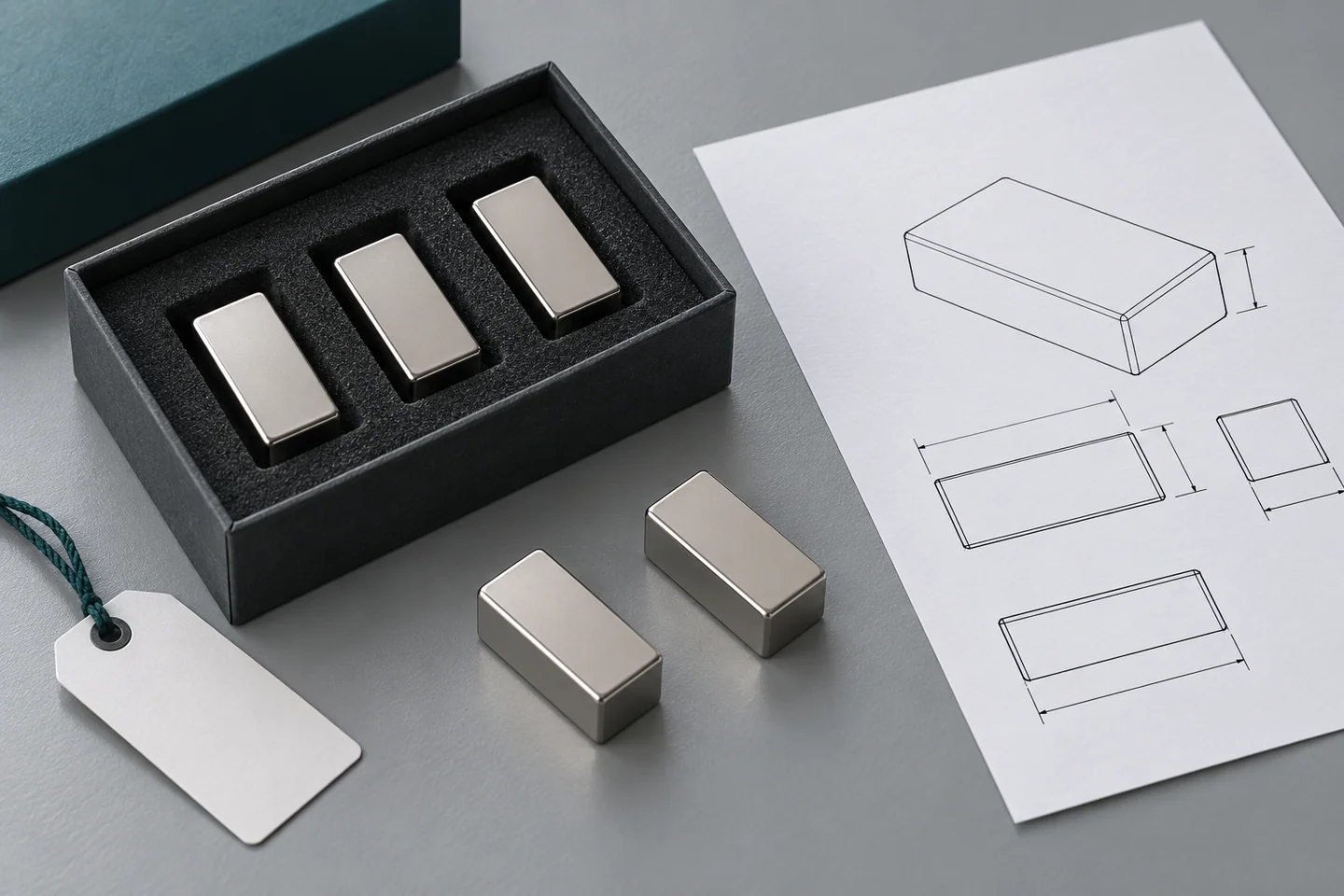
This purchase example is fictional, including the supplier reply and prices. Drawing Q-017 rev B requests a finished 20 × 10 × 3 mm sintered NdFeB N42 block, Ni-Cu-Ni coating and magnetization through the 3 mm thickness. The thickness tolerance is ±0.10 mm. The block will be used in a latch whose holding-force test conditions are still open. One candidate replies:
“We have reviewed drawing Q-017 rev B. We accept the stated material grade, coating and magnetization direction. For thickness, we propose ±0.15 mm instead of ±0.10 mm; this deviation needs your approval. Holding force remains open because the mating steel and installed gap have not been defined. Please provide those details so a test arrangement and acceptance limit can be agreed.”
The design owner must decide whether the wider thickness tolerance is acceptable. If it is not, the supplier needs to quote the specified tolerance or the offer leaves consideration. The buyer must also define the mating steel and installed gap so a force test and acceptance limit can be agreed. An unanswered requirement stays open until clarified.
Check document identity and scope. A quality-system certificate concerns an organization and its defined activities; a grade sheet gives material data; an inspection report records results for identified samples. Establish who performs the checks and who answers for the delivered part. K&J's description of manufacturing partners and its own inspections is one example of how those roles can be divided.[5]
For an undefined “powerful magnet,” use the pull-force guide to describe the assembly. Grade data and dimensional tolerances are separate fields in supplier specifications; neither replaces a test of your actual arrangement.[8]
Check compliance, then compare the complete cost
First decide whether each offer meets the part specification. Then compare the commercial scope of acceptable offers. Keep an approved alternative identifiable so its lower price is not mistaken for the price of the original part.
Step 2: compare the cost after clarifying the requirements
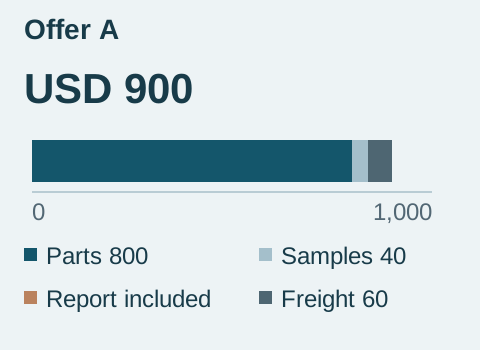
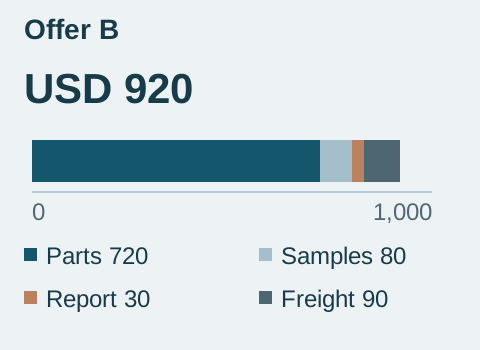
Continue with Q-017 rev B. Assume the buyer retains the original tolerance and now has two offers that accept it. The latch test conditions and acceptance limit have also been agreed and are included in both quotations. Each offer covers 1,000 production pieces plus 20 samples, the same inspection report and delivery to the same destination on the same terms. The following prices are illustrative, with taxes excluded from both totals.
| Item | Offer A (USD) | Offer B (USD) |
|---|---|---|
| 1,000 production pieces | 1,000 × 0.80 = 800 | 1,000 × 0.72 = 720 |
| 20 samples | 40 | 80 |
| Agreed inspection report | Included | 30 |
| Freight | 60 | 90 |
| Total of listed charges | 900 | 920 |
Compliant offers: identical part, different cost breakdown
1,000 production pieces
- Offer A (USD)
- 1,000 × 0.80 = 800
- Offer B (USD)
- 1,000 × 0.72 = 720
20 samples
- Offer A (USD)
- 40
- Offer B (USD)
- 80
Agreed inspection report
- Offer A (USD)
- Included
- Offer B (USD)
- 30
Freight
- Offer A (USD)
- 60
- Offer B (USD)
- 90
Total of listed charges
- Offer A (USD)
- 900
- Offer B (USD)
- 920
B saves USD 80 on production pieces but adds USD 100 more in the other listed charges. A is USD 20 lower for this purchase scope. Sample acceptance is still outstanding. For a repeat order without sample charges, request a fresh breakdown because the cost comparison has changed.
Check tooling, packaging and testing charges where applicable, plus payment terms, quotation validity and the event that starts lead time. “Four weeks” needs a start point, such as approved drawing, sample approval or payment. The quotation guide explains cost inputs; the bulk purchasing page covers quantity and packing requirements.
Approve what the sample actually demonstrates
Step 3 in the Q-017 purchase: confirm that the samples represent the quoted material, finished dimensions, coating and pole direction. Check the fit and run the agreed latch-force test. Record the results before approving production; the lower total cost alone cannot settle either check.
A stock sample of a nearby size can help explore a concept. A sample made to the production drawing can answer more specific fit questions. Ask the supplier to identify which material, dimensions, finish and magnetization match the intended order, and which differ. Osenc's sample policy illustrates this distinction between stock and requested specifications.[6]
Choose a check that answers the application question. For a latch, measure force with the intended gap and steel counterpart. A surface-gauss reading measures the field at a particular point; magnetic moment describes overall dipole strength. Neither is the same result as pull force in that assembly.[7]
Keep the accepted sample identifier, drawing revision, method and result together. For repeat supply, agree the lot identification, inspection records and changes requiring prior approval. Dexter's supplier manual provides an example of revision and change controls; the actual obligations belong in your own purchase agreement.[4]
Handle a mismatch without losing the evidence
Separate affected parts and record the lot, drawing revision, observed result and acceptance limit. Compare units and test conditions before concluding that reports conflict. Agree a disposition, such as replacement, further testing or an approved deviation. Keep that decision with the order; changing the drawing after the fact obscures what was originally accepted.
Agree investigation and return responsibilities before production. The supply and quality page helps identify relevant records without assuming that every order needs the same inspection package.
Manufacturer or trading company?
Either route needs a clear division of responsibility. Identify who reviews technical questions, places and controls the production order, checks the goods and handles a discrepancy. Compare the answers with the service your order requires. The business label alone does not establish those arrangements.
What you send and what the supplier should return
Buyer: describe the part and the need
Start with the information you have. If the grade, coating or test method is undecided, name the question and describe the application. The supplier's proposed answer can then be reviewed separately.
Buyer inquiry
Part reference / drawing revision / units, if available:
Known dimensions, material, coating and pole direction:
Application, mating part, gap and operating conditions:
Sample quantity / order quantity / expected repeat demand:
Delivery destination / required date / requested delivery terms:
Requirements still open / documents or tests requested:
Supplier: make the scope of the offer clear
- Identify the drawing or specification quoted, accepted requirements, proposed deviations and unresolved questions.
- State what the sample represents, including differences from production and the proposed acceptance checks.
- Separate part, sample, tooling, testing, packing and freight charges; identify exclusions and delivery terms.
- Give the lead-time start point, payment terms and quotation validity.
- Explain available lot records, change notification and the process for resolving a nonconforming delivery.
Compare those replies against the same buyer brief. Resolve deviations and missing information before selecting the offer and approving production.
Technical sources
Read each source with its stated material, test conditions and publication scope.
- Neodymium Disc MagnetsStandard-part catalogue: dimensions, grade, pack quantity and ordering controls.
- Custom Magnet & Assembly Design & EngineeringDrawing review, application inputs and manufacturability considerations.
- Custom Neodymium MagnetsInformation requested for a custom magnet quotation.
- Supplier Quality Manual (SQAR)Part revisions, conformity records, change control and nonconforming products.
- Our Commitment to Quality TestingHow one supplier separates manufacturing and incoming inspection responsibilities.
- Sampling Policy for Neodymium MagnetsSample descriptions and the limits of nearby stock samples.
- Magnetic Testing ServicesDifferent methods for measuring magnetic properties and finished-part performance.
- Neodymium Magnet Specifications & TolerancesMagnetic properties, dimensional tolerances and measurement conditions.