
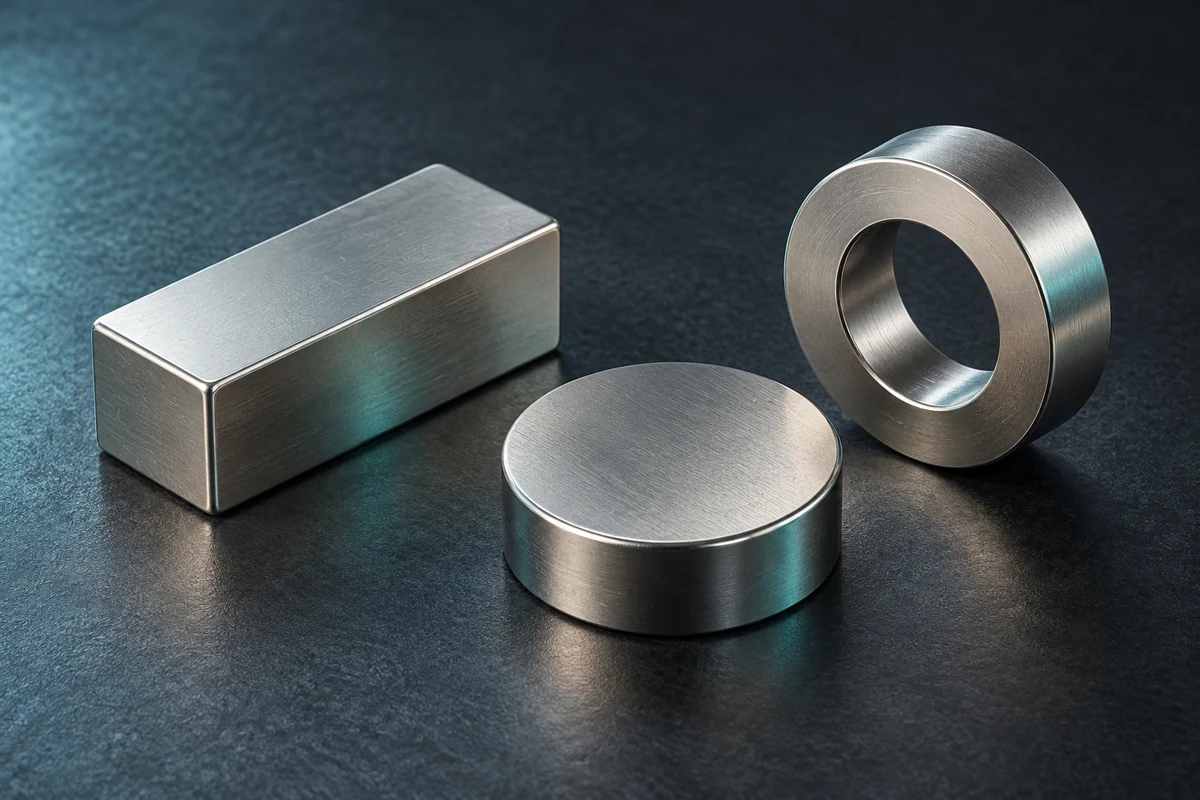
What sintered NdFeB means
Sintered neodymium–iron–boron is a rigid permanent-magnet material formed by a powder-metallurgy route. It is used where a compact magnet must provide substantial magnetic output. The material is hard and brittle, so a finished component needs suitable handling and support. Its metallic appearance does not identify its grade or magnetic direction.[1] [2]
In sintered material, powder is consolidated through sintering. Bonded NdFeB combines magnetic powder with a binder and follows a different forming route. A bonded ring and a plated sintered ring may fit a similar outline while having different magnetic, thermal and mechanical properties. Compare the sintered and bonded material systems before treating them as interchangeable.
- Already have a sintered-magnet drawing?
- Keep its material designation, revision and finished-part requirements together. This gives a supply inquiry a defined starting point.
- Still choosing the material?
- Start with the available space, required magnetic function, temperature and assembly. The highest grade number alone cannot resolve those choices.
From material processing to the finished part
A common route includes powder preparation, orientation and pressing, sintering and heat treatment, machining, and surface finishing. Processing establishes the material structure; subsequent operations bring the part toward its finished geometry and surface condition. The exact sequence depends on the material and product.[1]
- Prepare the powder. Establish the material composition.
- Orient and press. Relate the preferred direction to the component.
- Sinter and heat treat. Develop the material structure.
- Machine and finish. Work to the finished drawing and surface requirements.
- Magnetize and check. Apply the specified pole pattern and agreed acceptance checks.
Three details connect this background to a purchase specification: the preferred magnetic direction must match the part orientation; machining requirements must refer to the finished drawing; and any coating allowance must be included in the agreed finished dimensions. A process name supplies none of those values by itself.
Specify the finished magnet
Keep material data separate from the component drawing.[2] [3] A supplier's Br, HcB, HcJ and BHmax fields describe magnetic material properties under stated conditions. They do not specify the pull force or fit of every shape made from that material. Read the value type, units, reference temperature and document revision alongside the grade.[4] [5]
| Item | Include when known | When undecided |
|---|---|---|
| Geometry | Shape, dimensioned drawing, units, critical tolerances and revision. | Show the installation space and mating surfaces. |
| Material | Sintered NdFeB designation and the specified grade or supplier sheet. | Describe the magnetic function and operating conditions. |
| Poles | Magnetic axis, required pole face and any marking. | Show the orientation of the part in the assembly. |
| Surface | Coating and finished-part surface requirements. | Identify moisture, chemicals, adhesive contact or abrasion. |
| Acceptance | Dimension, magnetic or surface checks and their conditions. | Name the performance or fit that needs to be verified. |
Build a specification around the finished part
Geometry
- Include when known
- Shape, dimensioned drawing, units, critical tolerances and revision.
- When undecided
- Show the installation space and mating surfaces.
Material
- Include when known
- Sintered NdFeB designation and the specified grade or supplier sheet.
- When undecided
- Describe the magnetic function and operating conditions.
Poles
- Include when known
- Magnetic axis, required pole face and any marking.
- When undecided
- Show the orientation of the part in the assembly.
Surface
- Include when known
- Coating and finished-part surface requirements.
- When undecided
- Identify moisture, chemicals, adhesive contact or abrasion.
Acceptance
- Include when known
- Dimension, magnetic or surface checks and their conditions.
- When undecided
- Name the performance or fit that needs to be verified.
Use the datasheet reading guide to check material fields, the grade guide for designations, and the coating guide for surface-selection questions.
Discuss your sintered magnet
Nike Industrial Trading is your contact for the finished magnet. We bring the material requirement, drawing revision and quotation questions into one supply discussion. Share the details you have and leave unresolved choices as questions.
Product: sintered NdFeB magnet
Drawing number / revision / units:
Shape and finished dimensions:
Grade or magnetic performance requirement:
Magnetization axis / required pole face:
Coating and operating environment:
Operating temperature / thermal exposure:
Sample quantity / order quantity:
Required inspection or product documents:
Questions still to resolve:
A useful starting note could be: “Sintered block magnet to the attached drawing, revision B. Magnetic axis is marked. Coating is still open; the part is inside an enclosure with occasional condensation.” This describes the decision needed without guessing a grade or finish.
For drawings, email [email protected] or use WhatsApp. For a drawing-based requirement, include the revision; for price comparison or bulk purchasing, add quantities, destination and the quotation scope. Product availability, samples and commercial terms are confirmed for the specific inquiry.
Request a sintered magnet quoteRelated buyer guides
Explore this requirement
Technical sources
Read each source with its stated material, test conditions and publication scope.
- Cui et al. (2022), Manufacturing Processes for Permanent Magnets: Part I—Sintering and CastingJOM 74, 1279–1295. Manufacturing review; supplier-specific process capability is separate.
- Sintered Neodymium MagnetExternal supplier product page.
- Sintered NeodymiumExternal supplier product and sourcing page.
- NdFeB data sheetSupplier-specific material information; not an approved supply specification.
- Arnold NdFeB product and grade dataSupplier-specific material information; not an approved supply specification.