

Describe the exposure and the material
NdFeB is susceptible to corrosion. A protective finish limits exposure of the underlying material, but moisture, salts or other liquids can reach it through damaged areas or inadequate coverage. The coating and the environment must be evaluated as part of the finished component.[1] [4]
Record whether the part encounters condensation, splashes, immersion, salt, cleaning chemicals or changing temperature. Include handling and assembly contact that could damage the finish. A silver appearance does not prove the coating chemistry, its continuity or compatibility with a particular liquid.
If a part is already rusting, keep its identity, photographs and exposure history with the inspection record. A damaged or flaking magnet needs assessment against the assembly's acceptance requirements. Surface cleaning alone does not establish that its original protection or performance has been restored.
Example: rust appears around a mounting hole
A screw-mounted part sits in an enclosure that sometimes collects condensation. Rust first appears near the hole after assembly. Record that location, the screw-head fit, the support surface and any visible chips or finish marks before assigning a cause.
Compare the incoming inspection record with the installed part. Damage concentrated at the screw seat suggests a different investigation from widespread attack on otherwise intact surfaces. Review the coating specification, assembly procedure, actual moisture exposure and agreed acceptance requirements together. The location guides the investigation; a photograph alone cannot prove coating thickness, a root cause or remaining life.
Evaluate the coating as part of the finished part
“Nickel” or “epoxy” identifies a coating family, not a complete corrosion specification. The process, thickness, coverage at edges and holes, adhesion and mechanical damage all affect the protective system. Also account for finished dimensions and any bonding or contact requirement. The coating selection guide compares those choices in more detail.[1] [3] [4]
Published coating studies can show how a specific system behaved under a defined protocol. For example, the comparative study cited below used N38SH samples, multiple coatings and differing available geometries. Its results need those conditions retained. They do not produce a universal coating ranking for every shape or operating environment.[5]
- During receiving
- Check the agreed surfaces and edges for chips, cracks or finish damage using the specified inspection method.
- During assembly
- Consider screw contact, sliding, impact and adhesives. The protection has to remain appropriate after installation, not only before it.
- For a changed environment
- Revisit the exposure and verification requirements. A coating used successfully in a dry enclosure does not establish suitability for immersion.
Read the test method and the acceptance criteria
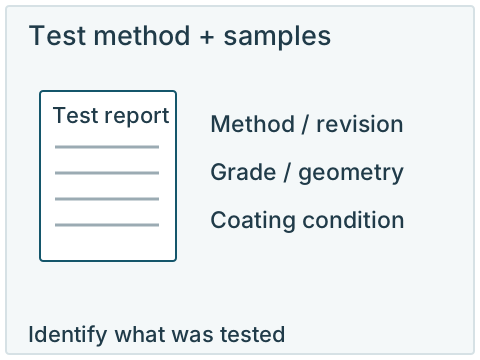
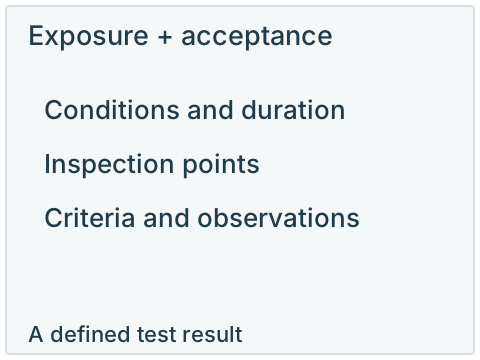
A useful corrosion report identifies the samples, coating condition, test method and revision, exposure conditions, duration, inspection points, acceptance criteria and observed results. “Salt spray passed” without that information leaves the result undefined.
Match the service exposure
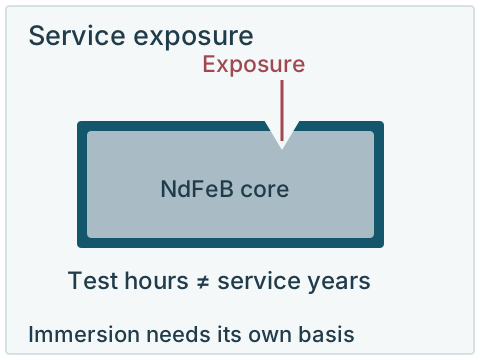
Salt-spray hours describe a test exposure. They do not establish years in service or suitability for immersion. Keep the report with its actual samples and conditions.
Open larger diagramThe public scope of ISO 9227:2022 describes salt-spray test methods and their limitations. It does not assign a product's exposure duration or acceptance criteria, and salt-spray testing does not directly predict long-term corrosion resistance in service. The full applicable procedure and product specification are needed for a compliance assessment.[2]
Bunting's published epoxy-coated magnet case records a particular sample group and protocol, including observations of rust and changes in mass and magnetic moment. Those observations belong to that experiment. They should not be converted into years of service for another magnet or coating.[3]
Does a coating make a magnet waterproof?
That claim needs a defined liquid, temperature, exposure duration and acceptance requirement for the actual finished part. Salt-spray performance does not by itself establish immersion suitability or a waterproof rating. Ask for the evidence matching the intended exposure.
Use the supply and quality checklist to identify the report and acceptance information you need. For a new drawing-based inquiry, include the environment with the geometry. The handling guide covers avoidable damage, and the lifespan guide separates corrosion from magnetic aging and system performance limits.
Related buyer guides
Technical sources
Read each source with its stated material, test conditions and publication scope.
- Neodymium Magnet Corrosion ResistanceTest results apply to the stated coating, sample and exposure conditions.
- ISO 9227:2022 Salt Spray TestsPublic scope of ISO 9227:2022; full test procedure and product acceptance criteria are separate.
- Salt Spray and Neodymium MagnetsTest results apply to the stated coating, sample and exposure conditions.
- Corrosion prevention of sintered Nd-Fe-B magnet by phosphate chemical conversionTest results apply to the stated coating, sample and exposure conditions.
- Comparative Evaluation of Anti-Corrosion Coatings for NdFeB-Type MagnetsTest results apply to the stated coating, sample and exposure conditions.