
Suspected magnet swallowing: seek urgent medical help
Get urgent medical help even if there are no symptoms. Tell the medical team that magnets may be involved. Keep loose magnets away from children and never put them in the mouth.[2]
Plan for the hazards before opening the package
| Risk | How it can arise | Preparation |
|---|---|---|
| Pinch or crushing injury | Sudden attraction to another magnet, tool or steel surface | Clear the work area, control movement and keep hands out of closing gaps |
| Flying fragments | Brittle parts collide or receive an impact | Prevent impact and use suitable eye protection and handling equipment |
| Ingestion | Loose magnets enter the mouth or become accessible to children | Keep them inaccessible; never use teeth to separate parts |
| Device interference | Strong fields interact with implanted or sensitive equipment | Follow device-specific guidance and control access |
| Dust and processing | Drilling, grinding or damaging the magnet produces particles | Leave processing to an appropriate professional process |
Different risks need different controls
Pinch or crushing injury
- How it can arise
- Sudden attraction to another magnet, tool or steel surface
- Preparation
- Clear the work area, control movement and keep hands out of closing gaps
Flying fragments
- How it can arise
- Brittle parts collide or receive an impact
- Preparation
- Prevent impact and use suitable eye protection and handling equipment
Ingestion
- How it can arise
- Loose magnets enter the mouth or become accessible to children
- Preparation
- Keep them inaccessible; never use teeth to separate parts
Device interference
- How it can arise
- Strong fields interact with implanted or sensitive equipment
- Preparation
- Follow device-specific guidance and control access
Dust and processing
- How it can arise
- Drilling, grinding or damaging the magnet produces particles
- Preparation
- Leave processing to an appropriate professional process
Magnet strength is not obvious from appearance. A small, shiny part may have significant attraction and a brittle interior. Manufacturer precautions cover the part, assembly and handling method together.[1] [5]
Treat ingestion and implanted-device interference seriously
If swallowing a magnet is suspected, obtain urgent medical help even when the person has no symptoms. Tell the medical team that magnets may be involved. Multiple magnets, or a magnet and another metal object, can attract through internal tissue. Keep loose magnets away from children and never put them in the mouth.[2]
People with pacemakers, defibrillators or other implanted medical devices should follow the device manufacturer’s and clinician’s guidance before entering a strong-magnet handling area. Arrange for another suitable person to handle the parts where necessary.
FDA’s guidance on certain consumer electronics confirms that magnets can change the operation of implanted devices. Its distance advice for phones and watches is not a universal safe distance for industrial magnets. The actual field, magnet arrangement and device must be considered.[3]
Receive and separate parts with a suitable method
- Identify the part, packaging instructions and personnel needed before unpacking.
- Clear loose ferrous objects and establish controlled positions for parts.
- Use appropriate protection and a fixture or separating equipment suited to the magnet size and force.
- Retain spacers until the next operation is ready; keep separated pieces under control.
- Quarantine chipped parts and fragments so they cannot enter assemblies unnoticed.
Do not rely on grip strength to control a large magnet or place fingers between attracting parts. A method suitable for a small disc may be unsuitable for a large block. Follow the supplier’s instructions for the actual packaged product rather than improvising leverage or prying against a brittle edge.[5]
Drilling and grinding can create combustible magnet dust, damage the coating and alter the part. Ask for the finished feature or an appropriate manufactured assembly instead of modifying a magnet with general workshop tools.[1]
Store for the next safe operation
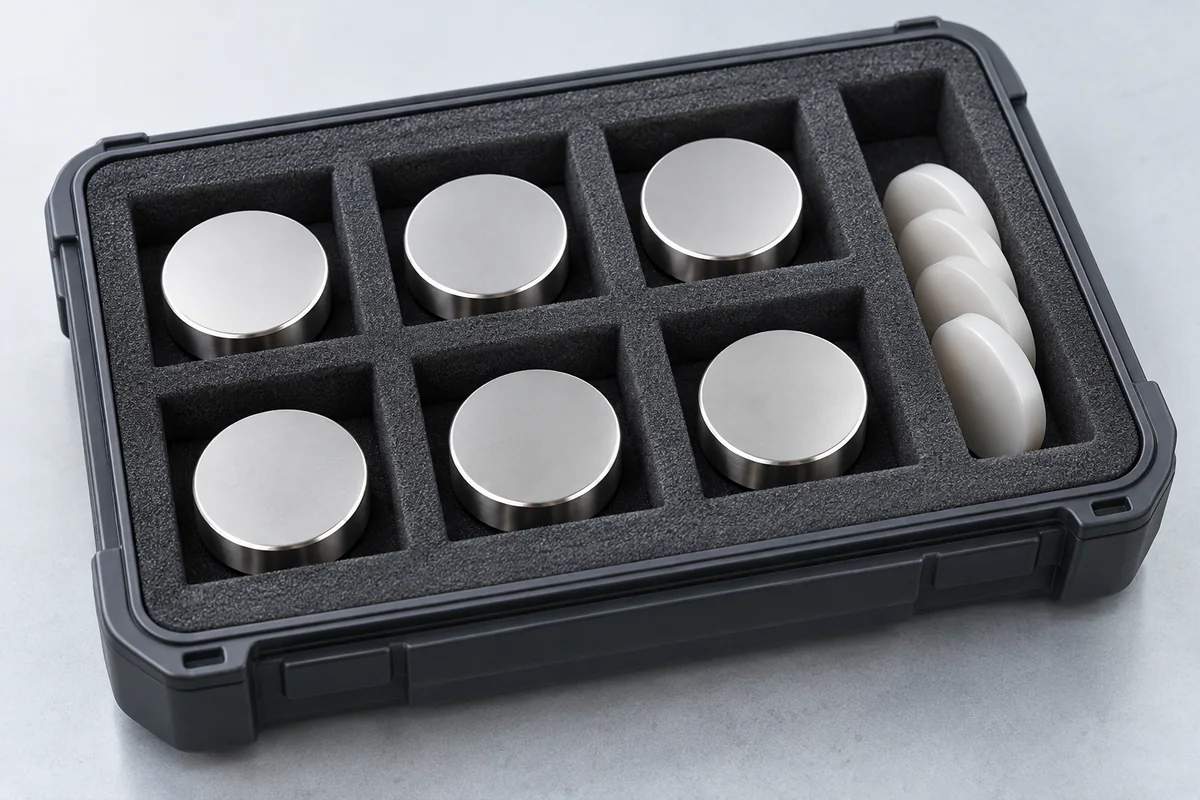
Keep the original appropriate spacers or packaging, protect against moisture and impact, and prevent uncontrolled attraction between stored parts. Use a clean storage system that limits ferrous debris. Provide enough controlled clearance for retrieval as well as static storage.[4]
Keep magnets away from magnetic recording media, sensitive instruments and areas where people with relevant medical devices could unknowingly approach. Storage temperature and environmental conditions must suit the actual material, coating and packaging.
Product use also matters. Consumer products and industrial components can fall under different requirements. CPSC’s guidance describes the ingestion hazard and its product scope; a general handling guide does not establish a finished product’s regulatory compliance.[6]
Include packaging, identification, assembly and handling needs in the inquiry. These are part of specifying a usable product, not details to resolve only after delivery.

Technical sources
Source material has its own scope and conditions. These references explain technical choices; they are not evidence of our stock, certifications or supplied products.
- TDK: NEOREC product guide: materials, measurement and precautions
- Health Canada: Magnet ingestion risks and immediate response
- US FDA: Magnets and implanted medical devices
- Dura Magnetics: Magnet handling and storage
- SM Magnetics / SuperMagnetMan: Product safety precautions
- US CPSC: Magnet-product hazard and scope FAQ