
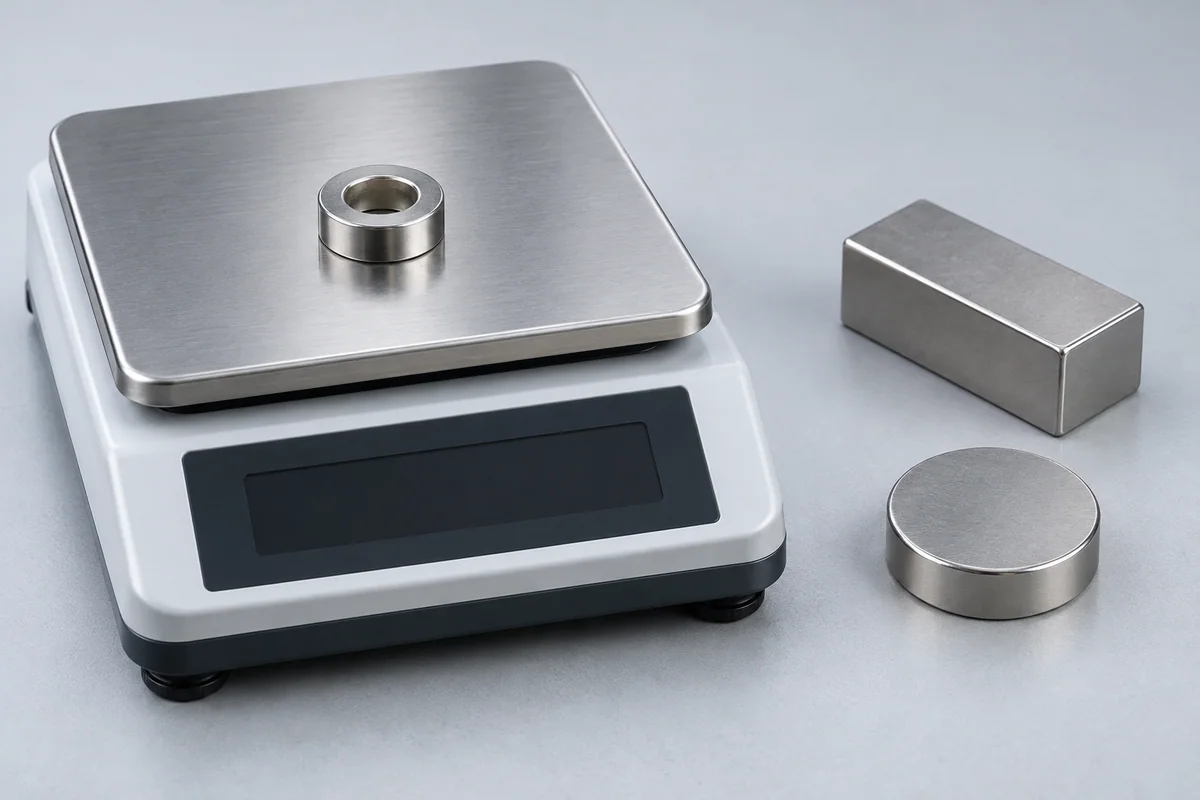
Use the density of the actual material
For preliminary calculations on a simple sintered NdFeB part, 7.5 g/cm³ is a useful stated assumption. It is not a universal acceptance value. K&J lists 7.4–7.5 g/cm³ for its sintered material reference, while other suppliers publish different typical ranges. Check the actual material sheet when the mass or fit is important.[1] [2]
Do not substitute the density of elemental neodymium. NdFeB is an alloy material system. Bonded magnets contain magnetic powder and a binder; the resulting density depends on formulation and forming. Magnequench’s MQ1-4 compression-bonded material lists 5.9–6.2 g/cm³, illustrating why the sintered assumption cannot be applied to every NdFeB product.[3]
Units can look deceptively similar. A density of 7.5 Mg/m³ equals 7.5 g/cm³ and 7,500 kg/m³. A supplier may also use lb/in³: multiply that value by approximately 27.6799 to obtain g/cm³. The unit must travel with the number.[4] [5]
Calculate a first mass estimate
Choose the geometric model that actually describes the solid material. For an arc, this calculator uses outer and inner radii, not diameters, and a constant axial length. It does not model a skewed segment, varying section or compound curvature.
Volume formulas with dimensions in millimetres
If V is in mm³ and density ρ is in g/cm³, divide the volume by 1,000 to convert it to cm³:
Mass in grams = V × ρ ÷ 1,000
| Shape | Volume V in mm³ | Dimension definitions |
|---|---|---|
| Block | L × W × t | Length, width, thickness |
| Disc / cylinder | π × D² × t ÷ 4 | Diameter and axial thickness |
| Ring / tube | π × (OD² − ID²) × t ÷ 4 | Outside and inside diameters, axial length |
| Arc segment | (θ ÷ 360) × π × (Rₒ² − Rᵢ²) × h | Angle in degrees, two radii and axial length |
Simple solid geometry
Block
- Volume V in mm³
- L × W × t
- Dimension definitions
- Length, width, thickness
Disc / cylinder
- Volume V in mm³
- π × D² × t ÷ 4
- Dimension definitions
- Diameter and axial thickness
Ring / tube
- Volume V in mm³
- π × (OD² − ID²) × t ÷ 4
- Dimension definitions
- Outside and inside diameters, axial length
Arc segment
- Volume V in mm³
- (θ ÷ 360) × π × (Rₒ² − Rᵢ²) × h
- Dimension definitions
- Angle in degrees, two radii and axial length
These are geometric derivations. Keep the units consistent before entering values. Treating a diameter as a radius makes the circular area four times too large.
| Illustrative dimensions | Volume | Estimated mass |
|---|---|---|
| Block 20 × 10 × 3 mm | 600 mm³ | 4.500 g |
| Disc D10 × 3 mm | 235.619 mm³ | 1.767 g |
| Ring OD20 × ID10 × 3 mm | 706.858 mm³ | 5.301 g |
| Arc Rₒ20, Rᵢ15, h10 mm, θ60° | 916.298 mm³ | 6.872 g |
Worked examples at an assumed 7.5 g/cm³
Block 20 × 10 × 3 mm
- Volume
- 600 mm³
- Estimated mass
- 4.500 g
Disc D10 × 3 mm
- Volume
- 235.619 mm³
- Estimated mass
- 1.767 g
Ring OD20 × ID10 × 3 mm
- Volume
- 706.858 mm³
- Estimated mass
- 5.301 g
Arc Rₒ20, Rᵢ15, h10 mm, θ60°
- Volume
- 916.298 mm³
- Estimated mass
- 6.872 g
The examples explain the calculation; they are not available-stock specifications or measured product weights.

Where the estimate stops being sufficient
Nominal dimensions omit dimensional variation and features such as chamfers, countersinks and extra holes. Coating adds material; a housing, adhesive or insert can change the assembly weight substantially. Do not use nominal part mass as package gross weight or a freight chargeable-weight calculation.
For a large production quantity, small per-piece differences accumulate. Use the agreed density or a measured sample mass where required, and separate the magnet, complete assembly and packaging in your records. A simple scale reading does not prove the magnetic grade.
Send the drawing, material route and whether the requirement is an estimate or a measured mass limit. Our inspection guide helps connect the part definition to an acceptance method.
Technical sources
Source material has its own scope and conditions. These references explain technical choices; they are not evidence of our stock, certifications or supplied products.
- K&J Magnetics: Neodymium material specifications
- Goudsmit Magnetics: NdFeB grade system and data sheets, August 2025
- Magnequench / Neo Performance Materials: MQ1-4 compression-bonded material data
- Alliance LLC: N33 material data and density units
- TDK: NEOREC product guide: materials, measurement and precautions