
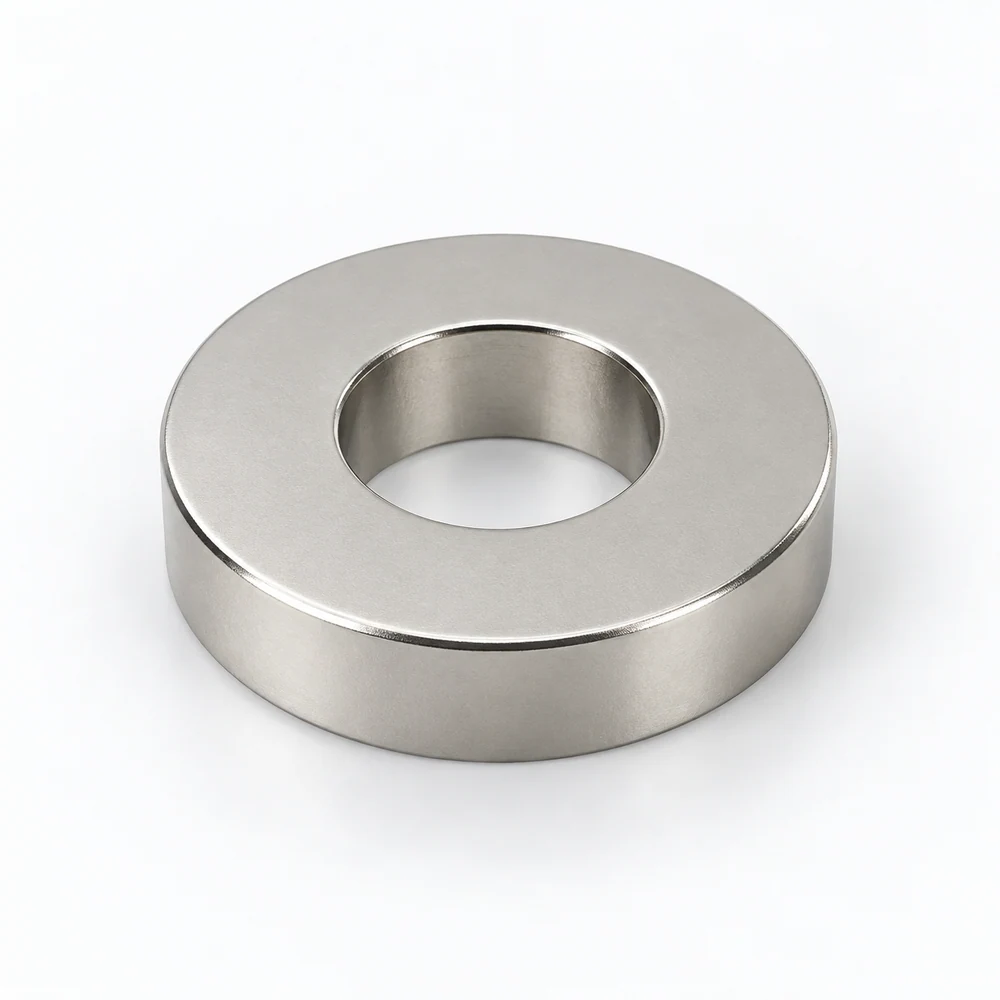
Specification at a glance
- Dimensions
- Outside diameter × bore diameter × axial thickness. See the drawing notation.
- Magnetic direction
- Axial, diametric or radial; distinguish multipole patterns. Compare the arrangements.
These are specification choices. Feasible dimensions, material options and availability are confirmed for the proposed part.
Specify both diameters and the axial length
A ring magnet has a central opening. Its basic geometry needs outside diameter OD, inside diameter ID and axial thickness t. A longer hollow part may be called a tube. Neither “ring” nor “tube” establishes a particular proportion, bore fit or magnetic direction.
Show finished OD and bore tolerances, axial seating faces and the reference axis. Use a section view for chamfers, counterbores or countersinks. Tie the required pole to a named face or angular reference.
OD20 × ID10 × 3 mm, axial magnetization illustrates an unambiguous basic description. It is not a listed stock size. Commercial ring tables keep OD, ID, thickness, material and plating separate; a single outside-diameter figure is insufficient.[1]
A central hole does not mean radial magnetization
| Direction | Pole regions | Information to add |
|---|---|---|
| Axial | Opposite flat annular ends | Required end polarity where assembly needs it |
| Diametric | Opposite sides around the cylindrical surface | Angular reference for the N/S axis |
| Radial | Inner and outer cylindrical surfaces | Inner/outer polarity and validated material, geometry and process |
Three different pole arrangements
Axial
- Pole regions
- Opposite flat annular ends
- Information to add
- Required end polarity where assembly needs it
Diametric
- Pole regions
- Opposite sides around the cylindrical surface
- Information to add
- Angular reference for the N/S axis
Radial
- Pole regions
- Inner and outer cylindrical surfaces
- Information to add
- Inner/outer polarity and validated material, geometry and process
Radially oriented rings can have grade, size-ratio and process constraints. A continuous radial ring, a multipole ring and an assembly made from individual arc segments are distinct designs. State which field pattern the application requires and let feasibility be checked against the actual drawing.[2] [3]
Treat the bore as a functional feature
A hole does not make NdFeB a conventional washer. Clamping pressure, a mismatched screw head, interference on a shaft or a sharp edge can load brittle material unevenly. Define how the ring is located and retained; a sleeve, housing or bonded interface may need review rather than tightening directly against an unsupported magnet.
Specify the finished bore and outside-diameter limits after coating. Show any mating part that controls alignment. If the application uses a sensor, include its position and the distance from the magnet. If a magnetic field is an acceptance requirement, define the probe position on the annular face or in space. The empty geometric centre is not the same measuring location as the surface centre of a solid disc.[4]
Temperature, moisture and chemistry also belong in the specification. Agree the relevant data sheet, surface treatment and measurement method for the product you intend to order.
One contact for the specification and quotation
Nike Industrial Trading handles the product and supply discussion. Use the proposal to bring the agreed specification, quantity, price basis and outstanding questions together. Before purchase, agree sample requirements, acceptance checks, packing and delivery terms for the actual part.
Download a ring specification record to keep the drawing revision and acceptance points together.
Blank project record. Actual supplier documents and inspection arrangements are confirmed for the order.
Request a ring magnet quote
Send OD × ID × axial length, magnetic direction and quantity. Include the shaft or housing fit, hole details and any critical operating conditions.
For samples, distinguish bore fit, pole position and the magnetic measurement you need.
Request a ring magnet quoteTechnical sources
Source material has its own scope and conditions. These references explain technical choices; they are not evidence of our stock, certifications or supplied products.