
Specification at a glance
- Dimensions
- Outer/inner radii × angle × axial length. See the drawing notation.
- Magnetic direction
- Parallel or radial orientation; identify poles within the set. Compare the arrangements.
These are specification choices. Feasible dimensions, material options and availability are confirmed for the proposed part.
Draw the arc, not just its width
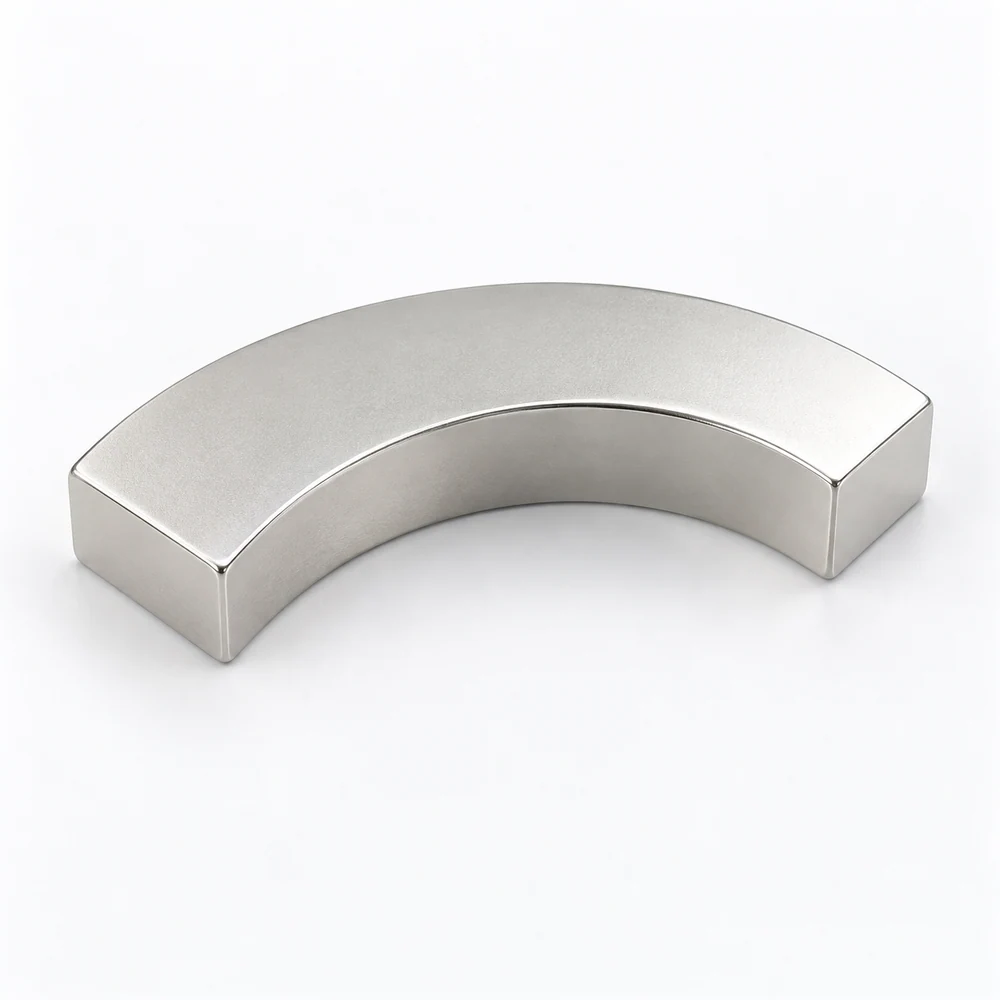
An arc magnet is a curved segment. A basic annular segment needs the outer radius Rₒ, inner radius Rᵢ, included angle θ and axial length h. Outer and inner diameters can be used instead, provided the drawing labels them clearly. A chord length, arc length and included angle are different quantities.
Define the common centre where applicable, included angle, end faces, segment gaps and any skew. Show finished profile tolerances, reference surfaces and N/S tied to an assembly view. Coating is part of the finished fit.
A real arc catalogue item can describe both diameters, thickness, angle and the outer-face polarity independently. Those fields cannot be recovered reliably from a product photograph.[1]
Separate the curved shape from the magnetic direction
“North on the outside face” identifies a pole requirement but does not, by itself, establish a truly radial material orientation. Common arc segments can have parallel orientation along a straight axis. Their magnetization vectors do not all converge at the ring centre; several such segments can approximate a radial arrangement.[2] [3]
Other designs require axial, tangential, multipole or special patterns. Show the desired direction and the angular reference on a drawing. TDK’s shape-and-direction examples distinguish segment geometry from magnetization codes and leave special dimensions to an individual delivery specification.[4]
For a complete rotor set, identify which pieces present N and S on the relevant surface, how many of each are required, and their installation sequence. Do not assume that a set of equal-looking pieces has interchangeable polarity.
Include the motor or coupling conditions
Room-temperature material grade is only one input. Supply the local magnet temperature range, possible opposing fields, rotational duty and the surrounding magnetic materials. Include the working gap, adhesive or sleeve arrangement and the mechanical retention of the segments.
A brittle arc segment needs support through handling and operation. The assembly must account for rotation, vibration and the consequences of a chipped or released part. Surface treatment, bonding and retention need to be evaluated together; a stronger magnetic grade cannot resolve a mechanical retention problem.[4]
Segmentation and special profiles can be discussed for motor designs, but their effect on losses, cogging or efficiency belongs to the actual electromagnetic and mechanical design. It is not a benefit that follows automatically from an arc-shaped magnet.[5]
One contact for the specification and quotation
Nike Industrial Trading handles the product and supply discussion. Use the proposal to bring the agreed specification, quantity, price basis and outstanding questions together. Before purchase, agree sample requirements, acceptance checks, packing and delivery terms for the actual part.
Download a arc specification record to keep the drawing revision and acceptance points together.
Blank project record. Actual supplier documents and inspection arrangements are confirmed for the order.
Request an arc magnet quote
Send the part and assembly drawing revisions, quantities and pole arrangement. State whether quantities mean individual segments, polarity pairs or complete sets.
Include the operating temperature, working gap and critical profile or magnetic acceptance requirements.
Request an arc magnet quoteTechnical sources
Source material has its own scope and conditions. These references explain technical choices; they are not evidence of our stock, certifications or supplied products.