
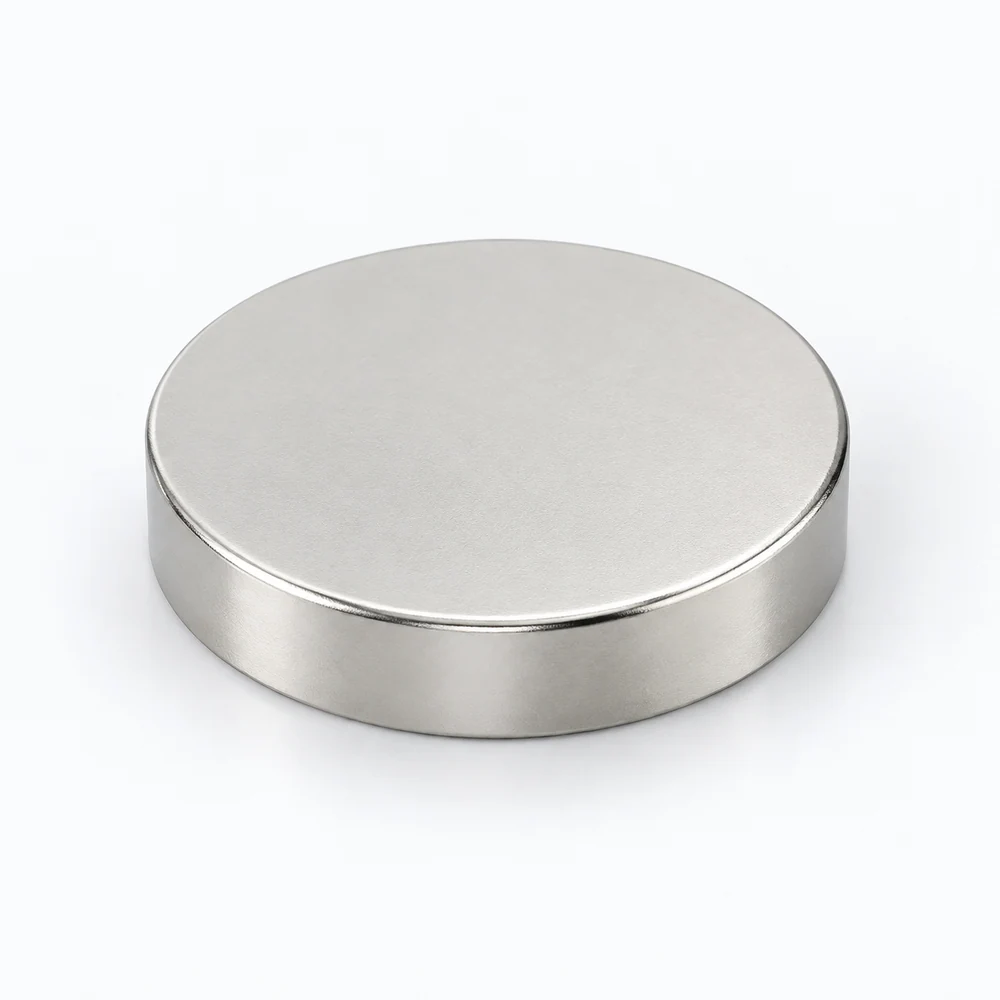
Specification at a glance
- Dimensions
- Diameter × axial thickness. See the drawing notation.
- Magnetic direction
- Axial or diametric; identify the assembly orientation. Compare the arrangements.
These are specification choices. Feasible dimensions, material options and availability are confirmed for the proposed part.
Diameter and thickness define a disc
Disc magnets are solid circular parts, usually described by outside diameter D and axial thickness t. A longer circular part may be called a cylinder or rod. The boundary between those names is not a dependable specification: write both dimensions and units. A central bore changes the geometry to a ring magnet; a countersunk fixing hole needs its own detailed drawing.
Specify the finished diameter and axial thickness, units, critical tolerances and edge treatment. A hole or countersink needs its own drawing details; the basic solid-disc description does not define those features.
A description such as Ø10 × 3 mm, axial magnetization is a geometry-and-direction example, not a stock offer. Adams’ disc tables show why diameter, thickness, grade, coating and magnetization must remain connected to the individual part.[1]
Axial and diametric are different parts
In an axially magnetized disc, the opposite poles are on the two flat ends. With diametric magnetization, the pole regions are on opposite curved sides. The parts can look identical. Their field at a sensor, attraction to a target and response when rotated can differ greatly.[2]
For a rotary sensor, send the sensor requirements, orientation and gap. Do not substitute an axial disc for a diametric disc because the diameter and grade match. For paired closures or mating parts, specify which face should present N or S and how the part is identified during assembly.
A magnetization arrow should be tied to the drawing rather than inferred from a photograph. Our direction guide explains the notation and the distinction between material orientation and the final magnetizing operation.
Allow for the finished surface and mounting
Set the diameter and thickness requirements on the finished, coated part. The fit may depend on the pocket, adhesive bond line, cover and other stack-up dimensions. Ask which dimensions are critical rather than applying the tightest tolerance everywhere. A supplier’s published general tolerance is not an agreement for a different product.[3]
Describe contact with moisture, chemicals or changing temperatures when discussing the surface. A metal coating does not make a brittle magnet a structural fastener. Avoid an interference fit or assembly impact unless the full design and method have been reviewed for that material and geometry.
For holding, show the target steel and the distance to it. Paint, a plastic cover or adhesive can add a magnetic gap. A vertical-wall application also needs a sliding test, since the contact friction is different from the normal pull-off condition.[4]
One contact for the specification and quotation
Nike Industrial Trading handles the product and supply discussion. Use the proposal to bring the agreed specification, quantity, price basis and outstanding questions together. Before purchase, agree sample requirements, acceptance checks, packing and delivery terms for the actual part.
Download a disc specification record to keep the drawing revision and acceptance points together.
Blank project record. Actual supplier documents and inspection arrangements are confirmed for the order.
Request a disc magnet quote
Send diameter × thickness, pole direction and quantity. Include the sensor or target position and working gap where they affect performance.
If the direction is undecided, describe the function rather than choosing a pole arrangement from the product image.
Request a disc magnet quoteTechnical sources
Source material has its own scope and conditions. These references explain technical choices; they are not evidence of our stock, certifications or supplied products.