
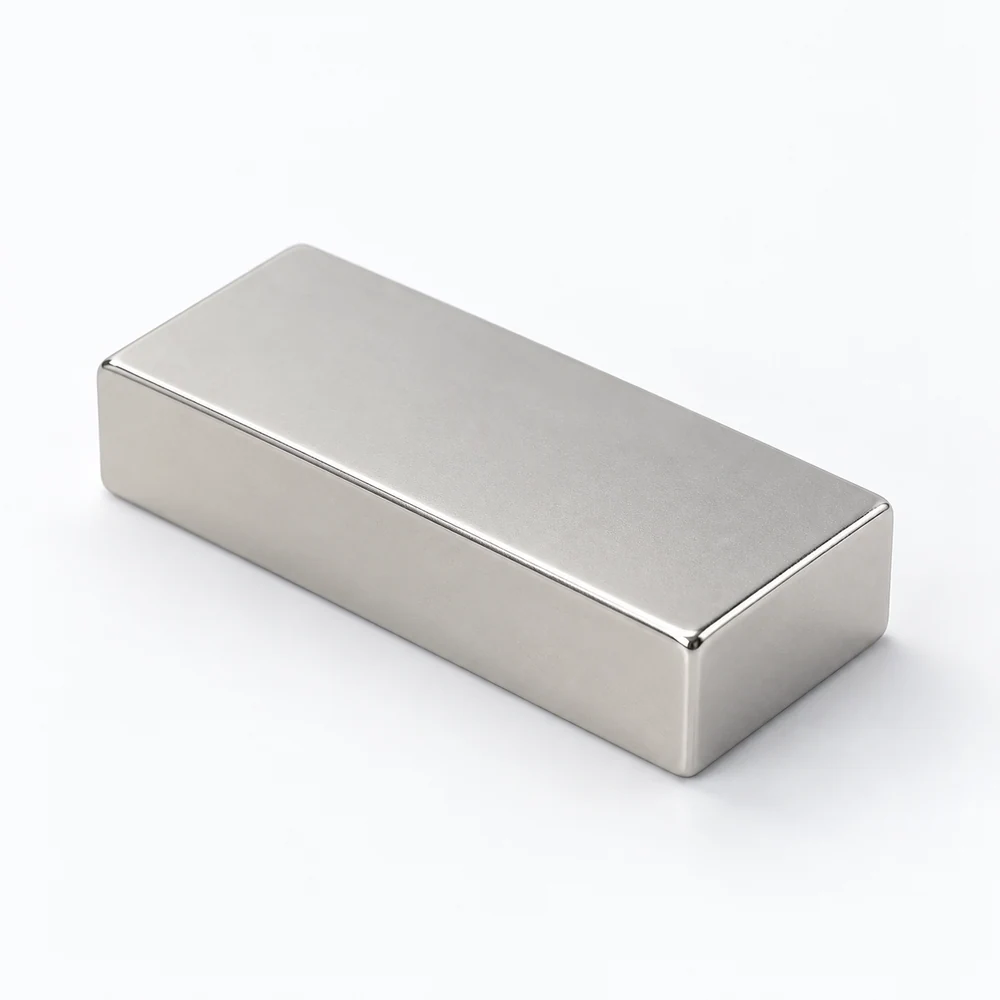
Specification at a glance
- Dimensions
- Length × width × thickness. See the drawing notation.
- Magnetic direction
- Thickness, width or length axis; identify the pole face. Compare the arrangements.
These are specification choices. Feasible dimensions, material options and availability are confirmed for the proposed part.
Define the block in three dimensions
A block magnet has a rectangular cross-section. A square has two equal side dimensions; a cube has three. A long bar and a thin plate may both appear in a block catalogue, but their proportions, mounting and magnetic behaviour can be very different. Use dimensions rather than a name such as “small”, “strong” or “flat”.
Label the three dimensions and units on the drawing. Show finished limits after coating, critical reference faces, chamfers, radii, holes or steps. Small or fragile features need feasibility review; mark the magnetic axis separately.
For example, a drawing might describe a 20 × 10 × 3 mm block, magnetized through the 3 mm dimension. This is an illustrative specification, not a listed stock item. Suppliers use different dimension conventions: Adams lists thickness, width and length explicitly, while other catalogues place the magnetic dimension last. A marked drawing avoids that translation problem.[1]
Match the poles to the assembly
A rectangular shape does not establish which faces carry the poles. Magnetization through the thickness, width or length produces a different field arrangement. For an anisotropic sintered magnet, the preferred axis is established during material processing; an existing part cannot simply be redirected to any axis by a different magnetizing pulse.[2]
If the magnet meets another magnet, identify the required pole on the mating face. If it operates near a sensor, include the sensor orientation and working distance. A higher grade does not correct an incorrectly oriented field. Use the magnetization drawing guide when specifying an axis or pole marking.
Check fit and performance separately
Define the pocket or fixture that retains the magnet. Show the installation clearance, adhesive space and any surfaces that must sit flush. Hard, brittle NdFeB should not be treated as a ductile steel insert: excessive interference, uneven support or uncontrolled impact can chip or crack it. Ask about the specific geometry before choosing an installation method.
Material grade and coating are separate choices. The material sheet describes magnetic properties; the coating changes the finished surface and its suitability for the environment. Supplier tolerances and coating thicknesses are reference data, so agree the required finished limits for the actual part.[3]
For a holding application, specify the steel, gap and direction of loading. A catalogue pull-force number obtained by pulling normally off thick steel does not establish how a block will hold on painted sheet metal or resist sliding. Those conditions need their own acceptance test.[4]
One contact for the specification and quotation
Nike Industrial Trading handles the product and supply discussion. Use the proposal to bring the agreed specification, quantity, price basis and outstanding questions together. Before purchase, agree sample requirements, acceptance checks, packing and delivery terms for the actual part.
Download a block specification record to keep the drawing revision and acceptance points together.
Blank project record. Actual supplier documents and inspection arrangements are confirmed for the order.
Request a block magnet quote
Send the drawing or L × W × t, magnetic axis and quantity. If the grade or finish is open, describe the fit, environment and holding or sensor requirement.
For a holding fixture, include target steel, air gap and load direction.
Request a block magnet quoteTechnical sources
Source material has its own scope and conditions. These references explain technical choices; they are not evidence of our stock, certifications or supplied products.