

Identify what the quoted kilogram represents
Raw-material inputs, alloy or magnet blanks, and finished coated magnets are different purchase objects. Their prices cannot be combined into a meaningful “NdFeB average” without a defined basis. A finished part includes the material and the work needed to meet its drawing, magnetic, surface and delivery requirements.[1] [4]
| Basis | What it refers to | What still needs definition |
|---|---|---|
| Raw-material input | A specified material or index at a stated date and market basis. | Conversion to a magnet, processing losses and the finished component. |
| Alloy or blank | A specified composition or magnet blank in an agreed condition. | Remaining machining, coating, magnetization and acceptance work. |
| Finished magnet | A component matching the agreed part specification. | Quantity, net-mass definition, packaging and commercial inclusions. |
Three price bases to keep separate
Raw-material input
- What it refers to
- A specified material or index at a stated date and market basis.
- What still needs definition
- Conversion to a magnet, processing losses and the finished component.
Alloy or blank
- What it refers to
- A specified composition or magnet blank in an agreed condition.
- What still needs definition
- Remaining machining, coating, magnetization and acceptance work.
Finished magnet
- What it refers to
- A component matching the agreed part specification.
- What still needs definition
- Quantity, net-mass definition, packaging and commercial inclusions.
The Alliance raw-material chart ends in 2019. It illustrates historical input-price movement; it cannot answer a current finished-magnet price request. A supplier's dated example or trend article likewise needs its date and product basis retained. Retail item prices also belong to a different quantity and service context from an industrial bulk quote.[2] [3] [4] [5]
For a current purchase, request a dated quotation matching your part and quantity. Historical price comparisons need records for the relevant period on the same basis.
Normalize the offers to the same weight basis
Before converting prices, identify the part and the definition of its mass. Small or intricate parts can contain more processing cost per kilogram than a simple blank; a finished-part kilogram price is therefore more than an alloy price.[1] [3] [4]
- Per piece versus per kilogram
- Obtain net mass per finished part. Use the same drawing revision, grade and finish in both offers before converting.
- Net part mass versus shipment weight
- Separate magnets from spacers, steel cups, cartons and pallets. For an assembly, state exactly which components the price and weight include.
- Part price versus delivered total
- Keep separately charged inspection, tooling or freight visible. Compare both the part rate and the total for the same order quantity.
Use the datasheet guide to align material identity. The quotation page covers the broader cost factors and a finished-part request; the bulk purchasing checklist covers quantity and repeat supply.
Convert per-piece and per-kg quotes on the same basis
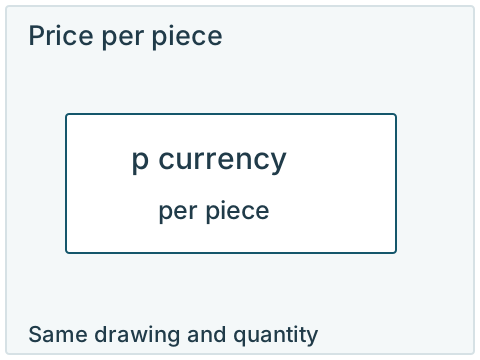
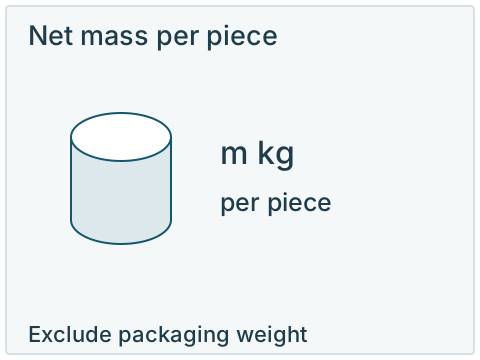
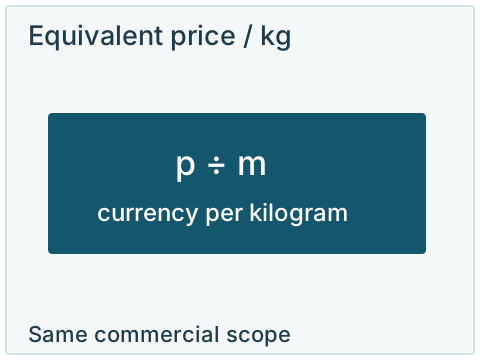
If the price per piece is p and the agreed net mass per piece is m kilograms, the equivalent price per kilogram is p ÷ m. Conversely, a per-kilogram rate r multiplied by m gives the corresponding material or part charge per piece on that same basis.
Equivalent price/kg = price/piece ÷ net kg/piece
Worked conversion with hypothetical numbers
Assume a finished magnet weighs 20 g net and an offer is USD 1.60 per piece for 1,000 identical pieces. These are teaching assumptions, not market prices or a quotation.
- Convert the mass: 20 g ÷ 1,000 = 0.020 kg per piece.
- Convert the unit price: USD 1.60 ÷ 0.020 kg = USD 80 per kg.
- Check the order: 1,000 pieces weigh 20 kg net and cost USD 1,600 before any separate charges.
If that same offer separately lists USD 100 freight, the delivered comparison total becomes USD 1,700, or USD 85 per net kg. It is still USD 80/kg for the parts plus a separately identified delivery cost. Keep the two figures labelled.
Using a 24 kg packed shipment instead would produce USD 66.67/kg from the parts price, but that denominator includes packaging. It would not be comparable with the USD 80/net kg figure. Both the arithmetic and the definition of weight matter.
Keep the denominator clear
Divide price per piece by net kilograms per piece. Identify freight separately. Changing the unit cannot make different parts or quotation scopes comparable.
Open larger diagramIf mass is recorded in grams, convert it first: m = grams per piece ÷ 1,000. The units then cancel as currency/piece divided by kg/piece. Do not use shipment weight including cartons, spacers or pallets as the part's net mass.
Keep separately charged work outside the conversion until you know whether it is included in both offers. For a full order comparison, use the total price for the same quantity and scope. The arithmetic changes the unit; it cannot correct a different specification or an unknown fee.
The magnet mass calculator can estimate simple solid geometry for an early check. Use the mass definition agreed in the quotation for the final comparison. Holes, recesses, chamfers, material density and assembly components can make a simple estimate differ from the quoted part.
Have a sintered magnet specification? Send the drawing, grade if known, quantity and destination to request a part-specific quotation discussion. No market average or current price list is implied by the formulas here.
Related buyer guides
Technical sources
Read each source with its stated material, test conditions and publication scope.
- NdFeB Magnet Pricing: Compare the Finished-Part QuotationDated examples explain quotation scope; they are not a current market price.
- Magnet Pricing and Raw MaterialsHistorical raw-material chart ending in 2019; not a current finished-part price.
- Neodymium Magnet Price TrendDated examples explain quotation scope; they are not a current market price.
- Neodymium magnet price per kgDated 2024 examples; not a current price list.
- The Cost of Neodymium Magnets: What Determines the PriceRetail pricing context; not an industrial price/kg benchmark.