
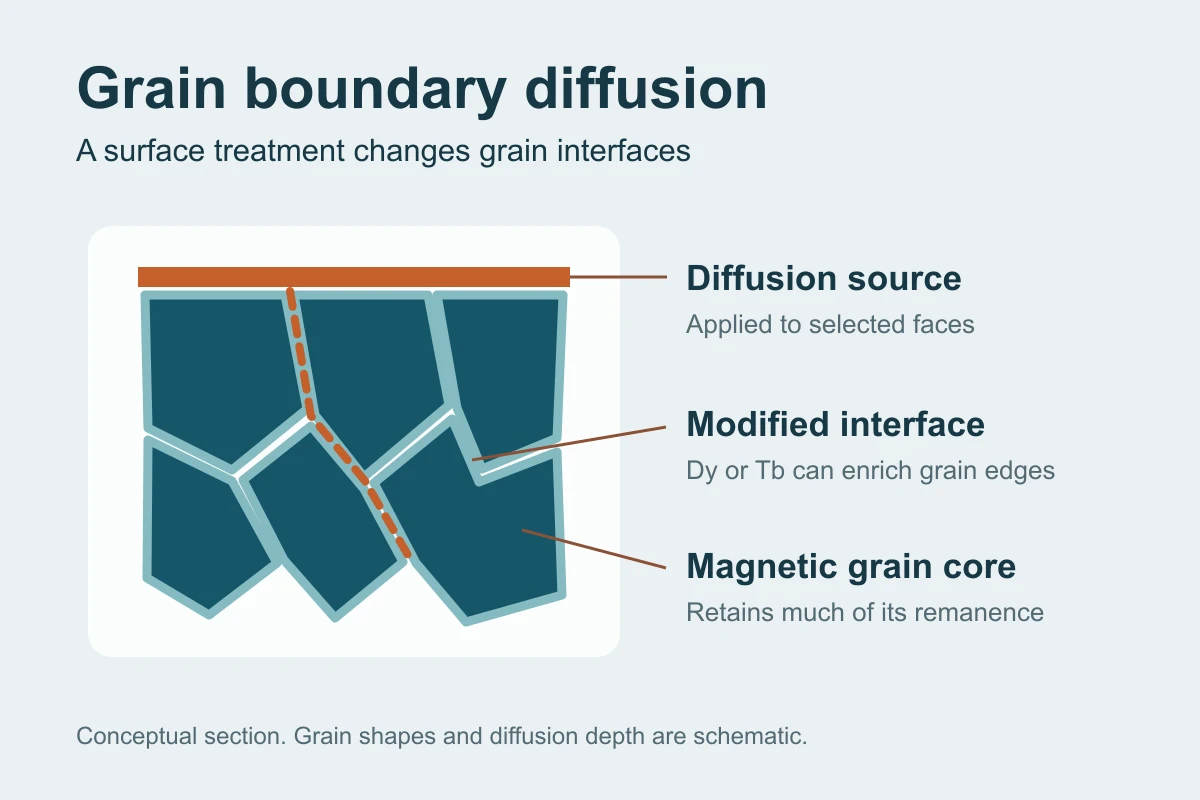
What grain boundary diffusion changes
Grain boundary diffusion (GBD) treats an already sintered NdFeB magnet. A diffusion source is applied to selected faces, then heat treatment carries material along grain boundaries. With a Dy- or Tb-bearing source, the outer region of some Nd2Fe14B grains can become enriched in the heavy rare earth. The modified grain surface is harder to reverse, so intrinsic coercivity HcJ can rise while much of the high-remanence grain core is retained.[1] [2]
This addresses a different problem from a protective coating. Diffusion modifies the magnet's internal microstructure. A specified coating still has to protect the finished part and meet its dimensions and bonding requirements.
Dy diffusion versus bulk alloying
Adding Dy throughout the alloy can raise coercivity, but replacing more Nd within the magnetic phase can reduce remanence. Surface diffusion concentrates the addition where it can improve resistance to reversal. The gain depends on the substrate, boundary continuity, diffusion source and heat treatment. Higher HcJ alone does not tell you whether the finished part retains enough flux or whether the knee is suitable at operating temperature.[1] [3]
| Design problem | Compare | Evidence to request |
|---|---|---|
| Need more resistance to reversal with little loss of remanence | A diffused candidate and a conventional grade with comparable hot coercivity | Hot B–H and J–H curves, minimum Br and the knee criterion for each candidate |
| Thick or irregular section | The intended treated faces and the longest distance from them | Validation on the proposed geometry, plus a representative core or centre check where justified |
| Reduce Dy or Tb use | Same magnetic duty and a defined mass basis | Declared composition or measured content for both materials. The label GBD gives no mass fraction. |
Choose the comparison by what your design needs
Need more resistance to reversal with little loss of remanence
- Compare
- A diffused candidate and a conventional grade with comparable hot coercivity
- Evidence to request
- Hot B–H and J–H curves, minimum Br and the knee criterion for each candidate
Thick or irregular section
- Compare
- The intended treated faces and the longest distance from them
- Evidence to request
- Validation on the proposed geometry, plus a representative core or centre check where justified
Reduce Dy or Tb use
- Compare
- Same magnetic duty and a defined mass basis
- Evidence to request
- Declared composition or measured content for both materials. The label GBD gives no mass fraction.
Shin-Etsu separates grain boundary diffusion grades in its reference table and flags size and shape effects. TDK's catalogue also lists diffusion and heavy-rare-earth-free grades for different magnetic duties. Compare grades against the same required output and hot margin before attributing a difference to their manufacturing routes.[4] [9]
Grain-boundary engineering can also start before sintering. In an Ames National Laboratory study, researchers blended PrAlCu powder with Dy-free NdFeB powder and obtained a coercivity gain with an energy-product tradeoff at higher additions. That route changes the starting mixture. A Dy diffusion treatment instead introduces material from the surface of a sintered magnet.[10]
One measured coercivity gain and its tradeoff
A published Tb2O3 diffusion experiment started with commercial sintered N-48 magnets measuring 30 × 30 × 7 mm. The table gives the authors' results at 300 K (about 27°C). The comparison applies to that material and treatment.[5]
| Quantity | Original | After GBD |
|---|---|---|
| Br (T) | 1.407 | 1.395 |
| HcJ (kA/m) | 1180.17 | 1685.13 |
| (BH)max (kJ/m³) | 351.48 | 347.98 |
In this experiment HcJ rose by about 43%, while Br fell by about 0.9%. In the same study, separate slices from the 7 mm block showed about 1816 kA/m near one treated surface and 1509 kA/m at the centre. The bulk comparison and the slice measurements answer different questions. A strong surface result does not establish the response throughout the magnet.[5]
Which dimensions and hot curves matter?
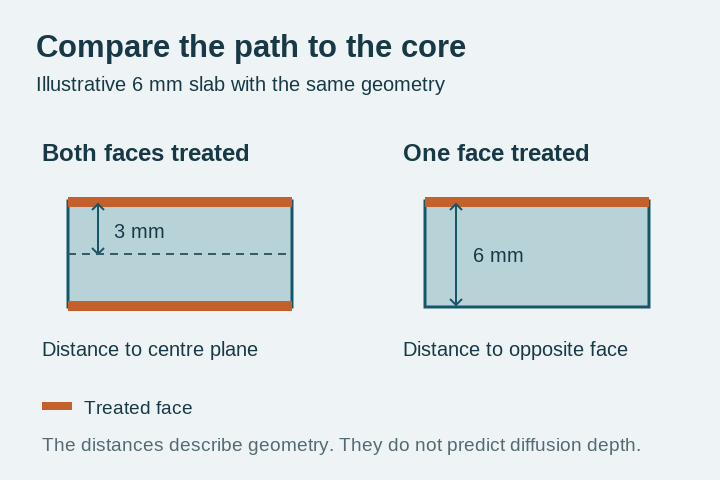
Measure the path from the treated face, rather than using the longest overall drawing dimension. For an ideal 6 mm slab treated on both broad faces, the centre is 3 mm from the nearer face. If treatment is applied to one face only, the opposite face is 6 mm away. These are geometric distances. They do not predict penetration or magnetic uniformity. Grain structure and diffusion conditions also matter, as shown by published microscopy and grain-size comparisons.[6] [7]
For a hot rotor, compare the candidate material curves at the estimated magnet temperature and the worst local reverse field. Set separate limits for output and irreversible loss. Ask whether the grade data came from the proposed finished thickness, a coupon, or a standard test piece. If machining after treatment removes material from a treated face, ask which condition the acceptance sample represents.[4] [8]
What to send for a diffusion-grade comparison
Start with the finished geometry and the duty the magnet must withstand. If a conventional magnet already meets the design margin, use its curve and cost as the baseline. If the issue is loss after a hot event, give that event and the acceptance test so the comparison can focus on the part that is failing.
If the hot curve or reverse field is unknown, send the drawing or old part description and explain when the loss appears, including any available temperature record. Mark the missing entries “unknown”. This gives a starting point for identifying the candidate material data and the operating information needed from the design team.
Part drawing, finished thickness and magnetization direction:
Operating magnet temperature and reverse-field condition:
Minimum Br, hot curve or knee criterion:
Allowed irreversible loss and test condition:
Current reference grade, finishing allowance and quantity:
Technical sources
Read each source with its stated material, test conditions and publication scope.
- TDK HAL process technical journal
- Uenohara et al., reduction grain boundary diffusion
- Dy–Al co-sorption study
- N-series grade and diffusion reference values
- Lu et al., gradient after Tb diffusion
- Itakura et al., Dy distribution by depth
- Guo et al., grain-size effect on Tb diffusion
- High-temperature motor application notes
- 2019 product survey, HAL and Dy-free grades
- Tang et al., boundary alloys in Dy-free sintered NdFeB