
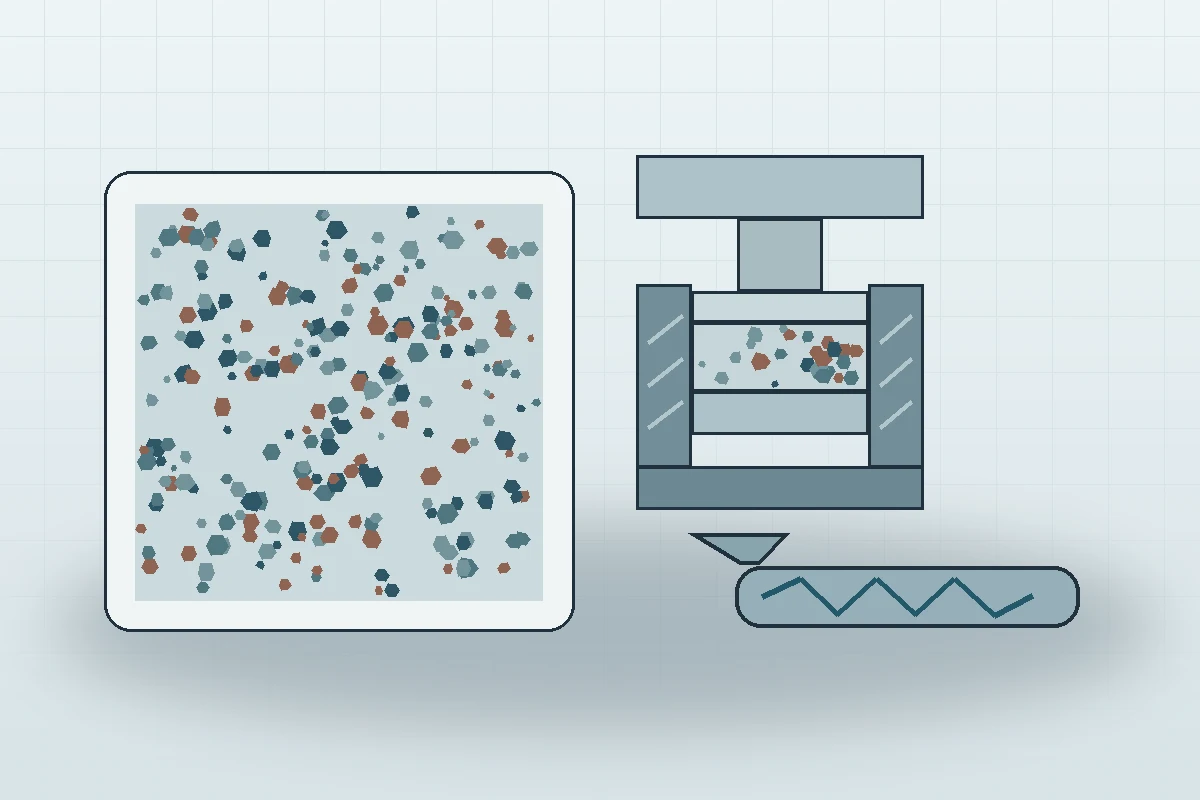
How the two bonded NdFeB routes make a finished part
Bonded NdFeB starts with magnetic powder mixed into a polymer that remains in the finished part. In a typical compression route, a press shapes the mix and a thermoset binder such as epoxy then cures. In a typical injection route, a thermoplastic compound flows into a mold, cools and is ejected. The manufacturer then applies and checks the specified pole pattern. [1] [2] [3]
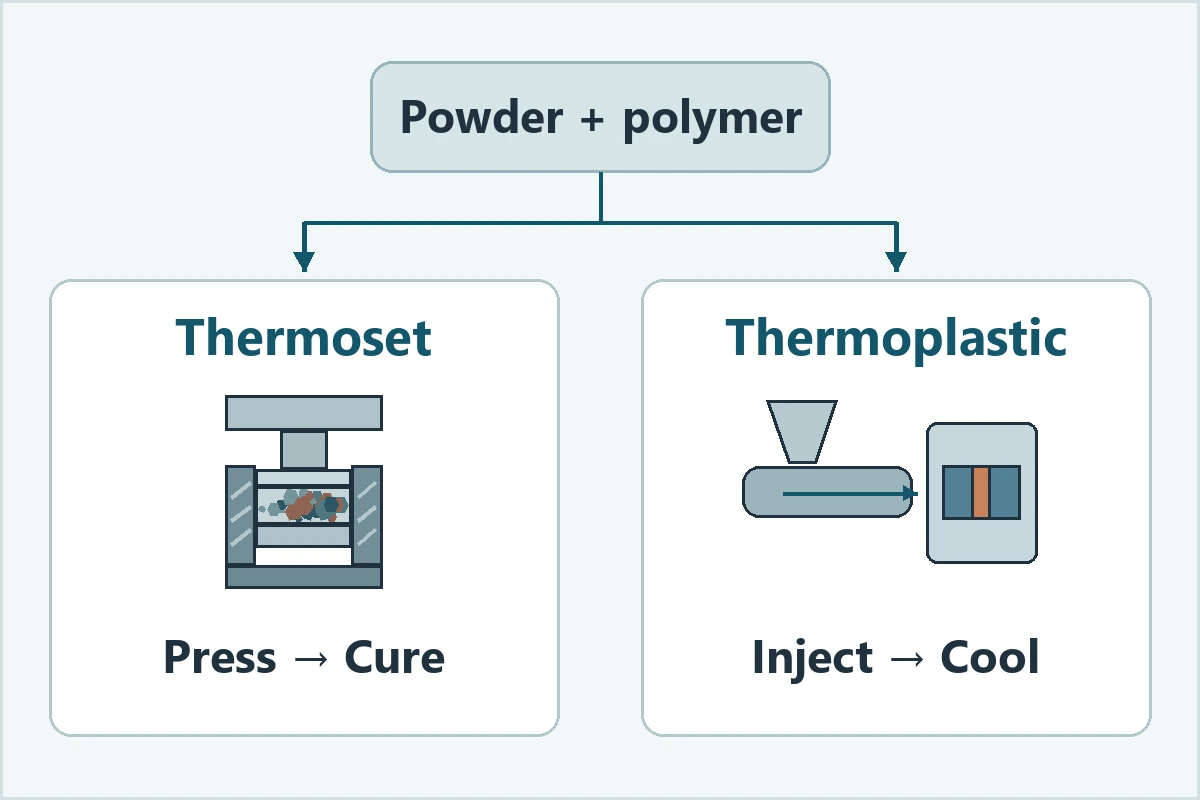
| Route | When to start with it | What to verify on the candidate |
|---|---|---|
| Thermoplastic injection molding | The drawing requires an insert or a molded feature that integrates the magnet with another part. | Confirm the binder and the retained insert, then check fit, the pole pattern and the field at the specified gap. [1] [3] |
| Thermoset compression molding | The shape can be pressed and ejected, and higher powder loading or finished density is a priority. | Check the actual powder fraction and density, the cured part’s magnetic properties, and handling or assembly limits for the geometry. [2] [4] |
Which bonded route to evaluate first
Thermoplastic injection molding
- When to start with it
- The drawing requires an insert or a molded feature that integrates the magnet with another part.
Thermoset compression molding
- When to start with it
- The shape can be pressed and ejected, and higher powder loading or finished density is a priority.
Magnequench illustrates its powder data using different preset volume loadings for compression, nylon injection and PPS injection. A change of binder or loading changes the basis of the comparison. In metal injection molding (MIM), the binder is removed before sintering, so a supplier calling a part “injection molded” should identify whether its finished magnet still contains polymer. Continue with the injection-molding process or compression-molding process for the individual routes. [4] [8]
How to read a bonded NdFeB test report
Trace the specimen to its grade, formulation and production lot. Record the powder, binder and test temperature, and check whether powder fraction is by mass or volume. Compare density with the specification for that formulation as a consistency check. Read Br, HcB, HcJ and (BH)max under the stated magnetic measurement method. A typical datasheet value is a starting point for sample selection. A purchase acceptance limit belongs on the approved drawing or test plan. [2] [5] [6] [7]
- Example material entry
- SG Technologies reports 6.6 g/cm³ and Br of 0.82 T for its Ultra-Dense-II compression-bonded grade. Newland also lists Br for its injection-molded grades. To compare the results, check both datasheets for the specimen, test method and temperature, and record any differences in powder and binder. [5] [6]
- Example environmental entry
- Lešić et al. used 120 ± 2 °C, 100% relative humidity and 2 bar for 96 h in a bulk corrosion test. They recorded magnetic moment before exposure, after exposure and after remagnetization. If the part must work after exposure without remagnetization, specify the permitted loss relative to the initial magnetic moment at that point. Record the post-remagnetization reading separately to show how much moment can be recovered. State which reading governs acceptance. [1]
For fit or field at an operating gap, add a finished-part check in the intended fixture. A material curve and a local field reading answer different questions. See bonded magnet protection for how to specify the environment or reading an NdFeB datasheet for the meanings of the magnetic fields.
Details to send for a bonded magnet inquiry
Part drawing, revision and any molded-in insert:
Preferred binder or material grade, if known:
Critical dimensions, orientation and pole pattern:
Field target, working gap and reference test temperature:
Exposure conditions, permitted loss, and acceptance reading (before or after remagnetization):
Required report, test method and sample quantity:
Technical sources
Read each source with its stated material, test conditions and publication scope.
- Lešić et al., corrosion of polymer-bonded magnetsSample preparation and bulk corrosion test. See Figure 7.
- Grujić et al., magnetic, mechanical and thermal properties of epoxy-bonded NdFeBSection 2, Table 1 and Data Availability. Some data reuse earlier research.
- Daido Electronics, isotropic bonded NdFeBProduction sections show compression and insert-molding options.
- Magnequench, bonded NdFeB powder and magnet comparison toolThe processing options use different preset filler volume fractions.
- SG Technologies, Ultra-Dense-II data sheetDensity and magnetic-property table on page 3.
- Newland Magnetics, injection-bonded NdFeB dataMagnetic-property and temperature columns for named materials.
- Vega Technik, bonded magnet grade tablesPublished properties are subject to the part’s shape and size.
- NdFeB feedstocks for metal injection moldingRoute context. Debinding and sintering are part of MIM.