
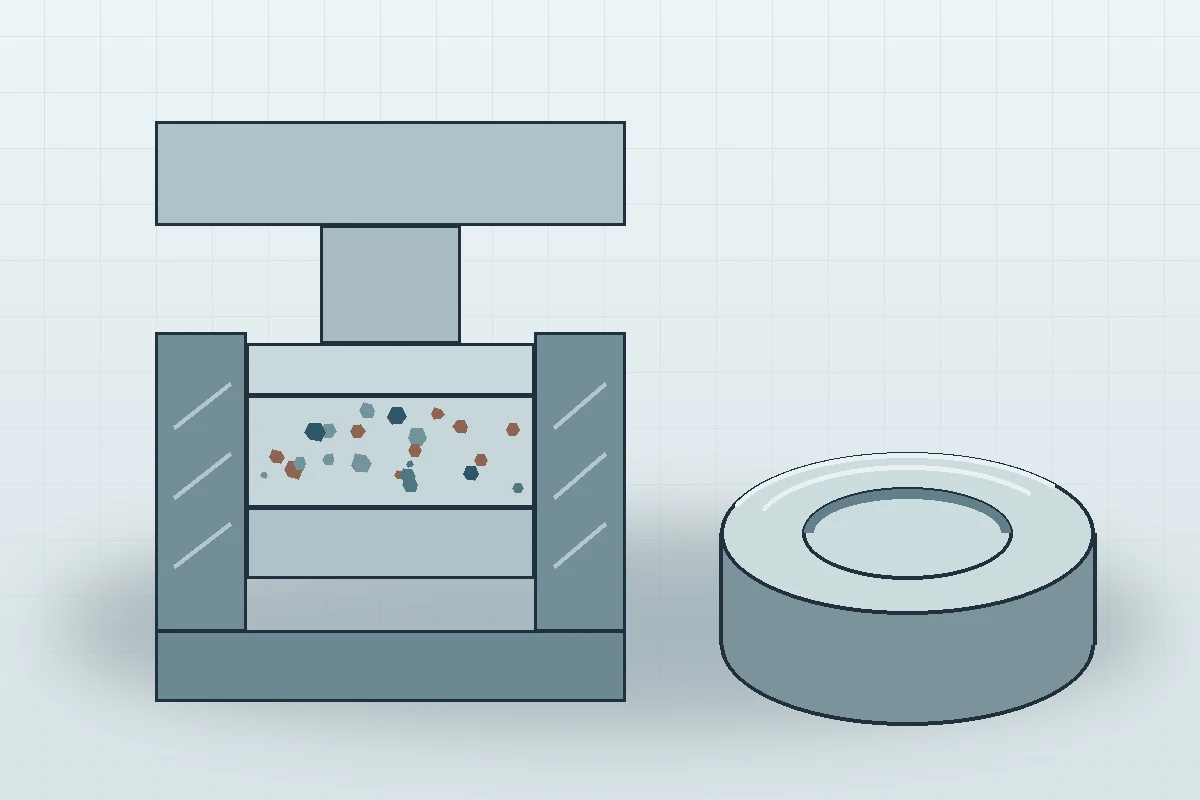
From a powder-and-resin mix to a compressed magnet
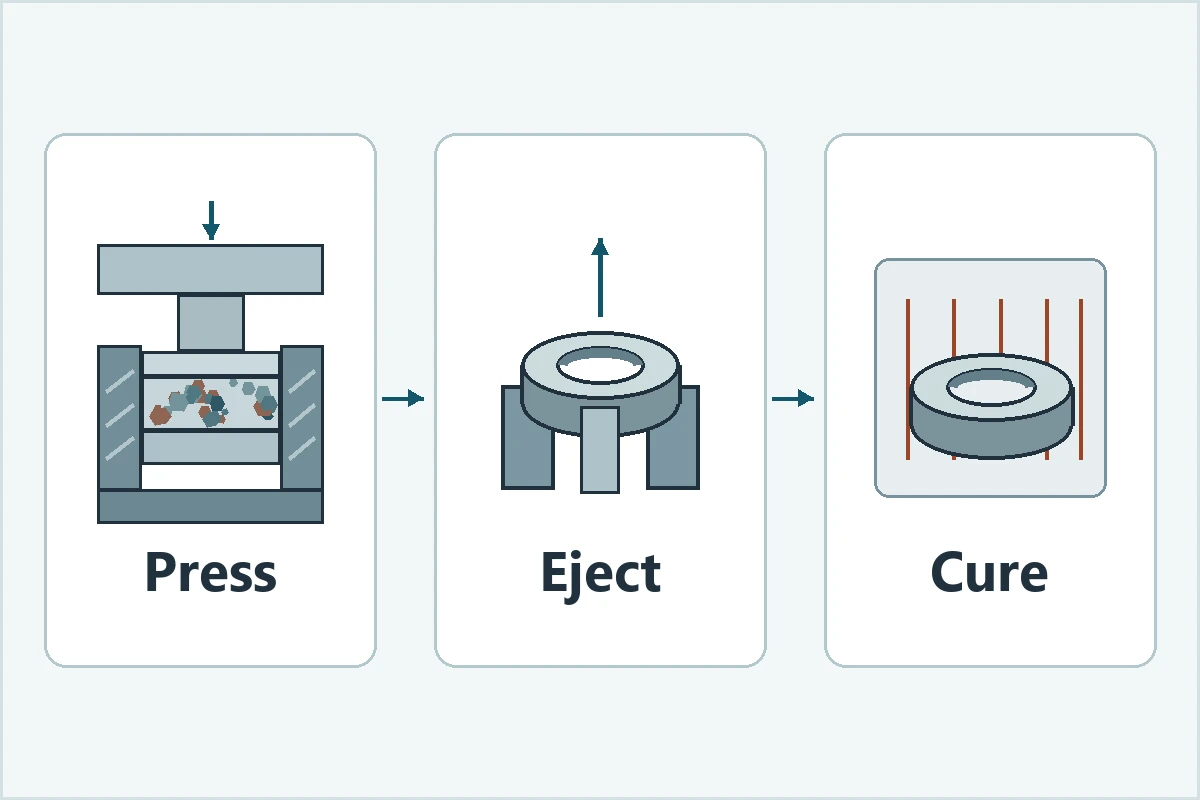
A compression-bonded NdFeB magnet is pressed from magnetic powder and a binder. In a typical epoxy system the press creates a green part, the part is removed from the mold, and the binder cures. Specify geometry for the cured part and separate dimensions critical to ejection from dimensions critical to assembly. For thin ring walls, agree the ejection direction and how to inspect damage during part qualification. [1] [2] [3]
Grujić and colleagues describe room-temperature epoxy specimens pressed at 4 MPa. Their 85 and 95 wt% NdFeB entries report Br of 0.44 and 0.64 T and (BH)max of 33.9 and 64.5 kJ/m³, respectively. Some magnetic data in that paper came from earlier work by the research group. This is a comparison within its test materials and a guide to which properties to measure on another formulation. [1] [2]
When comparing two finished grades, match the test temperature, orientation and measurement method. Keep mass percent and volume percent distinct when comparing powder loadings. [5] SG Technologies lists 6.6 g/cm³ and Br of 0.82 T for Ultra-Dense-II, a named commercial compression-bonded grade. [4]
For sample qualification, agree the fit test and acceptance criteria with the supplier. Once a thin ring meets the magnetic target, inspect the cured bore and edges for ejection damage. Trial the specified interference fit on the intended mating part and check the ring for cracking after assembly. For a fit calculation, the next section identifies the strain measurements to request.
How to verify Poisson’s ratio for a structural model
Poisson’s ratio relates transverse strain to axial strain under uniaxial stress in the proportional region. In a tensile test, measure both strain changes over the same interval and calculate ν = −Δεtransverse / Δεaxial. ASTM E132 covers room-temperature tensile tests on rectangular specimens when creep is negligible. Specify the loading and transverse measurement directions relative to the molding direction. [6]
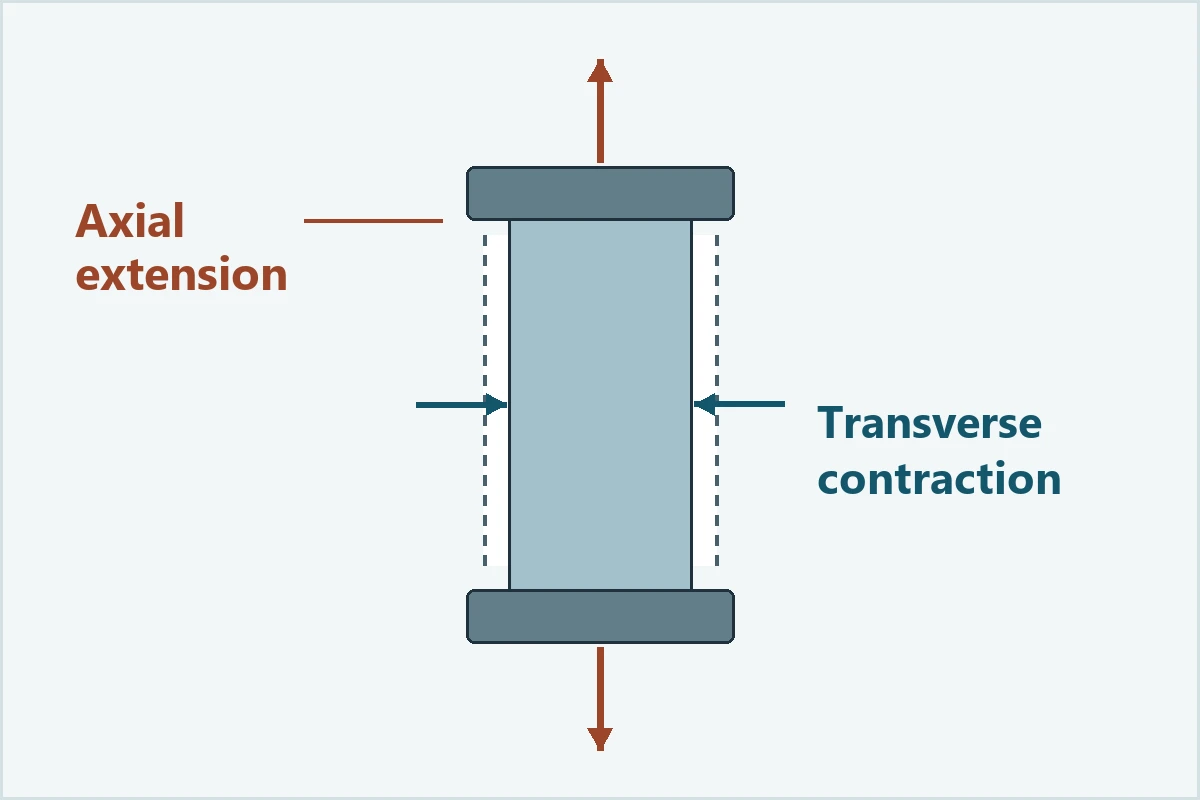
For a ring going into a press-fit assembly, ask for evidence on the cured composite with the same powder, binder, powder fraction, molding direction and thermal history as the part. Agree the temperature, specimen geometry, strain interval and any time dependence. For elevated temperature or compressive service, check how the material test and a separate part-level fit test represent the actual load and temperature. Keep the structural model provisional until those inputs are available. [1] [6]
The reported dynamic storage modulus describes the stiffness measured under a particular oscillatory test. The patent’s radial crush test concerns failure of a green ring before cure. Neither supplies the cured composite’s simultaneous axial and transverse strain, so a grade-specific Poisson’s ratio still needs a relevant measurement. The bonded NdFeB test report guide covers the separate magnetic and environmental evidence. [1] [3] [6]
Details to send with a compressed magnet inquiry
Finished drawing, revision and tolerance on the critical features:
Powder and binder if prescribed, or current grade and lot:
Press-fit geometry, load direction and operating temperature:
Required magnetic values, measurement method and temperature:
Required mechanical properties and test conditions:
Sample quantity and screening or acceptance requirements:
Technical sources
Read each source with its stated material, test conditions and publication scope.
- Grujić et al., dynamic mechanical behavior of polymer-bonded NdFeBRoom-temperature preparation, tensile, flexural and DMA methods.
- Grujić et al., magnetic, mechanical and thermal properties of epoxy-bonded NdFeBSection 2, Table 1 and Data Availability. Some data reuse earlier research.
- US20140043125A1, rare-earth bonded magnet compactionExamples distinguish the green ring’s radial crush test from cured-part properties.
- SG Technologies, Ultra-Dense-II data sheetDensity and magnetic-property table on page 3.
- Magnequench, bonded NdFeB powder and magnet comparison toolThe processing options use different preset filler volume fractions.
- ASTM E132-17(2025)e1, Poisson’s ratio at room temperaturePublic scope and significance. Applies to tensile testing of rectangular specimens under stated conditions.