
Start with the bonded magnet substrate
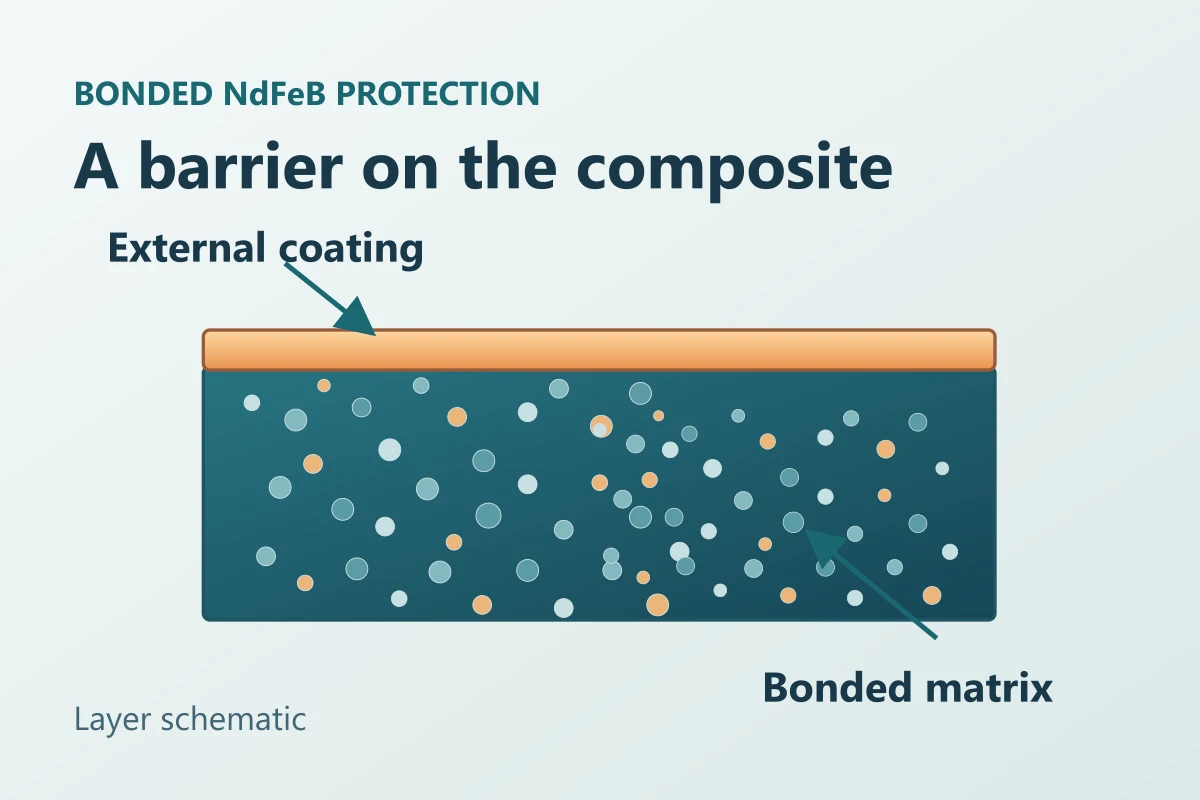
Choose a finish for the exact combination of magnetic powder, polymer, forming route and surface condition. The polymer binder holds NdFeB particles together, but exposed particles, pores and damaged areas can still admit moisture. The coating is a separate barrier added to that composite. For a clean, dry enclosure, compare an uncoated sample first. For condensation, salt or fluid exposure, test the selected protection on the production surface and the actual assembly.[1] [2] [3]
Compression-bonded epoxy and injection-molded PA12 or PPS are distinct substrates. A molded resin-rich surface can reduce exposure, while trimming the gate or machining an edge can change that surface. Toda's compound brochure shows a molded specimen with visible rust at the gate after a specific tap-water immersion test. That example makes the gate a useful inspection location and gives no guarantee for another formulation.[4] [5]
Which finishes are worth evaluating?
| Candidate | Reason to evaluate it | What would decide the choice |
|---|---|---|
| Sprayed organic coating | Consider for modest exposure where a compatible low-build film fits the part. | Coverage at edges, inner diameter and gate, plus adhesion after cure and exposure. |
| Electrophoretic coating | Consider where an established process for the substrate can provide even coverage. | Preparation, electrical contact, contact marks, cure and adhesion on the specific compound. |
| Parylene film | Consider a thin conformal barrier where coverage and clearance matter. | Substrate preparation, adhesion, masked interfaces and continuity after handling. |
| Metallic plating | Evaluate if the design specifically needs a metallic surface and the coater supports that composite. | Proof of a compatible preparation and coating stack. Verify adhesion and corrosion on the proposed surface. |
| Encapsulation or housing | Consider where part geometry or severity of exposure favors protecting the assembly. | Seams, feedthroughs, trapped moisture and the gap added between magnet and sensor or working surface. |
Match the protection concept to the actual surface and duty
Sprayed organic coating
- Reason to evaluate it
- Consider for modest exposure where a compatible low-build film fits the part.
- What would decide the choice
- Coverage at edges, inner diameter and gate, plus adhesion after cure and exposure.
Electrophoretic coating
- Reason to evaluate it
- Consider where an established process for the substrate can provide even coverage.
- What would decide the choice
- Preparation, electrical contact, contact marks, cure and adhesion on the specific compound.
Parylene film
- Reason to evaluate it
- Consider a thin conformal barrier where coverage and clearance matter.
- What would decide the choice
- Substrate preparation, adhesion, masked interfaces and continuity after handling.
Metallic plating
- Reason to evaluate it
- Evaluate if the design specifically needs a metallic surface and the coater supports that composite.
- What would decide the choice
- Proof of a compatible preparation and coating stack. Verify adhesion and corrosion on the proposed surface.
Encapsulation or housing
- Reason to evaluate it
- Consider where part geometry or severity of exposure favors protecting the assembly.
- What would decide the choice
- Seams, feedthroughs, trapped moisture and the gap added between magnet and sensor or working surface.
A nickel coating specified for sintered NdFeB cannot be carried over by name alone. Magnequench reports that nickel is uncommon for its MQ1 bonded Neo system because adhesion is less favorable. The supplier table lists other finishes for that system. Use those as candidates and have the coater substantiate preparation, thickness, adhesion and exposure performance for the exact composite in your drawing.[2] [3]
Read a coating result with its test conditions
In Magnequench’s MQ1 supplier table, approximately 20 μm e-coat is listed at about 100 hours in its salt spray column and about 10 hours in its pressure cooker test (PCT) column. Approximately 20 μm nickel is listed at about 30 hours and 120 hours respectively. The supplier lists 35 °C and 5% NaCl for salt spray, and 120 °C, 95% RH and 2 atm for PCT. The ranking changes between the two tests. Compare finishes on the exposure and endpoint relevant to the part.[2]
These are supplier examples for MQ1, with different processes at similar nominal thickness, and the table does not give a field life conversion. ASTM B117 describes a controlled exposure and cautions that stand-alone salt spray results seldom correlate with performance in natural environments. ISO 9227 also separates salt spray procedure from the product-specific exposure duration and interpretation. Agree on the method, sample orientation, duration, defect criteria and post-exposure magnetic check for your part.[6] [7]
Magnetic performance is a separate acceptance endpoint. A 2026 laboratory study of polymer-bonded NdFeB and Sm–Fe–N magnets reported that corrosion-exposed specimens did not fully recover their original magnetic moment after remagnetization. A Birmingham thesis also measured coercivity during humidity exposure and documented that an added surface layer did not always improve the outcome for its particular coating and binder combinations.[1] [8]
Budget the finish in the bore and working gap
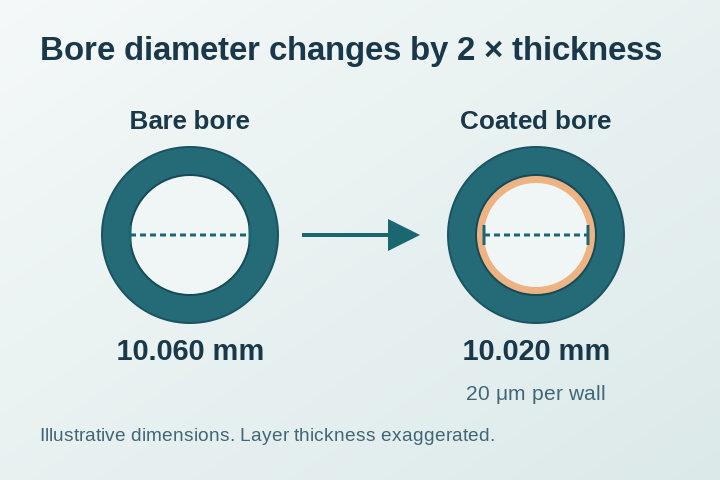
Take a teaching example with a 10.060 mm bare bore around a 10.000 mm shaft. If the bore receives a uniform 20 μm layer, the bore becomes 10.060 − 2 × 0.020 = 10.020 mm. Nominal diametral clearance falls from 0.060 to 0.020 mm before tolerances. If the bore is masked, the calculation changes, and the uncoated surface must be included in the exposure review.
Likewise, a nonmagnetic surface layer adds separation from a sensor if the mount keeps the same underlying geometry. Establish the finished fit and read the field at the installed working gap. For an adhesive joint, test adhesion through the coating and after cure. Follow the finished dimension and inspection guide and specify the agreed measurement points.
Verify the compound, coating and assembly together
- Match the part surface. Compare production-equivalent parts, including the gate, cut edges and inner diameter. Keep a bare control where it helps identify the coating contribution.
- Apply the assembly sequence. Inspect for damage from pressing, handling or bonding. Check the cure exposure against the full magnet system, including magnetic powder and binder.[5] [9]
- Expose and measure. Select an exposure that matches the duty you need to investigate, such as humidity, immersion in the actual fluid, or a specified chamber test. Record visual damage, adhesion, fit and magnetic performance on the same measurement basis before and after.
A surface treatment on the powder can improve interaction with the binder. A coating on the finished part addresses its exposed surface. Damnjanović and colleagues examined chemically treated powder molded into PA12 specimens. Some durability results improved, while both the pretreated and untreated batches exceeded the study’s 5% flux-loss limit in corrosive water. Test the finished assembly under the intended exposure before setting acceptance limits.[10]
Start a bonded magnet coating enquiry
Describe the exposure and the surface that matters, even if the finish is open. If you already have a coated sample, include the substrate and coating data you can identify and say where it failed or lost fit.
Magnet route, compound and binder, if known:
Part drawing and protected or masked surfaces:
Fluid, salt, humidity, temperature and exposure sequence:
Critical fit, sensor gap and adhesive/cure conditions:
Coating description and evidence, if already specified:
Test method, defect criteria and magnetic acceptance check:
Sample or production quantity:
Technical sources
Read each source with its stated material, test conditions and publication scope.
- Corrosion of injection- and compression-moulded bonded magnets
- Magnet coatings for MQ1 bonded Neo
- Magnetic coatings
- FEROTOP magnetic compounds: corrosion resistance
- Plastic-bonded injection-molded NdFeB magnets
- ASTM B117-26 salt spray apparatus practice
- ISO 9227:2022 salt spray tests
- McCain: aqueous corrosion of MQI bonded magnets
- Injection molded magnet capabilities
- Surface treatment of NdFeB powder for PA12 bonded magnets