
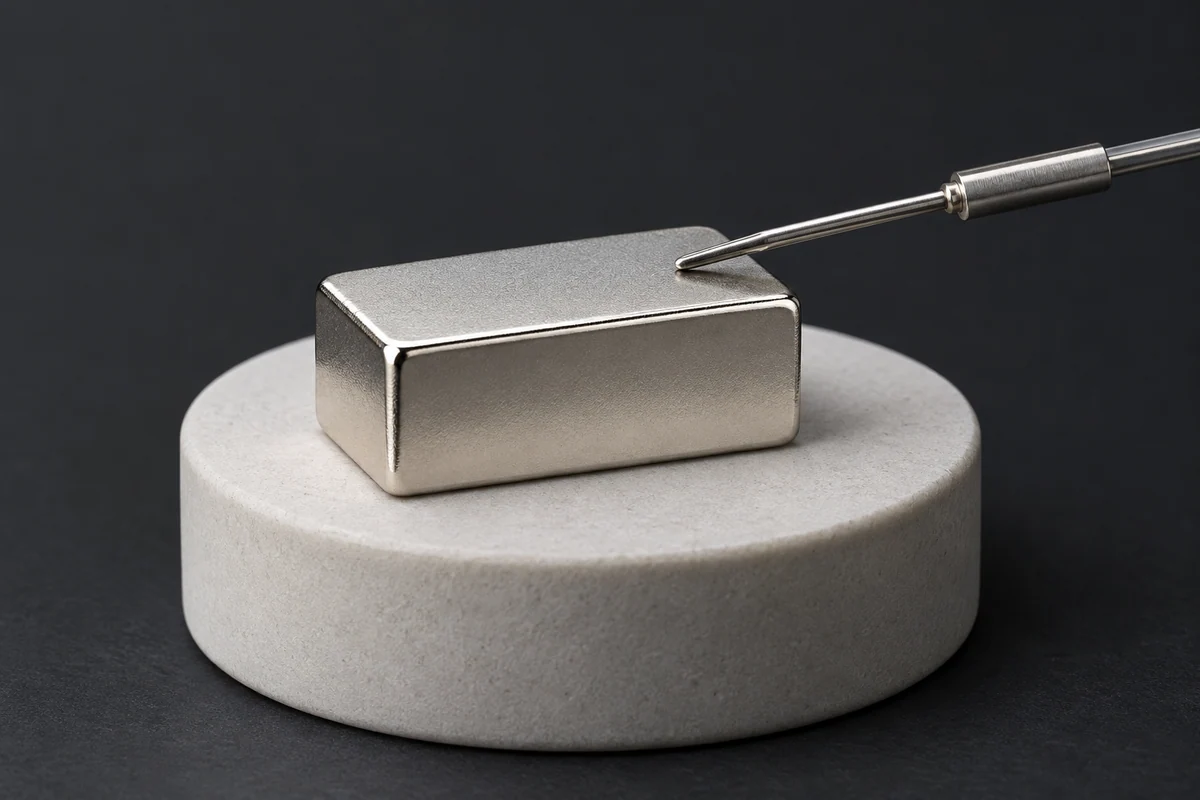
Read the grade and the supplier's conditions together
High-temperature NdFeB selection usually calls for attention to coercivity as well as useful magnetic output. Supplier grade families may use suffixes such as H, SH, UH or EH to distinguish magnetic and temperature-related characteristics. The grade number and suffix must be read with the matching supplier data.[1] [3] [5]
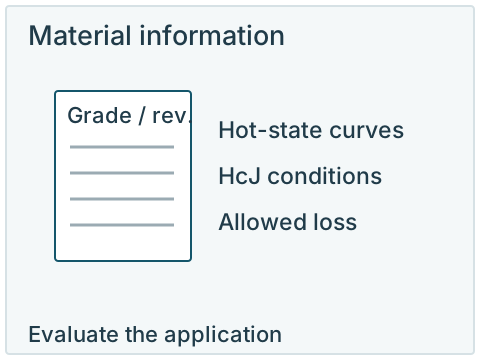
A higher N number indicates an energy-product class; it does not by itself provide greater resistance to heat-driven demagnetization. Check intrinsic coercivity HcJ, the curves at relevant temperatures and any conditions attached to a listed maximum working temperature. Keep minimum and typical values separate. The grade guide explains the notation in more detail.
When replacing an existing magnet
Use the existing drawing and datasheet as the baseline. Changing the grade suffix, thickness, air gap or surrounding steel can change the magnetic operating conditions. A replacement with a similar room-temperature strength still needs evaluation in the intended assembly.
Check the operating point, not just a temperature label
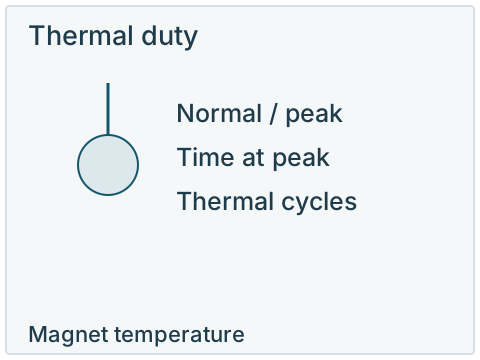
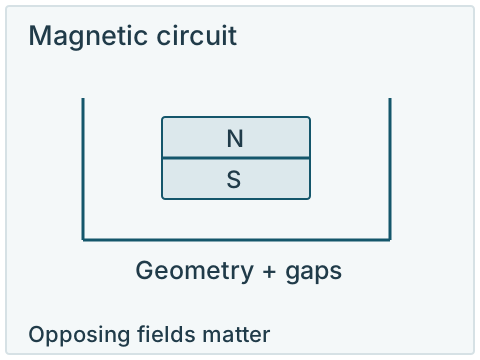
A magnet's usable temperature depends on its geometry and magnetic circuit, including air gaps and opposing fields. Time at temperature and repeated thermal exposure also belong in the requirement. A published rating for one set of conditions does not establish an unconditional temperature limit for a different shape or installation.[1] [2] [4] [5]
Check the same component
Read the hot-state curves with the circuit and thermal duty. Define whether acceptance concerns output while hot, permanent change after cooling, or both.
Open larger diagramFor purchasing, distinguish two acceptance questions: must the component meet its output while hot, and how much permanent change is allowed after cooling? These require stated measurement conditions. Curie temperature does not replace either acceptance requirement.
See temperature and demagnetization for the loss mechanisms and demagnetization curves for the relationship between material data and the operating point. Use the separate Curie-temperature guide when interpreting Tc. If NdFeB does not meet the application's thermal requirements, compare the complete conditions with SmCo rather than selecting by a single room-temperature property.
Discuss the part and its thermal duty
Nike Industrial Trading is your contact for sourcing the magnet component. We keep your drawing, thermal duty and known material data together when discussing the proposed supply. Describe the magnetic installation and any conditions still to be established.
Drawing / dimensions / units / magnetic axis:
Specified grade and supplier datasheet revision:
Normal and peak magnet temperature:
Time at peak / cycles / cooling conditions:
Magnetic circuit / air gaps / opposing fields:
Fault or transient conditions to consider:
Required output and permitted permanent loss:
Coating / moisture / chemical exposure:
Sample and order quantity:
Documents or validation still needed:
Use the temperature of the magnet where known, rather than assuming that ambient or housing temperature equals the magnet temperature. Identify whether the requirement concerns performance while hot, performance after cooling, or both. This makes the requested evaluation and acceptance conditions clearer.[2] [4]
Use the datasheet checklist to identify the relevant material documents. Send drawings to [email protected] or WhatsApp, or start online. Product terms are confirmed for the proposed part; assembly design approval stays with the responsible designer.
Discuss a high-temperature magnetTechnical sources
Read each source with its stated material, test conditions and publication scope.
- NdFeB data sheetSupplier-specific material information; not an approved supply specification.
- Temperature and Neodymium MagnetsSupplier-specific material information; not an approved supply specification.
- Sintered NdFeB Magnet Grades & Temperature LimitsSupplier-specific material information; not an approved supply specification.
- Neodymium Temperature RatingsSupplier-specific material information; not an approved supply specification.
- Dura available NdFeB gradesSupplier-specific material information; not an approved supply specification.