
What is the Curie temperature of NdFeB?
There is no single value for every NdFeB formulation. K&J’s material-family table gives Tc examples of 310°C for N, 340°C for NM/NH/NSH and 350°C for NUH/NEH/NAH. Those are that supplier’s reference values, rather than an application temperature limit.[6]
| Family in source | Curie temperature Tc | Listed maximum operating temperature |
|---|---|---|
| N | 310°C | 80°C |
| NSH | 340°C | 150°C |
| NUH | 350°C | 180°C |
K&J reference families: Tc and working temperature are different
N
- Curie temperature Tc
- 310°C
- Listed maximum operating temperature
- 80°C
NSH
- Curie temperature Tc
- 340°C
- Listed maximum operating temperature
- 150°C
NUH
- Curie temperature Tc
- 350°C
- Listed maximum operating temperature
- 180°C
The same table makes the practical distinction clear: a material can have a Curie point far above its listed working-temperature guideline. Neither field by itself qualifies a particular assembly. Use the chosen material’s sheet and hot-state magnetic circuit to assess your design.
What Curie temperature actually means
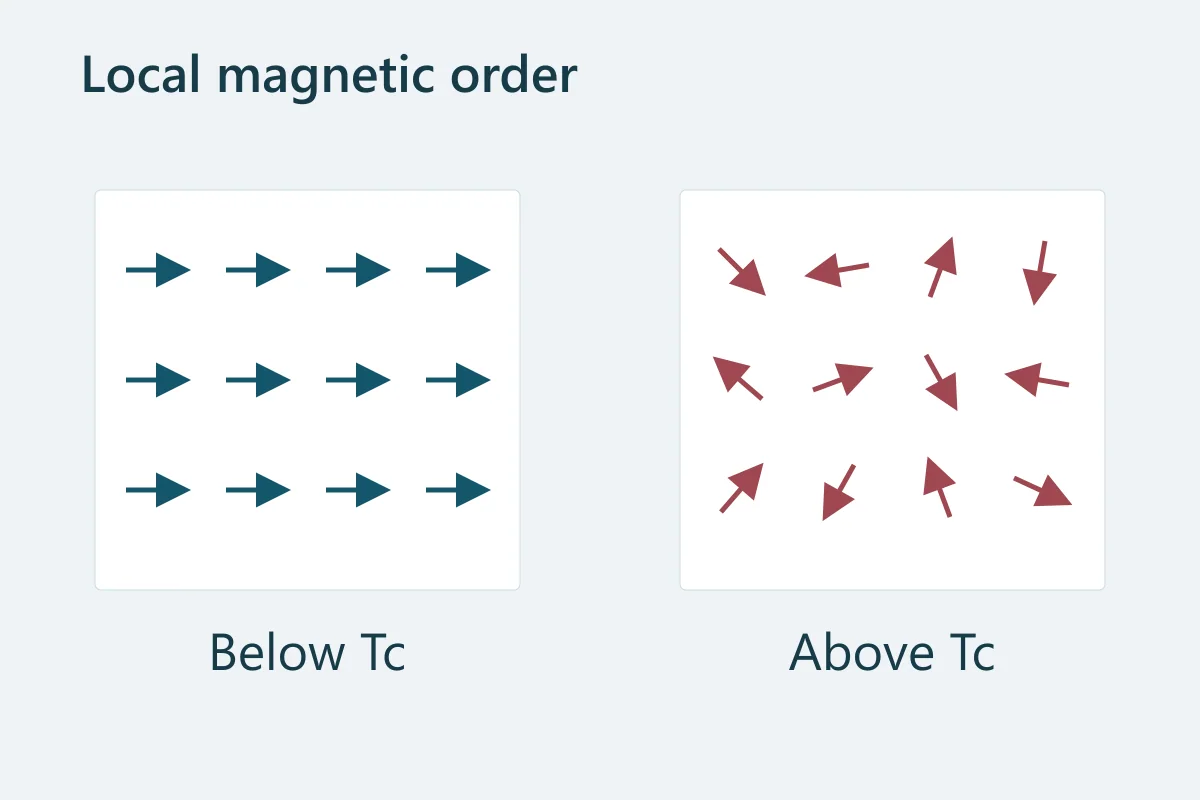
At the Curie temperature, a ferromagnetic material loses its spontaneous ferromagnetic order. It no longer behaves as the same permanent-magnet material in that state. This is a material transition; it is not the temperature at which an assembled device first becomes unreliable.[1]
Curie temperature depends on the composition of the magnetic material. It should not be taken from elemental neodymium, applied to every NdFeB formulation, or inferred from the N-number. A bonded product also contains a binder and may use a different magnetic powder formulation from a conventional sintered product.
| Field | Meaning | Use in a specification |
|---|---|---|
| Tc, Curie temperature | Material transition in magnetic ordering | Identify the material property and its units |
| Maximum working temperature | A conditional use guideline for material and application | Check geometry, circuit, exposure and acceptable loss |
| Required functional temperature range | Where your device must satisfy its performance requirement | Define and validate the actual application |
Two fields that answer different questions
Tc, Curie temperature
- Meaning
- Material transition in magnetic ordering
- Use in a specification
- Identify the material property and its units
Maximum working temperature
- Meaning
- A conditional use guideline for material and application
- Use in a specification
- Check geometry, circuit, exposure and acceptable loss
Required functional temperature range
- Meaning
- Where your device must satisfy its performance requirement
- Use in a specification
- Define and validate the actual application
Why a magnet can lose performance below Tc
Heat changes remanence and resistance to demagnetization before the Curie point is reached. A hot magnet may produce too little field for its task even while its change is reversible. If the operating point enters an unfavourable part of the demagnetization curve, some loss may remain after it cools.[3]
That operating point depends on the magnetic circuit and geometry, as well as opposing fields. Published reference temperature groupings can attach a specific length-to-diameter condition. Consequently, “below Tc” and “within the operating range” are not equivalent statements.[2]
Cooling from above a magnetic transition is also not a promise that the original pole pattern or performance will return. Do not use heating as a workshop method of modifying a finished magnet. Coatings, adhesives, binders and surrounding components can be damaged independently.

Read the exact material sheet
Check whether the document describes sintered NdFeB, a compression-bonded material, an injection-moulded compound or a complete assembly. Magnequench’s MQ1-4 compression-bonded sheet, for example, lists Curie temperature and maximum operating temperature as distinct fields. It demonstrates why a generic sintered-material value cannot be assigned to every magnet called NdFeB.[4]
Also check the units: some manufacturers report Tc in kelvin rather than degrees Celsius. Conversion requires subtracting 273.15 from kelvin. A temperature difference of one kelvin is the same size as one Celsius degree, but the absolute temperatures are not the same numbers.
Keep typical values, guaranteed limits and illustrative curves separate. Product-level specifications may differ from general material examples; TDK explicitly directs users to individual delivery specifications and sample confirmation.[5]
What to ask for instead of “safe below Curie”
- Identify the exact material and forming route.
- Provide the full magnet-temperature range and exposure time.
- Show the geometry, magnetic circuit and any opposing field.
- State the output needed while hot and the permitted change after cooling.
- Check coating, binder, adhesive and retention limits separately.
Use our working-temperature guide for thermal test planning. Keep Tc on the material sheet as useful context, while making the application’s functional requirement the acceptance criterion.
Technical sources
Source material has its own scope and conditions. These references explain technical choices; they are not evidence of our stock, certifications or supplied products.
- totalElement: Working temperature and Curie temperature
- Dura Magnetics: NdFeB grades and reference conditions
- Arnold Magnetic Technologies: Magnetic properties and measuring techniques
- Magnequench / Neo Performance Materials: MQ1-4 compression-bonded material data
- TDK: NEOREC product guide: materials, measurement and precautions
- K&J Magnetics: Neodymium material specifications