
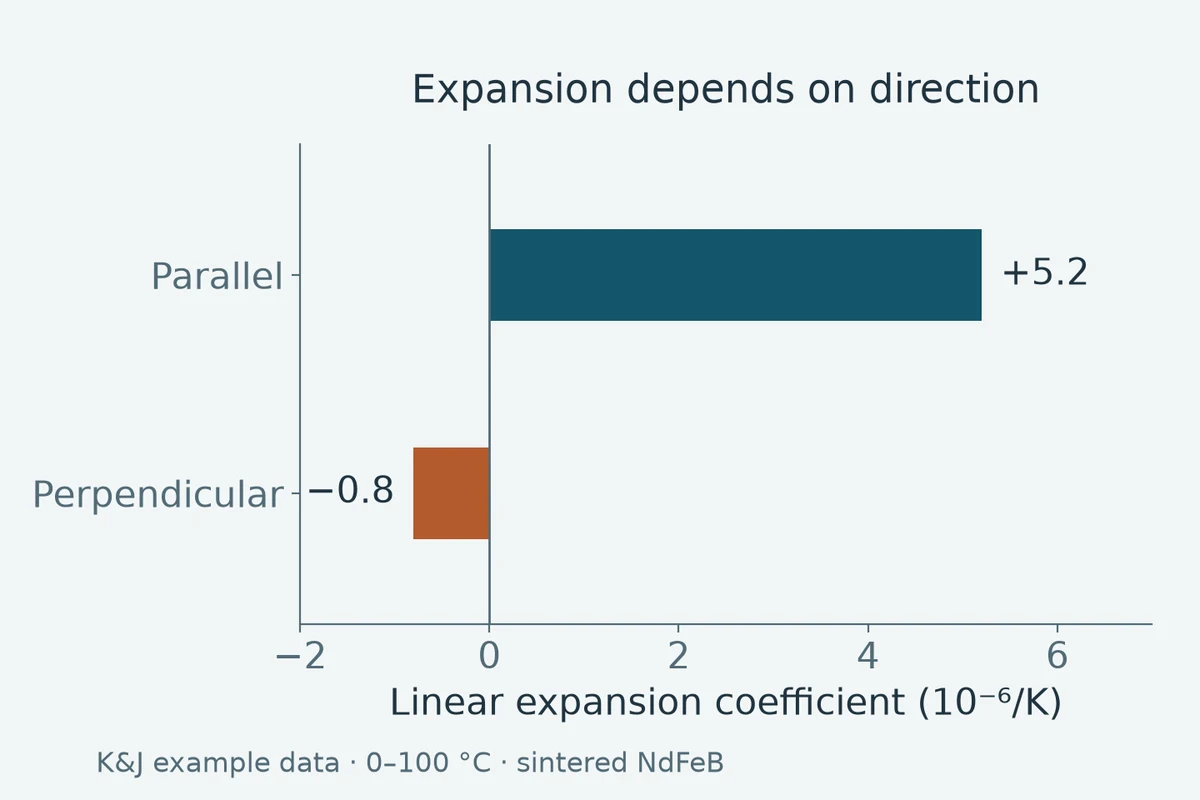
NdFeB expands differently along and across its orientation
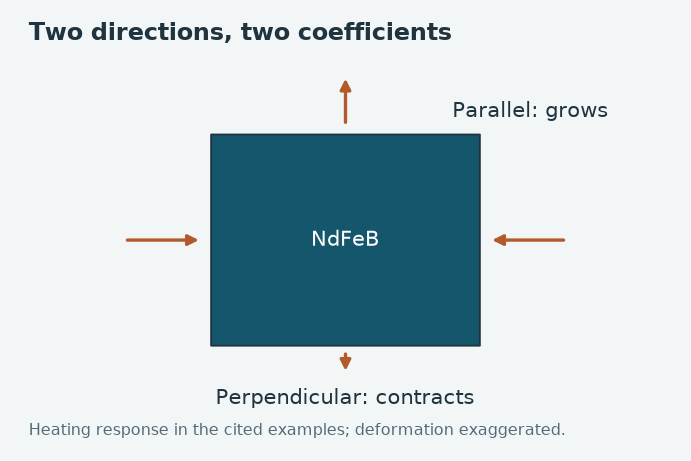
For sintered NdFeB, use a directional coefficient. K&J lists +5.2 × 10⁻⁶/K parallel and −0.8 × 10⁻⁶/K perpendicular to the preferred magnetic axis over 0–100°C. These example values mean growth along the axis and slight contraction across it when heated.[1]
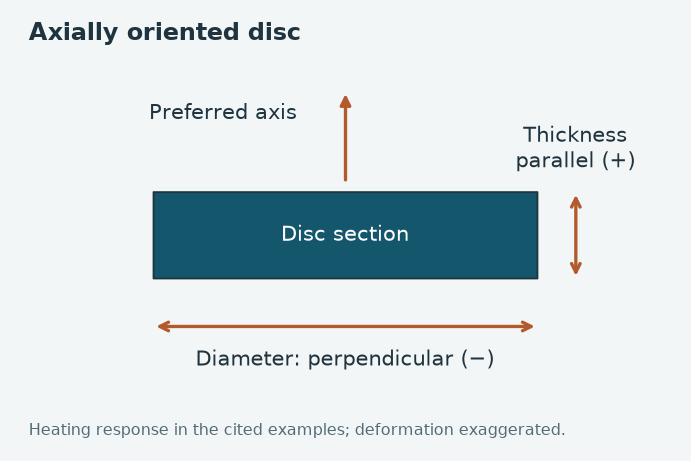
Use the orientation established during manufacture, not the longest dimension. For an axially oriented disc, thickness is parallel and diameter is perpendicular; reversing north and south leaves this distinction unchanged. The calculations below use the K&J values. Other published data and the direction diagrams appear later in this guide.
Calculate the free dimensional change
For a roughly constant linear coefficient over the interval, ΔL = αL₀ΔT. Here L₀ is the dimension at the reference temperature, α is the coefficient along that dimension, and ΔT is final temperature minus reference temperature.
Using the K&J examples, a 20.000 mm dimension heated from 20°C to 80°C changes as follows:
| Direction | Change (μm) | Final size (mm), approx. |
|---|---|---|
| Parallel | +6.24 | 20.0062 |
| Perpendicular | −0.96 | 19.9990 |
For the parallel direction, 5.2 × 10⁻⁶ × 20 × 60 = 0.00624 mm = 6.24 μm. Across the axis, −0.8 × 10⁻⁶ × 20 × 60 = −0.00096 mm. The rounded sizes show the scale of change, not a machining tolerance. If α varies substantially with temperature, integrate α(T) over the interval. Polymer-bonded magnets require data for their own composite.
The housing changes too
For a freely expanding magnet inside a freely expanding opening, calculate both dimensions before subtracting. At the reference temperature, let the opening be 20.100 mm and the magnet dimension be 20.000 mm. Assume an opening coefficient of 23 × 10⁻⁶/K and a magnet coefficient of +5.2 × 10⁻⁶/K along the fitted direction.
For the same 20°C to 80°C rise:
- Opening: 20.100 × (1 + 23 × 10⁻⁶ × 60) ≈ 20.1277 mm.
- Magnet: 20.000 × (1 + 5.2 × 10⁻⁶ × 60) ≈ 20.0062 mm.
- Using unrounded dimensions, total clearance is about 0.1215 mm (121.5 μm), up from 0.1000 mm.
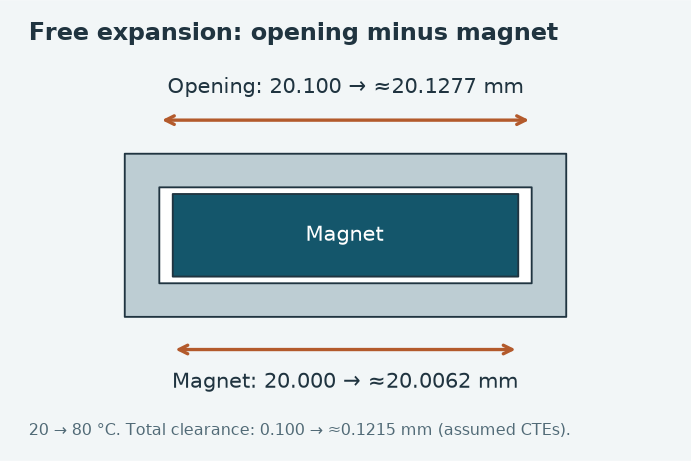
The opening coefficient is an assumed input, not a specified alloy property. Both parts are free to expand and at the same temperature. Half a diametral clearance is available on each side only for a centred cylindrical fit; a block against one datum has a different distribution of space. Next, apply the tolerances and check the cold end too.
Apply tolerances before declaring that it fits
Suppose the same opening is 20.100 ± 0.030 mm and the finished magnet is 20.000 ± 0.020 mm at 20°C. The minimum room-temperature clearance is 20.070 − 20.020 = 0.050 mm; the maximum is 20.130 − 19.980 = 0.150 mm.
Use the smallest opening and largest magnet at every temperature. At 0°C, ΔT = −20°C, so the minimum clearance is 20.070 × 0.99954 − 20.020 × 0.999896 ≈ 0.04285 mm.
| Temperature | Nominal gap (mm) | Minimum gap (mm) |
|---|---|---|
| 0°C | 0.09283 | 0.04285 |
| 20°C | 0.10000 | 0.05000 |
| 80°C | 0.12150 | 0.07145 |
The cold end has the least clearance in this example. It consumes about 7.15 μm of the room-temperature minimum. If the assembly needed an assumed 0.045 mm total allowance, room temperature would meet it while 0°C would fall short by about 0.00215 mm. That allowance is a teaching assumption, not a recommended bond line.
A positive calculated gap rules out size interference only within this simple free-expansion model. Shape error, burrs, runout, positional error and a required adhesive layer can consume it. A real fit also needs the proposed materials' coefficient limits, cold/hot temperatures and any thermal gradient.
Use finished dimensions consistently. If a magnet's drawing already specifies dimensions after coating, do not add that coating a second time. If dimensions refer to the substrate before coating, account for the layer on every fitted face. The tolerance and inspection guide covers this distinction.
Match the expansion data to the material and direction
| Source | Parallel | Across axis | Interval |
|---|---|---|---|
| K&J | +5.2 | −0.8 | 0–100°C |
| Neorem | +5 to +7 | −3 to −1 | Not stated |
| Goudsmit | +3 to +9 | −3 to 0 | Not stated |
These are separate source examples, not a tolerance band for one grade. Neorem and Goudsmit do not state the temperature interval in the cited property tables. Use the proposed material's own coefficient and valid interval for a critical fit; radially oriented rings and segmented assemblies also need their local directions resolved.[1] [2] [3]
10⁻⁶/K is also written ppm/K. A temperature difference of one kelvin equals one degree Celsius, so the coefficient's numerical value is the same per °C.
How adhesive joints and interference fits constrain expansion
Once constrained by adhesive or an interference fit, free expansion becomes a mismatch that can produce stress. The result depends on adhesive thickness and stiffness, temperature, substrate stiffness, joint geometry and load path. A clearance calculation alone cannot predict the stress or establish a safe bond line.
Adhesive data also need conditions. Polymer stiffness and expansion can change around the glass-transition region; a room-temperature coefficient is not a complete high-temperature joint model. A manufacturer's data sheet may report different coefficients below and above that region and specify the cure used for testing.[4]
Check the entire production temperature cycle. Some structural adhesives require a heat cure, which can exceed the magnet's service temperature. Confirm compatibility with the coating and magnetic state, then evaluate the bonded assembly after the specified cure and thermal cycling. Avoid press-fitting a brittle magnet on the assumption that it will deform like a ductile metal.[5] [6]
What belongs on the assembly drawing?
Start with the mating dimensions, material names and temperature range you know. A sketch is enough to identify which direction needs checking. We can help organize the component dimensions, missing material data and fit questions for the supply enquiry; leave unknown fields blank.
Reference temperature for dimensions:
Magnet material, preferred magnetic axis and finished dimensions:
Parallel / perpendicular expansion data and valid interval:
Mating material, opening dimensions and tolerances:
Cold limit, hot limit and possible thermal gradients:
Coating included in dimensions: yes / no
Bond-line or retention requirement and cure cycle:
Critical clearance or interference at each condition:
Thermal expansion concerns physical size. The reversible change of Br or coercivity with temperature concerns magnetic properties; its coefficients have different units and cannot be used in ΔL. See NdFeB magnetic temperature coefficients for that calculation.
Technical sources
Read each source with its stated material, test conditions and publication scope.